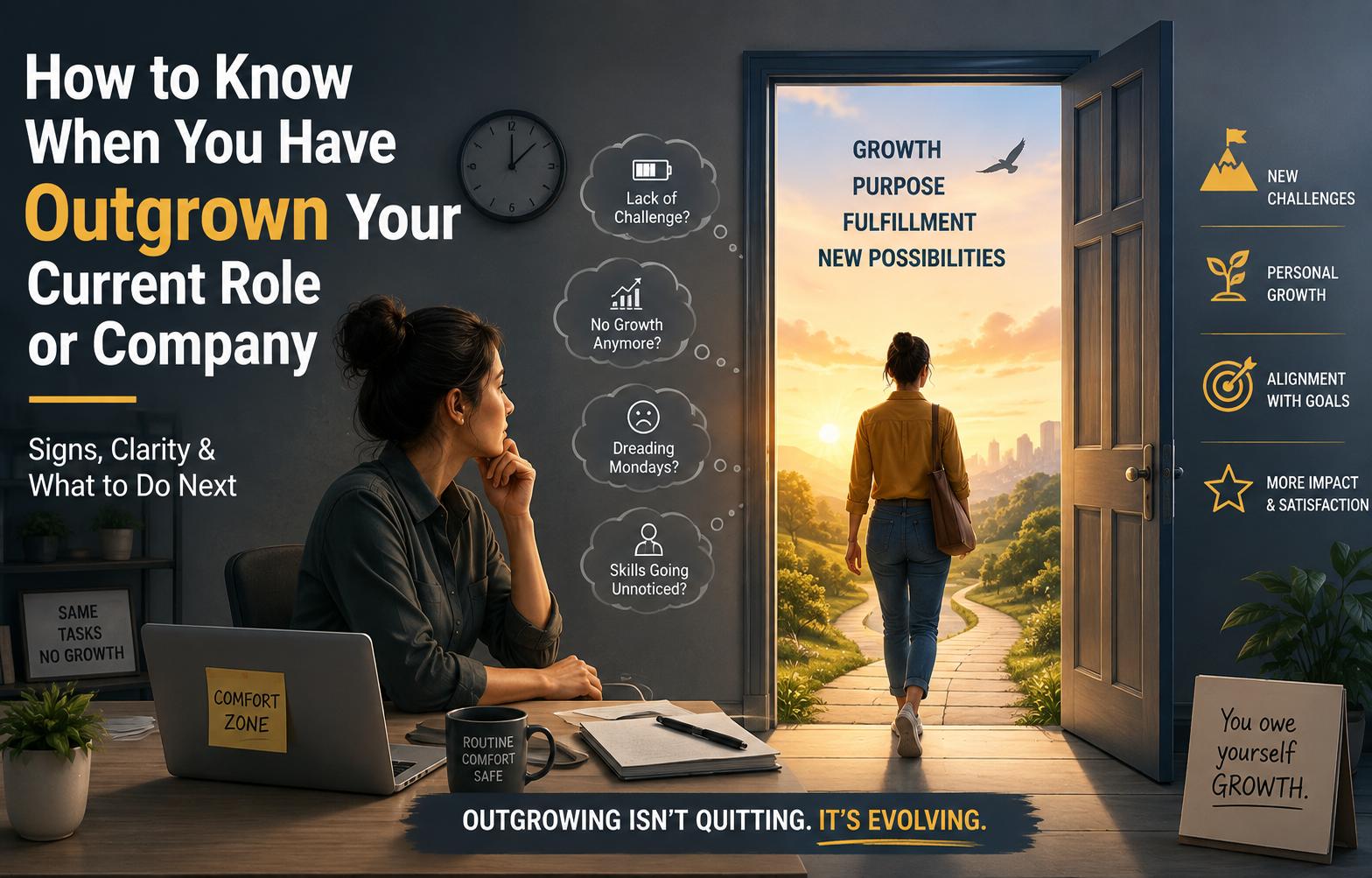
Introduction: Outgrown Your Current Role
There comes a time in every employee’s life when they realize their exciting new job is no longer so exciting. You may perform well, get along with coworkers, and earn decently, yet still feel stuck without meaningful growth or progress.
You could be bored or feel like you don’t have any future in the company. This doesn’t necessarily mean the company is bad or that you hate your job. It may simply mean you have outgrown your role or company and need to move on to find new challenges.
Being able to recognize when you have outgrown your current role or company is important because it allows you to make a decision based on your true needs. Recognizing it helps you avoid quitting impulsively out of boredom and instead consider whether you genuinely need a new job.
How to Know When You Have Outgrown Your Current Role or Company?
1. You No Longer Feel Challenged
The first sign that you have outgrown your role is that it is no longer a challenge. When you were first hired or promoted to your current position, you had to learn new skills, gain experience, and expand your knowledge of the field. Now, you are much more proficient.
Proficiency at work is not a bad thing, but if you barely have to try to get your work done, then you are no longer challenged to push yourself to do more.
A good job should never make you feel inadequate, but it should encourage you to learn and be better everyday. If you have been feeling like you have been doing the same tasks over and over without really learning or practicing any new skills, then it is probably time to move onto something new.
2. You Have Stopped Learning
Career growth almost always depends on the ability to acquire knowledge. It does not mean that you should learn something new every single day. However, even if you do not study anything particularly challenging, you should feel that your work helps you grow as a professional.
Think about what you have learned during the last six months or the previous year. Did you gain any new skills or learn any useful concepts? Did you take on any projects that would help you advance in your chosen career path?
If you answered no, it is worth considering whether your professional life has stalled. Perhaps, the company offers various training courses, and you have not decided to take any of them yet. On the other hand, there might be no opportunities for growth, and you should think about searching for a new job. The moment you feel like your position does not challenge you anymore is the time to start looking for a change.
3. You Have Stopped Learning
Career growth almost always depends on the ability to acquire knowledge. It does not mean that you should learn something new every single day. However, even if you do not study anything particularly challenging, you should feel that your work helps you grow as a professional.
Think about what you have learned during the last six months or the previous year. Did you gain any new skills or learn any useful concepts? Did you take on any projects that would help you advance in your chosen career path?
If you answered no, it is worth considering whether your professional life has stalled. Perhaps, the company offers various training courses, and you have not decided to take any of them yet. On the other hand, there might be no opportunities for growth, and you should think about searching for a new job. The moment you feel like your position does not challenge you anymore is the time to start looking for a change.
4. Your Goals Have Changed
A person, their aspirations, and even their career plans may evolve over time. The position that seemed ideal three years ago may no longer align with your current professional aspirations.
For instance, if you joined a company seeking experience, you may now desire to take on more responsible roles, lead projects, increase your income, or work in a more creative field. Your current organization may not support these new objectives.
Therefore, it is essential to reassess your career goals periodically and consider whether your present position contributes to your long-term vision. If you realize that you are drifting away from your objectives, it might be time to explore alternative opportunities.
5. You Are Doing More Than Your Role but Not Growing
There are times when employees take on greater responsibilities without any recognition in terms of new positions, compensation, or development opportunities. While assisting colleagues or mentors in their work is a great way to gain new knowledge and experience, it is important to distinguish between being given the opportunity to further develop one’s professional skills and the ability to consistently perform higher-level job functions without any compensation.
If you have taken on additional duties beyond the ones defined by your position for an extended period of time, it might be a good idea to speak with your manager about the possibility of developing your career. Be sure to discuss what additional responsibilities you are currently handling and what opportunities for growth you would like to pursue in the future.
If you feel that the company wants you to take on more duties without additional compensation, it might be a sign that you have outgrown your position and it is time to move on. The value of your work and expertise may no longer be reflected in the parameters of your current role.
6. Your Ideas Are No Longer Heard
As you gain experience, you may develop more insightful recommendations for improving work in your profession. In a healthy organization, you will not always find your ideas acted on, but you should always feel that your thoughts have been considered.
If, despite your efforts to improve the status quo, your ideas are consistently ignored, you may be feeling frustrated.
That could especially be the case if you feel that your talents and expertise are going unused. You might also be in a company where there is no room for change and innovation. If that is the case, and you want to bring new approaches to the table, it may be time for you to think about moving on.
7. You Feel More Excited About Opportunities Outside
Another crucial sign that indicates you may need a change in your current job is by seeing or hearing about other opportunities. If job descriptions, industries, or companies outside of your workplace arouse more interest than what you do daily, it could be time for a new challenge.
Now, this doesn’t mean you should update your resume and start applying to every “exciting” opportunity that comes your way. Most people get excited about other options and possibilities at some point. However, if you can consistently envision yourself doing different work and feel more inspired by the thought of your future elsewhere, then you may need to move on.
Conclusion: Outgrown Your Current Role
Outgrowing a role or company is not necessarily a bad thing. It is a normal process for learning, gaining experience and evolving toward new goals. The challenge is to make these decisions deliberately rather than being swept away by a single disappointing week or two.
Recognizing when the work no longer engages you, when you learn, when your personal goals change and when there is no future are all signs you may have outgrown your position or company. It is important to understand these signs so that you can take charge of your future career and search for a fit with the type of professional you are becoming.
“Outgrowing your role can be a sign that you’re ready for a new challenge, not a reason to doubt your progress. Evaluate your growth, responsibilities, learning opportunities, and long-term goals before deciding your next move. Take control of your career journey with Best Job Tool.”

Leave a Reply