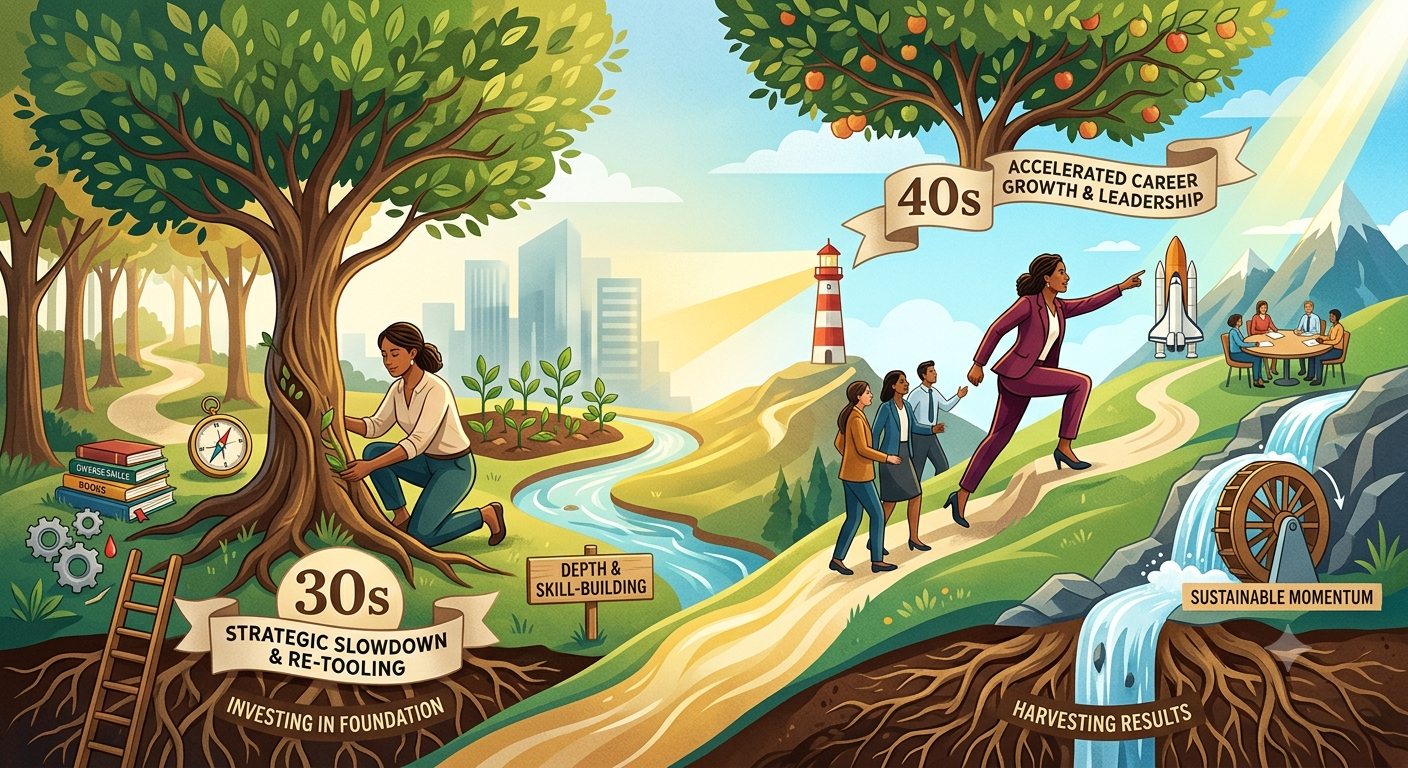
Introduction: Slowing Down
People tend to believe that their 30s are the decade when a working adult should accelerate their career. You should make more money and get more done. Your title should advance every year while your responsibilities increase and your salary grows. Slowing down does not mean giving up; it means taking a step back in order to make better decisions about your career.
Sometimes that is not the case. Sometimes it may be better to slow down your career and get yourself together to understand what you want to do with the rest of your working life.
Therefore, I would like to explain why slowing down your career can set you up for your 40s, helping you understand your options and choose the one that will benefit you in the years to come.
Why Slowing Down Your Career in Your 30s Can Set You Up for Your 40s?
1. Slow Down to Understand What You Want
When people make decisions in their 20s, it is hard to have a clear picture of the future, so the only way to get ahead is to do the things people usually do – switch jobs more often, get promotions and salary increases. The jobs you take and the employers you work for shape the future. You learn who you deal with, who are your clients, what are appropriate goals to strive for and what kind of person you work with.
However, you may be in your 30s and have a clearer picture of what you want for yourself. You may understand what kind of job and employer you want to work with and what title and salary you actually need. Slowing down your career can help you ask yourself these critical questions.
2. Do I enjoy what I am doing?
Do I want to become a leader or is there another goal that attracts me more? Is a more flexible schedule more important than a cool job title I always wanted? Does this affect the quality of life I want to have?
Having these questions in mind, a person will be less likely to waste the precious time of their 40s in a career they never envisioned.
3. Think Big, But Don’t Work Harder All the Time
Accelerating your profession takes toll on your body when you work every day at the maximum. People who work hard until they burn out may get ahead further in life, but at some point, the accumulated fatigue begins to interfere with everyday life.
There is nothing wrong with the big goals you have. In many cases, you will achieve them sooner or later, but the question is in the quality of work. If you want to do high-quality work for the entire course of your career, try slowing down your career instead.
For your 40s, when the work-life balance shifts again, this strategy will enable you to take a deep breath and be more productive when it really matters.
4. Build a Sustainable Career in Your 30s to Rely on It in Your 40s
We get promoted, earn more each year and achieve great things at work. We look at those who have made it and think we have to accomplish the same feats faster and more efficiently than they did. However, it is important to understand that a career is a sustainable system that can work for several decades if properly built.
When slowed down, it builds high quality and sustainable experience. In your 30s, you can work to acquire vital competencies that will become extremely valuable by your 40s.
You may decide to hone your management skills or become an expert in your subject. You may understand the industry you work in at large and not only your department. There is plenty of valuable things to learn and you need to choose what will get you more rewards and recognition.
Your 30s can be a time of gaining new knowledge as well as the time of using the vast experience you already have to get a promotion and a raise.
5. Protect Yourself to Help Your Career Deliver More Value
Many people forget that in order to keep delivering value, we need to keep ourselves physically and mentally strong. I have realized that sometimes I do not give myself enough time to restore my energy. When we sacrifice sleep, health, relationships and time with loved ones to make a big step in our career earlier, we may fail to give our best. The pace we set for ourselves can be more than our bodies can handle for a long time.
When making a decision to slow down, people usually put their career on pause to be able to gain experience in the industry. Alternatively, they may decide to make some changes in their daily routine. A simple addition of time needed to have a proper break or to refuse to work overtime can help to keep your body and mind strong to deliver more value to your employer.
Mental health is even more important, but the whole system encourages us to work as much and as hard as we can while neglecting our health. This puts our body and mind at greater risk of strain and burnout, so slowing down can be a great option here.
6. Make Better Career Moves in the Future with a Cooler Head
Under pressure, a person may do desperate things. In a job interview, people sometimes fail because they were so eager to be hired they did not notice that the company was a pyramid scheme or that the position was ill-paid.
When you are pressed for time to respond, you make the move, not the decision, and that can put your career at severe risk. Making a move in no rush can help you avoid many of these traps because you understand what you would need to do instead to get the best offer of employment.
7. Prepare the Groundwork for Financial Stability
It can be much easier and safer to slow down your career to prepare your finances for the next step. You need to increase your income, but it can be more effective to save money for a rainy day or for some time, control your spending to build up financial reserves. When you have a choice between increasing or decreasing your income, choose slowing it down to increase your quality of life.
Financial stability will be even more important as you move to your 40s. This is also the time when you may decide to change the way your profession develops.
If you plan on shifting to another industry, going into self-employment or changing some other fundamental conditions of work, financial stability will be necessary. Having it will help make this transition easier. Your 40s is not the time to change directions again, it is a time of stability and a sustainable career path.
8. Build Leverage to Increase Your Impact at Work
Your 40s will be a different chapter in your professional life. You need the leverage to get into a better position to decide how you spend your time at work. You may work with a younger generation of employees who are more enthusiastic and energetic.
May need to use your experience, management skills and other qualities to become a mentor or a key figure in decision-making for the organization. The time of slowing down will come for everyone when they need to rely on the knowledge and skills. For some, it will be after a career burnout, but most will find it comes as they reach their 40s.
You may be tired of striving to be ahead of others and ready to consolidate your achievements to become a leader to guide your future employees through their own professional transitions.
Conclusion: Slowing Down
Slowing down your career at your 30s does not mean giving up on being successful and wanting to climb up your career ladder. This happens to many people, and it does not mean that you are not ambitious enough. Instead, slowing down your career can give you an extra push, needed to be really successful in your field someday. Your 30s can give you a chance to figure out who you are, become skilled and gainful, take care of your own needs, be financially stable, and be wise about your career moves.
You do not have to rush towards getting a promotion and increasing your pay grade. Sometimes, it is better to slow down and take things gradually. Having a solid foundation from your 30s will allow you to be more successful and get a better income by your 40s.
A successful career should not be measured by how high you climb on the career ladder and how much money you earn. It should be measured by how long you stay on top and how well you prepared yourself to stay there. Hence, slowing down your career path now will allow you to advance more quickly in the future.
Ready to take the next step in your career? Use the right Best Job Tools, explore relevant job opportunities, update your resume, and strengthen your professional profile before making your next career move. Take your time, compare opportunities, and choose a job that supports your long-term goals, financial stability, and work-life balance.



Leave a Reply