Introduction: Salary Bands
When people apply for jobs, they often focus on the salary listed in the job description. They may see a range such as $50,000 to $70,000 and wonder why the company does not simply offer everyone $70,000. The answer is that salary bands are usually more complicated than they look.
Hiring managers do not normally decide salaries alone. They work within a salary structure created by the company. This structure helps the company pay employees fairly while also managing its budget. Understanding how hiring managers think about salary bands can help job seekers have better salary conversations and set realistic expectations.
What Is a Salary Band?
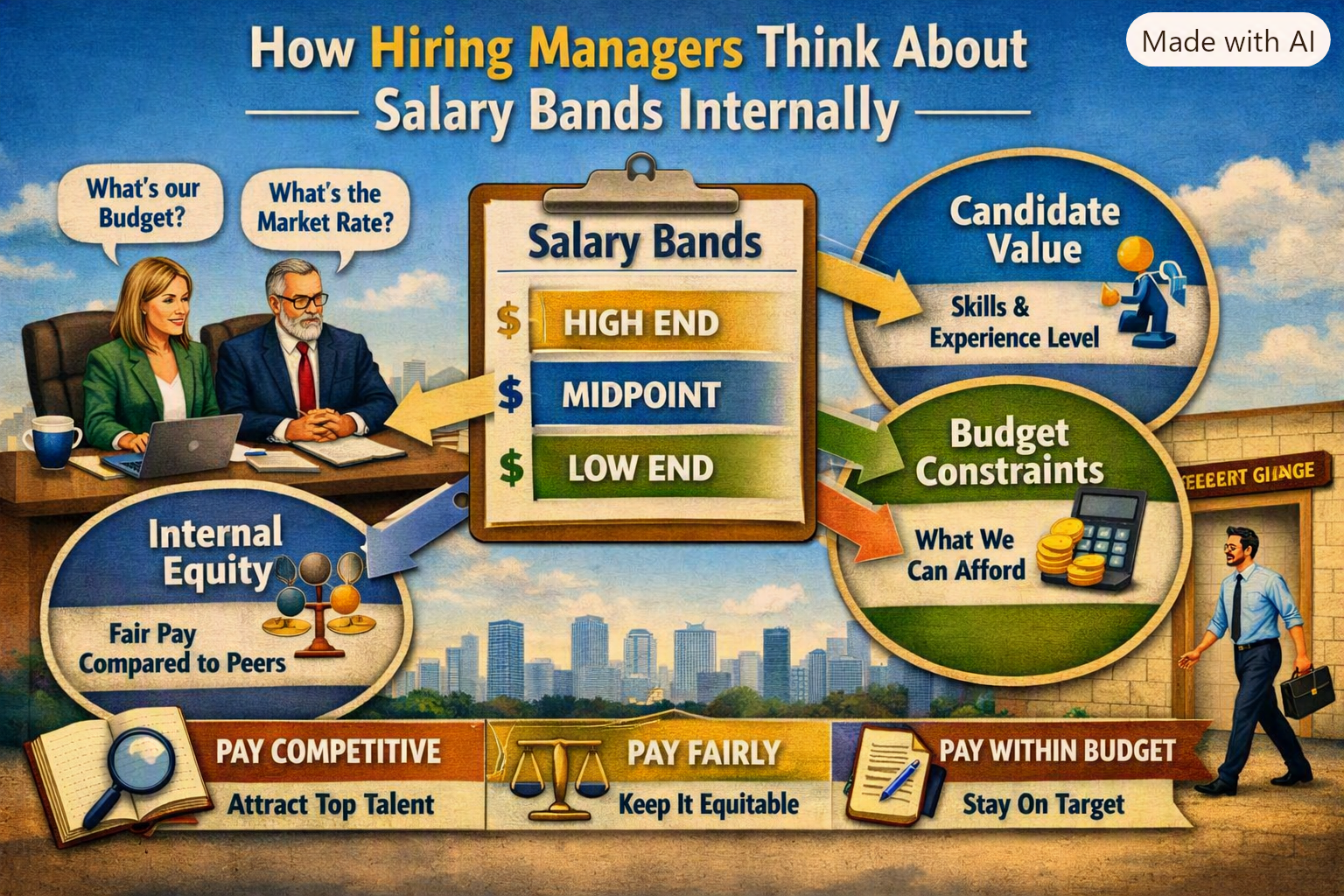
A salary band is a range of money that a company is willing to pay for a particular job. For example, a company may create a salary band of $60,000 to $80,000 for a marketing specialist position.
The lower number is often called the minimum, while the higher number is the maximum. There may also be a midpoint between the two numbers. In this example, the midpoint would be around $70,000.
Companies use salary bands to create consistency. If two employees have similar responsibilities and experience, the company does not want to pay one person much more than the other without a good reason.
Salary bands can also change based on location, experience, skills, industry, company size, and the level of the position.
How Hiring Managers Think About Salary Bands Internally?
1. The Midpoint Is Often Important
The midpoint of a salary band can help companies understand where an employee stands in the range.
A candidate who meets the basic requirements of a job may receive an offer closer to the lower part of the range. Someone with strong experience and skills may receive an offer closer to the midpoint.
A candidate with rare skills, excellent experience, or a strong record of success may have a better chance of receiving an offer near the top of the range.
However, being highly qualified does not automatically mean a candidate will receive the maximum salary.
Companies also think about internal fairness and the salaries of existing employees.
2. Experience Matters, But It Is Not the Only Factor
Experience is one of the biggest factors that can influence where a candidate falls within a salary band. However, hiring managers also look at the type of experience.
For example, ten years of experience in a completely different field may not be as valuable as five years of direct experience in the same role.
A candidate who has worked with the same tools, customers, industry, or processes may be more useful to the company from the beginning.
Hiring managers may also consider leadership experience, technical skills, communication skills, certifications, and the ability to work independently.
The important question is not only “How many years of experience do you have?” It is also “How relevant is your experience to this position?”
3. Internal Equity Is a Major Concern
Internal equity means employees doing similar work should generally be paid fairly compared with each other.
Hiring managers have to think about this when making offers.
Suppose a company has two software developers with similar responsibilities. One earns $80,000 and another earns $82,000. If the hiring manager offers a new developer $100,000 for a similar position, the difference may cause problems.
Employees may feel that the company does not value them fairly.
This can lead to dissatisfaction, requests for raises, and even employee turnover.
Because of this, hiring managers often discuss salary offers with HR before making a final decision.
4. Budget Also Plays a Role
Even when a candidate deserves more money, the company may not have the budget to provide it.
Every department usually has a budget. Hiring managers need to work within that budget.
For example, a manager may have approval to hire three employees for a total budget of $180,000. If the manager spends too much on one employee, there may not be enough money for the other positions.
This means salary decisions are sometimes about the entire team rather than one candidate.
A candidate may be excellent, but the company still has to consider what it can afford.
5. Hiring Managers Think About the Candidate’s Value
A hiring manager is not simply asking, “What salary does this person want?”
They are also asking, “What value will this person bring to the company?”
A candidate who can solve important problems, improve processes, bring in customers, reduce costs, or take responsibility for important projects may have a stronger case for a higher salary.
For example, a content writer who can only produce basic articles may be placed at the lower end of a salary band. A writer who can research complex topics, create high-quality content, understand SEO, manage a content calendar, and improve traffic may be considered more valuable.
This is why candidates should explain their skills in terms of business value.
6. The Job Level Matters
Salary bands are usually connected to job levels.
A company may have levels such as Junior, Mid-Level, Senior, Manager, and Director. Each level has different responsibilities and a different salary band.
Sometimes candidates ask for a higher salary when the real issue is job level.
For example, a candidate may be asking for $100,000 for a position classified as a mid-level role. The company may not want to pay that amount for the level.
However, if the candidate has enough experience to perform senior-level responsibilities, the better solution may be to discuss whether the position should be evaluated at a higher level.
This is why understanding the responsibilities of a position is important.
Conclusion: Salary Bands
Hiring managers usually think about salary bands as part of a larger system rather than as a simple number on a job advertisement. They consider the candidate’s experience, skills, job level, internal equity, budget, location, market conditions, and total compensation.
The salary range tells you what the company has generally approved for the position, but your final offer may depend on where you fit within that range.
Understanding this can make salary negotiations easier. Instead of focusing only on getting the highest possible number, candidates can explain the value they bring and ask thoughtful questions about how the company determines compensation.
When you understand how hiring managers think about salary bands internally, you can approach salary discussions with more confidence and realistic expectations. You also become better prepared to decide whether an offer matches your experience, responsibilities, and career goals.
You can read more such blogs with the Best Job Tool.






Leave a Reply