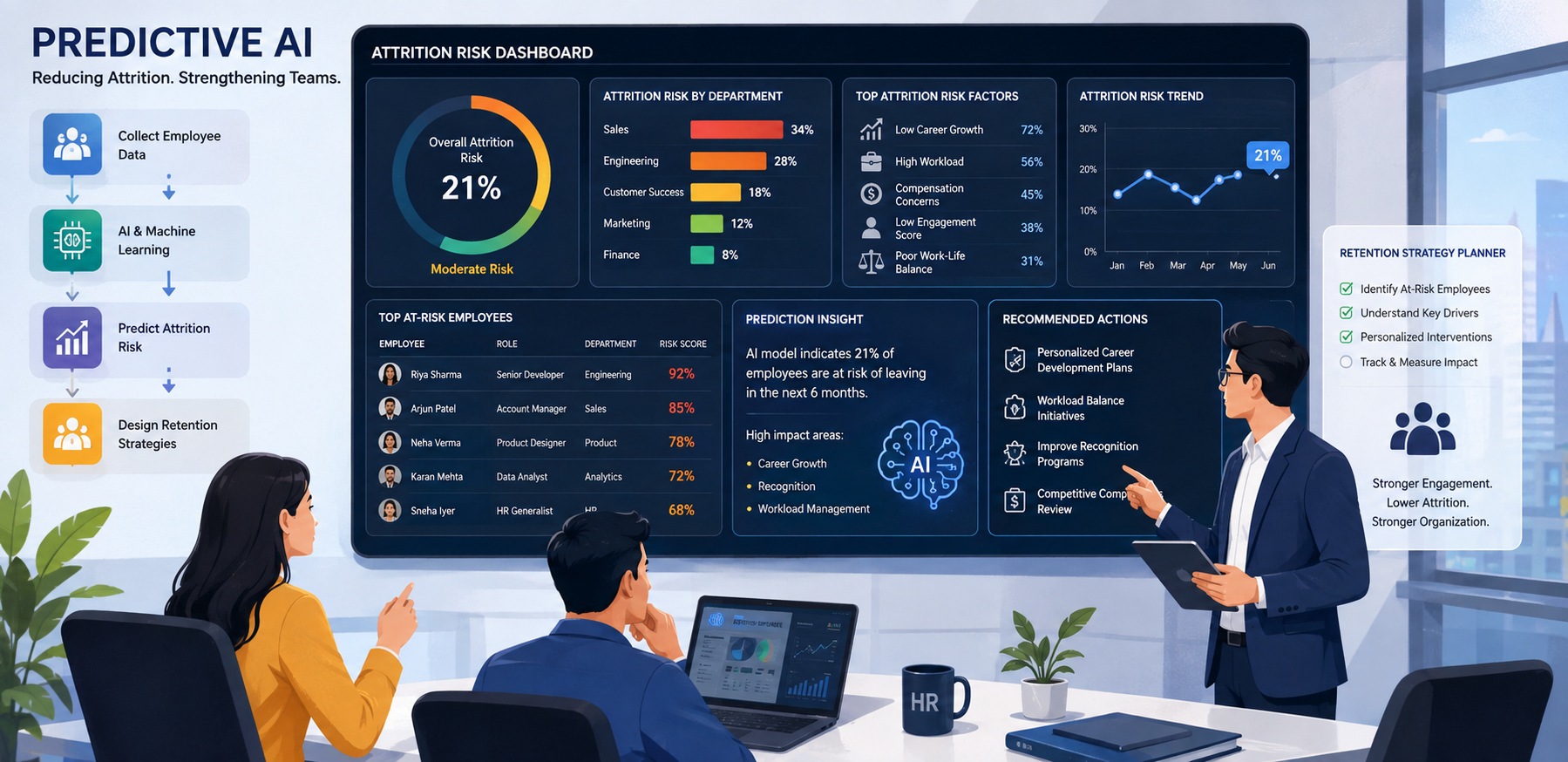
Introduction: Predictive AI
Employee attrition poses one of the most challenging problems for any company. Apart from the immediate effects on the productivity of a firm, workforce turnover has negative consequences on the team’s dynamics, customers’ perceptions, and the company’s intellectual property.
Furthermore, the search for new employees and their training requires substantial time and monetary investments. Therefore, eliminating employee turnover is of utmost importance for any organization. Most firms attempt to mitigate this issue by analyzing employee data, such as performance reviews, exit interviews, and suggestions.
However, as valuable as this information may seem, it rarely helps in preventing attrition. Instead, more and more companies are beginning to utilize predictive AI to determine which employees are likely to leave the organization.
How Companies Are Using Predictive AI to Reduce Attrition?
1. Understanding the Causes of Attrition
In addition, an organization could use predictive AI to determine the factors that led to the employee’s decision to leave the company. Various human resource management strategies have been implemented, but they do not necessarily solve the retention issue. Artificial intelligence can analyze the workforce data at a much bigger scale to identify the crucial aspects.
For example, some business could see that the attrition problem occurs among the employees who stayed in the same position for too long. Therefore, the human resource management would be able to implement a policy that would encourage the workers to take on new tasks and responsibilities.
At the same time, another company could observe that long hours or the inability to effectively balance work and personal life cause employees to quit. This way, the organization would be much more effective at retaining talent since it would be actively addressing the underlying issues.
2. Creating Personalized Approaches to Retention
After highlighting the risky cases, predictive AI can prioritize them and suggest particular actions for each scenario. For example, if an algorithm detects that an employee is at risk of stagnation, the company might consider providing additional training, mentoring, a promotion, or a transfer to another department. In turn, if one’s performance is suffering from excessive workloads, the firm can re-evaluate the distribution of tasks or offer to outsource some responsibilities.
Overall, predictive analytics can facilitate the personalized approach to each case, which is much more effective than a generic one, as different workers value different things, and there is no universal method to increase job satisfaction and prevent attrition. Thus, by helping to differentiate between scenarios, AI can make the retention process more efficient.
3. Increasing the Accuracy of Workforce Projections
Moreover, by analyzing past attrition scenarios, predictive AI can forecast future trends and help the firm to prepare retention plans. For instance, the mentioned technology can calculate the likelihood that an employee will depart from the company, considering such factors as one’s department, position, working conditions, etc.
Therefore, if a particular division foresees a high risk of losing talented and experienced workers, it can investigate the issue and solve it before it happens. In turn, such strategic planning will help the company reduce the costs and inconvenience caused by unexpected losses.
4. Building a More Proactive Workplace
Perhaps the most interesting benefit of predictive AI is that it helps transform retention into a proactive undertaking. It can enable organizations to discover possible issues affecting employee retention ahead of the actual event. This would help drive better discussions among workers, managers, and the HR department.
At the same time, it is important to remember that predictive AI will never take the place of human insight. Many issues that contribute to a worker’s decision to leave a company are much too nuanced to be encoded in any algorithm. The most successful companies will employ these technologies to complement their existing efforts and investments in human resources.
Maintaining good relations with all employees based on mutual understanding will continue to be the key pillar of successful retention strategies. As predictive analytics becomes more sophisticated over time, its role in building retention strategies will continue to grow.
Companies that are early adopters of these kinds of technologies can give themselves a distinct advantage. They will be able to collect and process the right information about their employees’ behavior, thus enabling the workforce to be managed more efficiently. This will make predictive AI a key enabler of more proactive, intelligent, and employee-centric retention strategies.
5. Reducing Attrition Through Internal Mobility
There may be a different, more effective option for employees who wish to change their position within the company – not necessarily leaving the company for another one. With predictive AI, it will be possible to find suitable vacancies based on the skills and area of improvement. This way, more experienced and qualified workers will remain within the company – improving its overall productivity.
6. Challenges Companies Must Consider
Although it has many benefits, predictive AI should not be seen as a perfect tool. First, predictions are only as good as the data they are based on. Second, privacy rights must be respected. And finally, companies must not think of employees as numbers, but rather as people with thoughts, feelings, and desires.
The first challenge is that AI is only as good as the information it is given. It may sound obvious, but historical data often contains errors or biases. Therefore, if companies use such information for their benefit, their results will be erroneous too.
Moreover, organizations must ensure that they are not corrupt and that they respect employees’ privacy rights. Thus, people should not feel like they cannot do anything without permission from their officials.
Most importantly, companies should not use AI to dehumanize employees. Predictions show risks; however, they cannot show people’s intentions, desires, and thoughts. Therefore, managers should use this information for dialogue with workers and not decide their fates on their own.
Conclusion: Predictive AI
Predictive AI can be utilized in various ways to improve employee retention rates. The technology can help the companies determine potential risks and losses concerning personnel. Thus, the management will be able to review some of the negative trends that usually precede staff departures.
Simultaneously, organizations can use predictive analytics in employee retention to improve the workers’ performance, engagement, and inspiration, which will bring about overall optimization in most sectors. When firms invest in analyzing the relevant workforce data, they can improve workers’ performance in terms of skills, relationships, compensation, and experience. Additionally, the organizations can identify the key causes of attrition and reduce the likelihood of losing talents to competitors.
Moreover, firms can increase their chances of retaining skilled workers if they utilize predictive analytics technology to make informed business decisions. Companies can use such information to have a competitive advantage over other businesses and motivate their workforce to boost productivity and profit.
Human resource professionals can also focus more on employees’ behaviors with the help of predictive AI. Although the use of predictive analytics in employee retention involves complex algorithms, it is essential for the company managements to consider other ethical factors when dealing with workers.
“Predictive AI can help companies identify workforce trends, understand potential retention risks, and take action before valuable employees leave. Learn how smarter data-driven strategies can strengthen retention, improve employee experiences, and build stronger teams with Best Job Tool.”




Leave a Reply