Introduction
Programmatic advertising is changing how businesses plan, purchase, and optimize digital media. Instead of relying entirely on manual media buying, companies use technology, audience data, automated bidding, and real-time optimization to reach potential customers across websites, mobile applications, video platforms, connected TV, and other digital channels.
This shift is creating new career opportunities for professionals interested in digital marketing, media buying, data analytics, campaign management, advertising technology, and marketing strategy. The industry offers opportunities for both creative and analytical professionals because successful campaigns require a combination of audience understanding, strategic planning, technical knowledge, and performance analysis.
A career in programmatic advertising does not require every professional to become a technology expert. Different roles focus on campaign execution, media planning, analytics, client management, ad operations, or strategy.
Professionals can also develop relevant skills through online learning, practical projects, remote work, and career testing. Understanding the available career paths can help job seekers choose a specialization that matches their interests and long-term goals.
1. Understand How Programmatic Advertising Works
Before pursuing a career in programmatic advertising, it is important to understand the basic advertising ecosystem.
Programmatic advertising uses software and automated systems to purchase digital advertising inventory. Advertisers can define campaign objectives, budgets, audiences, bidding strategies, and performance requirements through advertising platforms.
The ecosystem commonly includes:
- Advertisers and brands
- Digital marketing agencies
- Demand-side platforms
- Supply-side platforms
- Publishers
- Ad exchanges
- Data providers
- Measurement platforms
A campaign may involve identifying a target audience, selecting suitable advertising inventory, placing bids, delivering advertisements, and measuring results.
Professionals entering this field should understand common digital advertising metrics, including:
- Impressions
- Reach
- Frequency
- Click-through rate
- Conversion rate
- Cost per click
- Cost per acquisition
- Viewability
- Return on advertising spend
Learning these concepts provides a foundation for understanding campaign performance and communicating effectively with employers and clients.
Start by studying the complete campaign process, from media planning and audience selection to campaign execution, optimization, and reporting.
2. Explore Careers in Programmatic Campaign Management
Programmatic campaign management is one of the most direct career options in the industry.
Programmatic specialists and campaign managers are responsible for setting up campaigns, monitoring performance, managing budgets, adjusting targeting, and making optimization decisions.
Typical responsibilities include:
- Setting up advertising campaigns
- Selecting audience segments
- Managing campaign budgets
- Monitoring performance
- Adjusting bids
- Testing creative formats
- Reviewing campaign data
- Identifying performance problems
- Preparing reports
- Recommending optimization strategies
Attention to detail is critical because incorrect campaign settings can affect advertising performance and spending.
However, campaign management involves more than monitoring dashboards. Professionals need to understand why a campaign is performing well or poorly.
For example, a campaign may generate a high number of clicks but very few conversions. Increasing the budget may not solve the problem. The campaign manager may need to examine audience quality, creative messaging, landing-page performance, conversion tracking, or advertising placements.
This ability to investigate performance and make evidence-based decisions is an important skill for long-term career growth.
3. Build a Career in Media Planning and Media Buying
A media professional may evaluate:
- Target audiences
- Campaign objectives
- Advertising channels
- Budget requirements
- Expected reach
- Historical performance
- Competitor activity
- Seasonal trends
- Cost efficiency
Programmatic technology has automated many parts of media buying, but strategic decision-making remains essential.
Technology can help purchase advertising inventory efficiently, but professionals still need to determine where the budget should be invested and which audiences are most valuable.
For example, a company launching a new product may prioritize awareness during the first stage of a campaign. Later, the same company may focus more heavily on conversions and customer acquisition.
Create sample media plans to develop these skills. Build one strategy for brand awareness and another for lead generation. Compare the audience, channels, budget allocation, and performance metrics for each plan.
This exercise can help demonstrate strategic thinking when applying for media buying roles.
4. Develop Data Analytics Skills for Programmatic Advertising
Data analysis is a major part of programmatic advertising because campaign decisions depend heavily on performance information.
Professionals need to identify meaningful patterns, evaluate campaign efficiency, and determine where advertising budgets should be optimized.
Important skills include:
- Advanced Excel
- Data visualization
- Power BI
- Google Analytics or similar analytics platforms
- SQL fundamentals
- Conversion analysis
- A/B testing
- Attribution
- Performance reporting
You do not need advanced programming skills for every advertising role. However, you should be comfortable working with data and explaining what the results mean.
Suppose a campaign receives 20,000 clicks but generates only 100 conversions. A basic report might simply calculate the conversion rate.
A stronger analyst would examine performance by:
- Audience segment
- Device
- Location
- Advertising placement
- Creative format
- Landing page
- Time period
This deeper analysis can identify where campaign performance is strongest and where advertising spend may be inefficient.
To build practical experience, create a fictional advertising dataset and develop a dashboard containing impressions, clicks, conversions, spend, cost per acquisition, and return on advertising spend.
Then write several recommendations based on the results. This gives you a portfolio project that demonstrates both analytical and marketing skills.
5. Consider Ad Operations and Advertising Technology Roles
Programmatic advertising also offers opportunities for professionals who enjoy technical and operational work.
Ad operations specialists support the technical execution of digital campaigns. Their responsibilities can include campaign trafficking, creative implementation, tracking, troubleshooting, and platform management.
Potential career options include:
- Ad operations specialist
- Advertising technology specialist
- Technical account manager
- Campaign implementation specialist
- Marketing technology specialist
- Data operations analyst
- Platform support specialist
These roles can suit professionals who enjoy solving technical problems while remaining connected to digital marketing.
Develop an understanding of campaign tracking, advertising platforms, data quality, measurement, and privacy requirements.
You do not necessarily need to become a software developer. In many positions, the ability to understand advertising systems, identify technical problems, communicate solutions, and maintain accurate campaign processes is more valuable.
As advertising technology continues to evolve, professionals who understand both marketing objectives and technology can create strong long-term career opportunities.
6. Use Remote Work and Career Testing to Build Experience
Many programmatic advertising activities can be performed remotely because campaign management, reporting, analytics, and client communication depend on digital platforms.
However, remote positions may still require employees to follow specific working hours. This is particularly important when managing campaigns for international clients across different time zones.
Before accepting a remote position, evaluate:
- Working-hour requirements
- Time-zone expectations
- Client meeting schedules
- Platform-access policies
- Data-security requirements
- Equipment requirements
- Team communication processes
- Performance expectations
Career testing can also help you identify the right specialization before making a major career change.
These exercises provide practical exposure without requiring an immediate career commitment.
Professionals who want to combine remote work with travel should test the arrangement carefully. Before working from another country, consider employer policies, internet reliability, time-zone differences, accommodation expenses, tax requirements, and data-security obligations.
A best job tool can help professionals find digital marketing, programmatic advertising, media buying, and performance marketing opportunities that match their skills and preferred work arrangements.
7. Plan Your Programmatic Advertising Career Growth
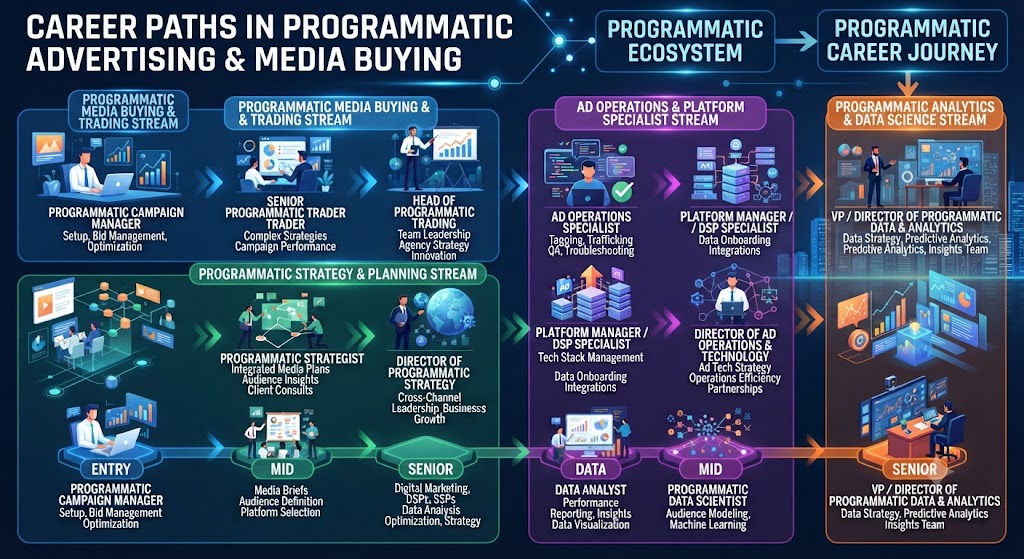
Programmatic advertising offers several career progression options depending on your interests.
A campaign-focused career may follow this path:
Campaign Coordinator → Programmatic Specialist → Senior Programmatic Specialist → Programmatic Manager → Media Director
A media planning career may develop as:
Media Analyst → Media Planner → Senior Media Planner → Strategy Manager → Media Strategy Director
A technology-focused path could include:
Ad Operations Specialist → Ad-Tech Specialist → Technical Account Manager → Ad-Tech Manager
Analytics professionals may progress toward:
Marketing Analyst → Digital Media Analyst → Senior Analyst → Marketing Analytics Manager → Analytics Director
Choose a path based on your strengths rather than trying to learn everything simultaneously.
Review your progress every six to twelve months. Track:
- Advertising platforms learned
- Campaign experience
- Analytics skills
- Certifications
- Portfolio projects
- Campaign results
- Client experience
- Strategic responsibilities
Financial planning should also be part of career development.
Before investing in courses or certifications, calculate:
- Training costs
- Certification fees
- Software expenses
- Expected salary changes
- Emergency savings
- Relocation expenses
- Remote-work equipment
- Travel costs
Do not choose training simply because it is popular. Review current job descriptions and identify the skills employers consistently request.
A best job tool can also help you compare relevant opportunities and identify positions that match your current capabilities while showing potential next steps for career growth.
Conclusion
Programmatic advertising and media buying offer diverse career opportunities for professionals interested in digital marketing, technology, analytics, and strategy. The industry includes roles in campaign management, media planning, media buying, analytics, ad operations, client services, and advertising technology.
The best way to enter the field is to build a strong understanding of digital advertising fundamentals before choosing a specialization. Campaign management requires attention to detail and optimization skills, media buying requires planning and commercial awareness, analytics requires strong data interpretation, and ad operations requires technical problem solving.
Practical experience is particularly valuable. Build campaign simulations, create media plans, analyze advertising data, and develop dashboards that demonstrate your capabilities. These projects can strengthen your portfolio and give you useful talking points during interviews.
Remote work can provide flexibility for suitable programmatic advertising roles, but professionals should evaluate working hours, time zones, security requirements, and employer policies before adopting a travel-based work model. Career testing can also help you determine whether campaign management, media planning, analytics, or advertising technology is the right fit.
Long-term success requires continuous learning because advertising platforms, privacy standards, measurement systems, and consumer behavior continue to change. Professionals who combine marketing knowledge with data skills, technology awareness, strategic thinking, and strong communication can build sustainable careers in this growing field.
With focused learning, practical experience, careful financial planning, and targeted job searching, programmatic advertising can become a strong career option for professionals seeking opportunities across digital marketing and media buying.



Leave a Reply