Introduction
Performance marketing is becoming an attractive career option for freshers who want to enter digital marketing through measurable, data-driven work. Unlike traditional marketing, performance marketing focuses heavily on measurable outcomes such as leads, sales, conversions, website traffic, and customer acquisition.Fresher
For freshers, this field offers opportunities to develop practical skills without requiring years of professional experience. However, simply completing a digital marketing course is not enough. Employers increasingly look for candidates who understand advertising platforms, campaign metrics, data analysis, audience targeting, and performance optimization.
The good news is that freshers can build these skills through structured learning, practical projects, internships, campaign simulations, and entry-level roles. Remote work can also provide opportunities to gain experience with international teams, while careful career testing can help determine whether performance marketing is the right Fresher professional path.
A focused learning plan can help freshers move from having basic marketing knowledge to becoming job-ready performance marketing professionals.
1. Understand What Performance Marketing Involves
The first step is to understand what performance marketing actually means.Fresher
Performance marketing is a form of digital marketing where campaigns are evaluated based on measurable business outcomes. These outcomes can include clicks, leads, app installations, purchases, registrations, or revenue.
Performance marketing professionals may work with:
- Search advertising
- Social media advertising
- Display advertising
- Affiliate marketing
- Remarketing
- Lead-generation campaigns
- E-commerce advertising
- Mobile advertising
The exact responsibilities depend on the Fresher organization.
A fresher may begin by assisting with campaign setup, reporting, keyword research, audience research, creative testing, or performance monitoring.
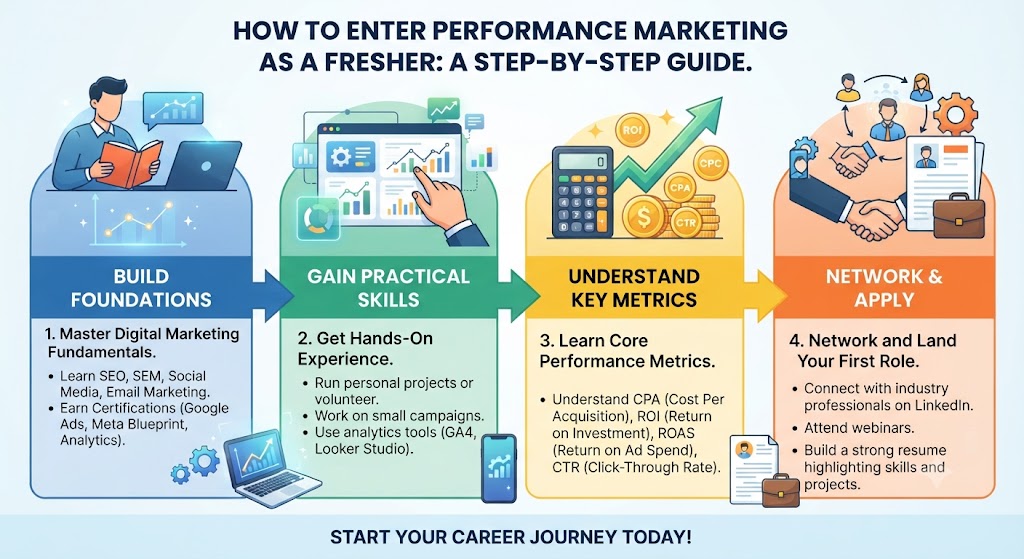
Learn the most common marketing metrics before applying for jobs:
- Click-through rate
- Conversion rate
- Cost per click
- Cost per lead
- Cost per acquisition
- Return on advertising spend
- Customer acquisition cost
- Return on investment
Understanding these metrics will help you speak confidently during interviews and analyze campaign results.
2. Learn the Core Digital Marketing Skills
Freshers do not need to master every marketing platform immediately. Start with the fundamentals.
Build knowledge of:
- Search engine marketing
- Social media advertising
- Search engine optimization
- Landing pages
- Conversion tracking
- Audience targeting
- Marketing funnels
- Email marketing
- Basic analytics
Understand how a customer moves through a marketing funnel.
For example:
Awareness → Interest → Consideration → Conversion → Retention
Performance marketers need to understand where potential customers leave the funnel and what can be changed to improve results.
You should also understand the difference between traffic and valuable traffic. A campaign that produces thousands of visitors but no qualified leads may not be successful.
This business-focused perspective is important when transitioning from theoretical learning to professional performance marketing.
3. Learn Advertising Platforms Through Practice
Platform knowledge is one of the most important requirements for entering performance marketing as a fresher.
Depending on your career interests, learn platforms such as:
- Google Ads
- Meta Ads
- LinkedIn Ads
- Google Analytics
- Google Tag Manager
- Advertising dashboards
- Reporting and visualization tools
Do not limit your learning to watching tutorials.
Create simulated campaigns and practice:
- Selecting campaign objectives
- Defining audiences
- Creating ad groups
- Writing advertising copy
- Selecting keywords
- Setting budgets
- Monitoring metrics
- Comparing campaign performance
You can use hypothetical businesses for practice.
For example, create a fictional campaign for an online education company.Define its audience, advertising objective, keywords, ad copy, landing page, budget, and expected results.
Then explain how you would optimize the campaign if the cost per lead increased.
This type of practical thinking is much more useful for interviews than simply stating that you completed a course.
4. Build a Portfolio Before Applying for Jobs
One of the biggest challenges freshers face is the lack of professional experience.
A practical portfolio can help solve this problem.
Your portfolio does not need to contain campaigns for major brands.Fresher It can include well-documented practice projects.
Create three to five projects such as:
Paid Search Campaign
Develop a hypothetical Google Ads campaign with keywords, ad copy, audience intent, budget allocation, and expected performance.
Social Media Campaign
Create a Meta advertising strategy for Fresher a fictional product. Include audience targeting, creative concepts, campaign objectives, and measurement metrics.
Performance Dashboard
Build a dashboard showing:
- Advertising spend
- Impressions
- Clicks
- Leads
- Conversions
- Cost per acquisition
- Return on advertising spend
Campaign Optimization Case Study
Create a fictional campaign with poor results and explain how you would improve it.
For every project, explain:
Objective → Strategy → Execution → Results or Expected Results → Optimization
This demonstrates structured thinking and gives recruiters something concrete to evaluate.
5. Develop Data and Analytical Skills
Performance marketing is closely connected to data. Freshers who develop analytical skills can differentiate themselves from candidates who focus only on creative advertising.
Start with:
- Excel
- Basic statistics
- Data visualization
- Google Analytics
- Power BI
- Conversion analysis
- A/B testing
- Reporting
Learn how to interpret data instead of simply recording it.
For example, suppose an advertising campaign has a strong click-through rate but a poor conversion rate.
Possible reasons could include:
- Incorrect audience targeting
- Weak landing-page experience
- Poor offer
- Mismatch between advertisement and landing page
- Tracking problems
- Low-quality traffic
A performance marketer needs to investigate these possibilities before making changes.
Practice analyzing sample datasets and writing short recommendations. This will improve your ability to turn marketing data into business decisions.
A best job tool can help freshers identify entry-level performance marketing and digital marketing positions while comparing the skills employers request.
6. Gain Experience Through Internships, Remote Work, and Career Testing
Internships are one of the most effective ways for freshers to gain practical experience.
Look for internships involving:
- Paid advertising
- Campaign management
- Digital marketing
- Marketing analytics
- Lead generation
- E-commerce marketing
- Social media advertising
Do not focus only on the company name. Examine the actual responsibilities.
An internship where you only create social media posts may provide less performance marketing experience than one where you analyze campaigns, manage advertising dashboards, and prepare reports.
Remote internships can also provide useful experience, particularly when working with distributed marketing teams.
Before accepting remote work, check:
- Working hours
- Training availability
- Communication process
- Manager support
- Campaign access
- Reporting responsibilities
- Expected deliverables
Career testing is another useful approach.
Before committing to performance marketing as a long-term career, spend several weeks learning the basics and completing simulated projects. This can help you determine whether you enjoy working with advertising data, campaign optimization, and measurable targets.
If you plan to work remotely while traveling, test the arrangement gradually. Reliable internet, time-zone differences, employer policies, and work schedules should be considered before combining travel with professional responsibilities.
7. Create a Job Search and Financial Plan
Entering performance marketing as a fresher requires a targeted job-search strategy.
Do not apply randomly to every digital marketing position.
Search for roles such as:
- Performance Marketing Intern
- Digital Marketing Intern
- Paid Media Intern
- PPC Executive
- Performance Marketing Executive
- Digital Advertising Analyst
- Paid Search Executive
- Marketing Analyst
Customize your resume for each position.Fresher
Highlight:
- Advertising platform knowledge
- Marketing projects
- Analytics skills
- Certifications
- Internship experience
- Portfolio projects
- Relevant academic work
Use numbers wherever possible.
Instead of writing:
“Created a digital marketing project.”
Write:
“Developed a simulated paid-search campaign containing 30+ targeted keywords, multiple ad groups, conversion goals, and a performance dashboard.”
This provides stronger evidence of practical skills.
Financial planning is also important when starting your career.
Before accepting an internship or entry-level position, consider:
- Monthly expenses
- Expected salary
- Commuting or relocation costs
- Training expenses
- Certification fees
- Emergency savings
- Remote-work equipment
- Travel expenses
Do not spend heavily on multiple certifications before gaining practical experience.
A best job tool can help freshers compare entry-level opportunities and identify roles that match their skills, preferred location, and remote-work requirements.
Conclusion
Entering performance marketing as a fresher is achievable with the right combination of marketing knowledge, practical experience, analytical skills, and targeted job searching.
Start by understanding how performance marketing works and learn the fundamentals of advertising, audience targeting, conversion tracking, and campaign measurement. Then develop platform knowledge through practical exercises instead of relying exclusively on theoretical courses.
A portfolio can help overcome the experience gap. Build simulated campaigns, dashboards, optimization case studies, and media strategies that demonstrate how you think and solve marketing problems.
Data skills are equally important because performance marketing depends Fresher on measurable outcomes. Learn Excel, analytics, reporting, and basic data visualization so you can explain not only what happened but also why it happened and what should be done next.
Internships and remote opportunities can provide valuable practical exposure. Career testing can also help you confirm whether the field matches your interests before making a long-term commitment.
Finally, approach your job search with a clear financial plan. Target relevant entry-level roles, customize your resume, build a strong portfolio, and continue developing skills based on real employer requirements.
With consistent practice and a results-oriented mindset, freshers can build a strong foundation for a long-term career in performance marketing, paid media, digital advertising, and marketing analytics.



Leave a Reply