Introduction
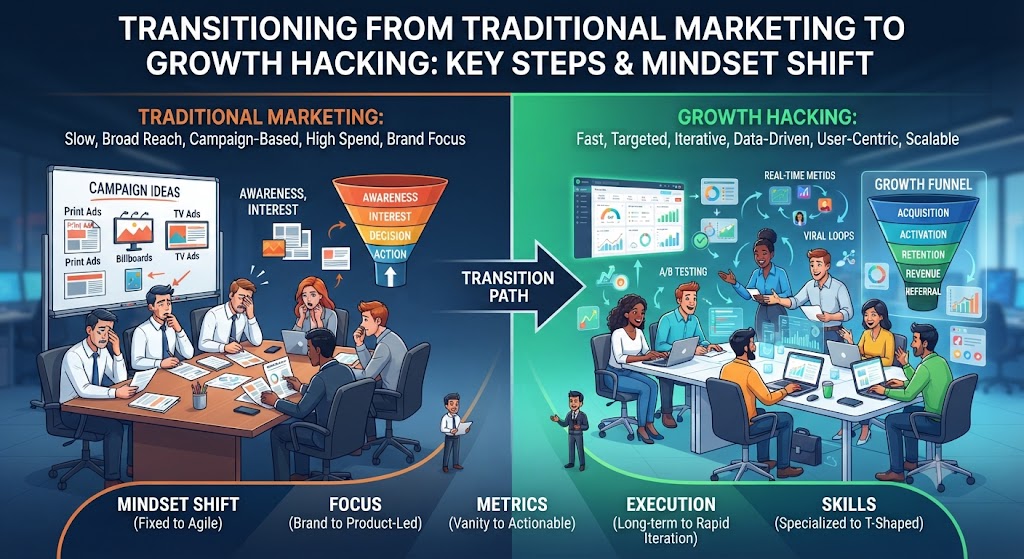
Growth hacking has become an increasingly relevant career path for marketing professionals who want to combine creativity, experimentation, data analysis, and technology. Unlike traditional marketing, which may focus heavily on brand awareness, campaigns, and long-term audience development, growth hacking emphasizes rapid experimentation and measurable business growth.
For traditional marketers, moving into growth hacking does not require starting from scratch. Existing skills in customer research, campaign planning, content, communication, and brand management can provide a strong foundation. The main transition involves learning how to use data, testing, automation, and customer behavior insights to identify scalable growth opportunities.
Growth hacking can be applied across startups, technology companies, e-commerce businesses, SaaS companies, and digital platforms. Roles may involve acquisition, activation, retention, referral, conversion optimization, and product-led growth.
The transition is most effective when approached systematically. Marketing professionals should identify their transferable skills, develop analytical and technical capabilities, build practical experiments, and gradually take on growth-focused responsibilities. Remote work and career testing can also make the transition more flexible, while financial planning can reduce the risks associated with changing career direction.
1. Understand What Growth Hacking Really Means
The first step is understanding how growth hacking differs from traditional marketing.
Traditional marketing often focuses on activities such as:
- Brand awareness
- Advertising campaigns
- Content marketing
- Public relations
- Social media
- Market research
- Brand positioning
Growth hacking focuses more heavily on finding efficient ways to increase measurable business outcomes.
These outcomes may include:
- Customer acquisition
- Website conversions
- Product adoption
- User activation
- Customer retention
- Referrals
- Revenue growth
Growth hacking is not simply about finding clever marketing tricks. It is a structured approach to identifying growth opportunities, testing hypotheses, measuring results, and scaling successful initiatives.
A growth professional might ask:
Which customer segment converts best?
Where are users leaving the conversion funnel?
Which onboarding step prevents activation?
Which acquisition channel produces the highest-value customers?
What experiment could improve conversion rates?
This mindset represents one of the biggest changes for traditional marketers.
2. Identify Your Transferable Marketing Skills
Traditional marketing professionals already possess several capabilities that can be valuable in growth hacking.
For example, experience in customer research can support audience segmentation. Content marketing experience can support acquisition experiments. Brand knowledge can help maintain consistent messaging during rapid testing.
Identify your transferable skills in areas such as:
- Customer research
- Campaign management
- Content creation
- Audience segmentation
- Copywriting
- Social media
- Email marketing
- Market research
- Brand strategy
- Project management
Then identify the capabilities you need to strengthen.
Growth hacking commonly requires stronger knowledge of:
- Marketing analytics
- Conversion rate optimization
- A/B testing
- Customer funnels
- Product analytics
- Marketing automation
- Data visualization
- Basic technical concepts
Create a simple skills gap assessment.
Current skill → Required growth skill → Learning method → Practical project
For example:
Email marketing → Lifecycle marketing → Study retention funnels → Build an automated email sequence
This approach creates a practical learning roadmap instead of requiring you to learn every growth marketing technique simultaneously.
3. Build Data and Experimentation Skills
Data-driven decision-making is at the center of growth hacking.
Traditional marketers may evaluate campaign performance using metrics such as impressions, engagement, and reach. Growth-focused professionals typically go deeper into the customer journey.
Important metrics can include:
- Customer acquisition cost
- Conversion rate
- Customer lifetime value
- Retention rate
- Churn rate
- Activation rate
- Referral rate
- Revenue per customer
Learn how to connect these metrics to business objectives.
For example, a campaign may produce a low customer acquisition cost but attract customers who leave the product quickly. In this situation, optimizing acquisition alone may not create sustainable growth.
Experimentation is equally important.
Develop a basic testing framework:
Hypothesis → Experiment → Measurement → Analysis → Decision
For example:
Hypothesis: Shortening the registration form will increase sign-ups.
Experiment: Compare the existing form with a shorter version.
Measurement: Track completion and activation rates.
Analysis: Determine whether the improvement is statistically and commercially meaningful.
Decision: Keep, modify, or reject the change.
This structured approach helps marketers move from opinion-based decisions toward evidence-based growth.
4. Learn Analytics, Automation, and Technology
Technology is an important part of modern growth hacking.
You do not need to become a developer, but understanding how marketing and product systems work can significantly improve your effectiveness.
Prioritize skills such as:
- Google Analytics or equivalent analytics platforms
- Excel
- SQL fundamentals
- Power BI
- Customer relationship management systems
- Marketing automation
- Landing-page tools
- A/B testing platforms
- Customer engagement platforms
Basic technical knowledge can help you identify opportunities that traditional campaign planning may overlook.
For example, understanding website analytics can help identify where users abandon a funnel. Learning marketing automation can help create personalized customer journeys. SQL knowledge can help you investigate customer behavior directly from databases.
Focus on practical application rather than collecting software certifications.
Build small projects such as:
- A conversion dashboard
- An automated email sequence
- A customer funnel analysis
- An A/B testing plan
- A retention analysis
These projects can demonstrate your growth capabilities to employers.
5. Create a Growth Hacking Portfolio
A portfolio can make the career transition easier because it provides evidence of your ability to think experimentally.
You do not need access to a major company’s marketing data. Create hypothetical or independent case studies.
Conversion Optimization Case Study
Identify a fictional landing page problem and propose two alternative versions.
Explain:
- The existing problem
- Your hypothesis
- Proposed changes
- Success metrics
- Testing method
Customer Retention Case Study
Analyze a fictional SaaS customer journey and identify where users are likely to churn.
Then recommend:
- Onboarding improvements
- Email campaigns
- Product reminders
- Customer education
- Retention experiments
Acquisition Experiment
Create a growth experiment comparing two customer acquisition channels.
Evaluate:
- Cost
- Traffic
- Conversion
- Customer quality
- Expected lifetime value
For every portfolio project, follow a consistent structure:
Problem → Hypothesis → Experiment → Metrics → Results → Recommendation
If actual results are unavailable, clearly identify them as projected outcomes.
A strong portfolio should demonstrate how you think rather than simply showing attractive marketing designs.
6. Use Remote Work and Career Testing Strategically
Many growth marketing activities can be performed remotely. Analytics, experimentation, content testing, reporting, email marketing, and campaign optimization can often be managed through digital tools.
However, remote work does not mean unrestricted flexibility.
Before accepting a remote growth role, evaluate:
- Working hours
- Time-zone expectations
- Team communication
- Meeting schedules
- Access to marketing platforms
- Data-security requirements
- Performance expectations
Career testing is useful for traditional marketers who are uncertain about making the transition.
Before leaving your current marketing role, try completing several growth-focused projects.
Analyze a conversion funnel, create an A/B testing plan, build a performance dashboard, or develop a customer-retention experiment.
This gives you a realistic understanding of whether you enjoy data-driven experimentation.
If you want to combine growth marketing with travel, test the arrangement gradually. Consider reliable internet, employer policies, time-zone differences, accommodation costs, and the need for real-time collaboration before adopting a travel-based remote-work model.
A best job tool can help marketing professionals discover growth marketing, performance marketing, digital marketing, and related remote opportunities.
7. Build a Long-Term Career and Financial Plan
Transitioning from traditional marketing to growth hacking can lead to several career opportunities.
A possible career progression is:
Marketing Executive → Growth Marketing Specialist → Growth Manager → Head of Growth → Growth Director
Other directions may include:
- Product growth
- Performance marketing
- Conversion optimization
- Lifecycle marketing
- Product marketing
- Marketing analytics
- Customer retention
- Growth strategy
Do not feel pressured to change your job immediately. You can begin by taking growth-related responsibilities within your current marketing position.
Ask to work on:
- Conversion optimization
- Marketing analytics
- Customer retention
- Lead-generation experiments
- Landing-page testing
- Marketing automation
This creates practical evidence before you formally transition.
Financial planning is also important.
Before changing roles or investing in training, evaluate:
- Current income
- Expected salary range
- Course expenses
- Certification costs
- Emergency savings
- Remote-work equipment
- Relocation expenses
- Travel costs
Avoid spending heavily on courses before understanding the skills employers actually require.
Review current growth marketing job descriptions and identify repeated requirements. Use those requirements to guide your learning plan.
A best job tool can help you compare growth marketing opportunities and identify positions that match your existing marketing experience and newly developed skills.
Conclusion
Transitioning from traditional marketing to growth hacking is less about abandoning your existing marketing experience and more about expanding it with data, experimentation, technology, and business-focused thinking.
Traditional marketers already understand customers, messaging, campaigns, and market positioning. The next step is learning how to measure customer behavior, identify growth opportunities, test hypotheses, and connect marketing activities to measurable business outcomes.
Start by understanding the growth mindset and identifying transferable skills. Then develop capabilities in analytics, conversion optimization, experimentation, automation, and customer retention.
Practical projects are one of the best ways to demonstrate these skills. Build growth case studies, analyze customer funnels, create testing strategies, and develop dashboards that show how you approach business problems.
Remote work can provide flexibility for suitable growth roles, while career testing allows professionals to explore the field before making a major career decision. If travel is part of your plans, evaluate employer policies, connectivity, time zones, and financial requirements carefully.
A successful transition also requires financial discipline. Build skills gradually, avoid unnecessary training expenses, and target roles based on actual employer requirements.
Growth hacking is ultimately a combination of marketing knowledge, analytical thinking, experimentation, and continuous improvement. Traditional marketers who develop these capabilities can position themselves for opportunities in growth marketing, product growth, performance marketing, lifecycle marketing, and digital strategy.



Leave a Reply