Introduction: Startup Role
Startups are fundamentally different in the kind of work environment they provide to an employee. MNCs offer specialisation in work areas, well defined processes, dedicated teams, and clearly laid down responsibilities. At a startup, the employee may have a more fluid experience with multiple responsibilities, more flexibility and faster decision making.
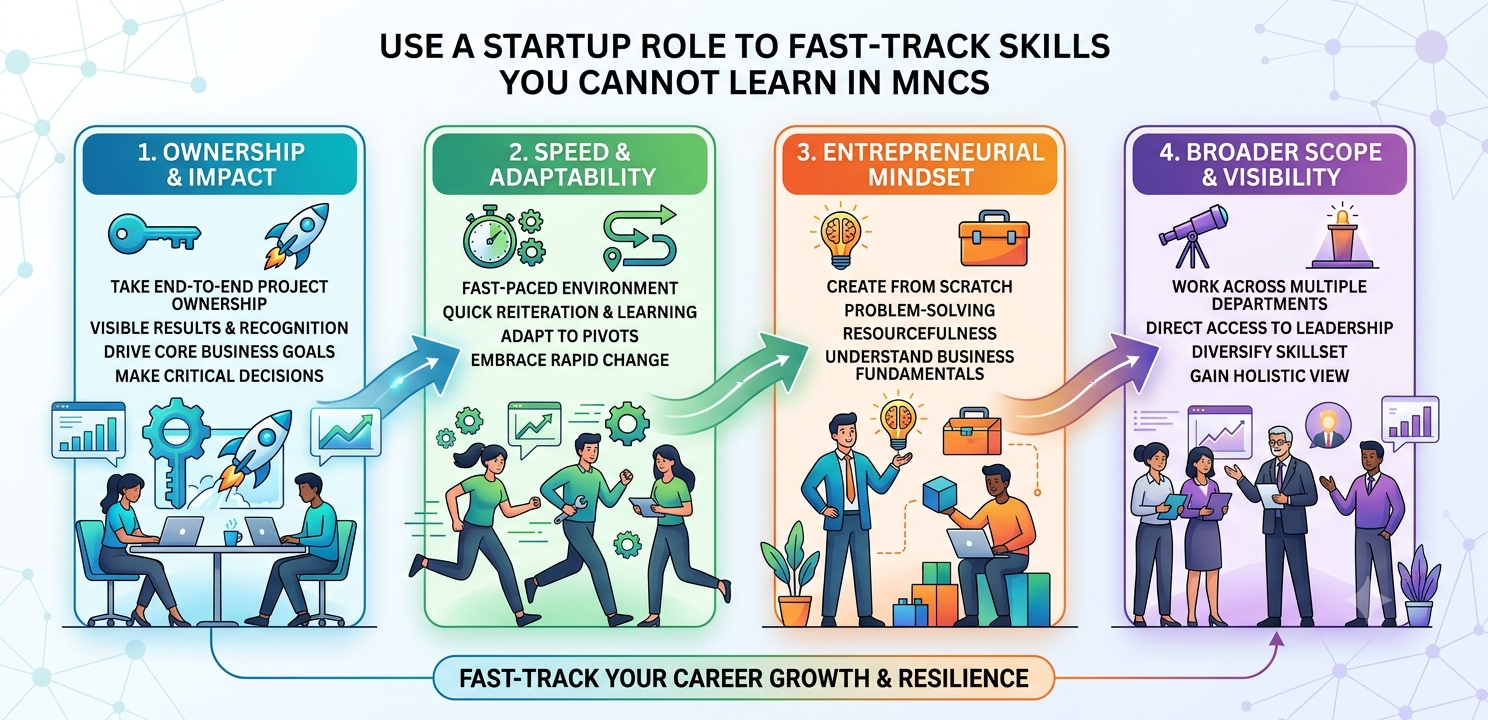
How to use a startup role to fast track skills you cannot learn in MNCs is a question of interest to many people thinking of switching to a startup. Startup roles offer the possibility to take up multiple responsibilities, work directly with decision makers within the company, have a chance to learn about the workings of the company at a fundamental level, and experience faster decision making than one would at an MNC.
How to Use a Startup Role to Fast Track Skills You Cannot Learn in MNCs?
1. Take ownership and expand your responsibilities
At a startup, the scope for taking up responsibilities is far greater than at an MNC. For example, in an MNC, the duties of a marketing professional may be limited to only creating and maintaining social media content or managing emailers. At a startup, the same marketing employee may handle content writing, content analysis, customer communication, and campaign management.
The upside to this can be tremendous – the employee may gain valuable skills by picking up these extra duties. However, ownership of tasks should not be taken to mean unending work with no positive outcome. Try and take up additional responsibilities that teach you valuable job skills and make you a better professional.
2. Learn about the workings of the business
At a startup, the employee has a unique opportunity to get a deeper understanding of the company than one would at an MNC
For example, they may witness firsthand the connection between sales, marketing, operations and the financial gains of the company. Try and understand terms like revenue, costs, CAC, retention, LTV, and profits, and what role your work plays in determining these numbers. At this point, it’s not necessary to become an expert at financial Modelling. Once you understand the bigger picture, it can become your competitive advantage in the future.
3. Work directly with decision makers
Startups tend to have fewer levels of management than MNCs, which means that an employee may get the chance to work directly with the people who run the company. Try and utilise this chance by studying how the decision makers in your industry think and operate.
When you present a proposal to them, make sure to include not just your idea, but the problems you faced, your potential solutions to these problems, and a risk assessment of the best solution. This will enable you to build far stronger decision-making skills as a professional.
4. Learn to deal with ambiguity
MNCs tend to have a fully worked out system and process for nearly every possible task that one would undertake as an employee. At a startup, there may be no clearly laid down system for the work you’re expected to do. In such a case, don’t try and ask your manager to spell it out for you. Instead, take ownership of the situation and try to understand the problem you need to solve. Do your own research, test a potential hypothesis, and learn from the results.
5. Develop skills through actual projects
Apart from your own specific duties at the startup, keep track of the sorts of projects people are working on You can benefit immensely from contributing to such projects
Even if you’re just an intern, you can request to gain experience with different types of projects within the company that relate to your field of work. Save these projects and their results as evidence of your work to put on your resume later.
6. Build skills in related fields
A startup is a great place to develop skills in areas that relate to your own work but aren’t explicitly required for it. A sales professional may want to brush up on marketing, an operations manager may want to learn more about finance or sales, and a content writer may want to develop SEO skills.
However, it’s important to pick and choose the fields to upskill in rather than trying to become an expert in all areas at once.
For instance, a content professional could gain valuable skills in SEO, analytics, and research in addition to their content writing. Each of these areas, when combined with content development, can make one far more marketable.
Conclusion: Startup Role
A startup role provides the perfect opportunity to learn and grow much faster than one would be able to elsewhere. This is because of the opportunity to take up more responsibilities, work with decision makers, and work on a variety of projects. However, the only way to utilize such an opportunity is to look at it as one. Taking ownership, seeking to understand the bigger picture, contributing to a wide variety of tasks, learning related skills, and documenting evidence of work can enable one to use a startup job to their own advantage.
Ready to accelerate your career? Use a startup role to gain hands-on experience, take on broader responsibilities, and build skills that are harder to develop in traditional MNC roles. Explore opportunities on Best Job Tool to find startup roles that can help you learn faster and grow your career.
Leave a Reply