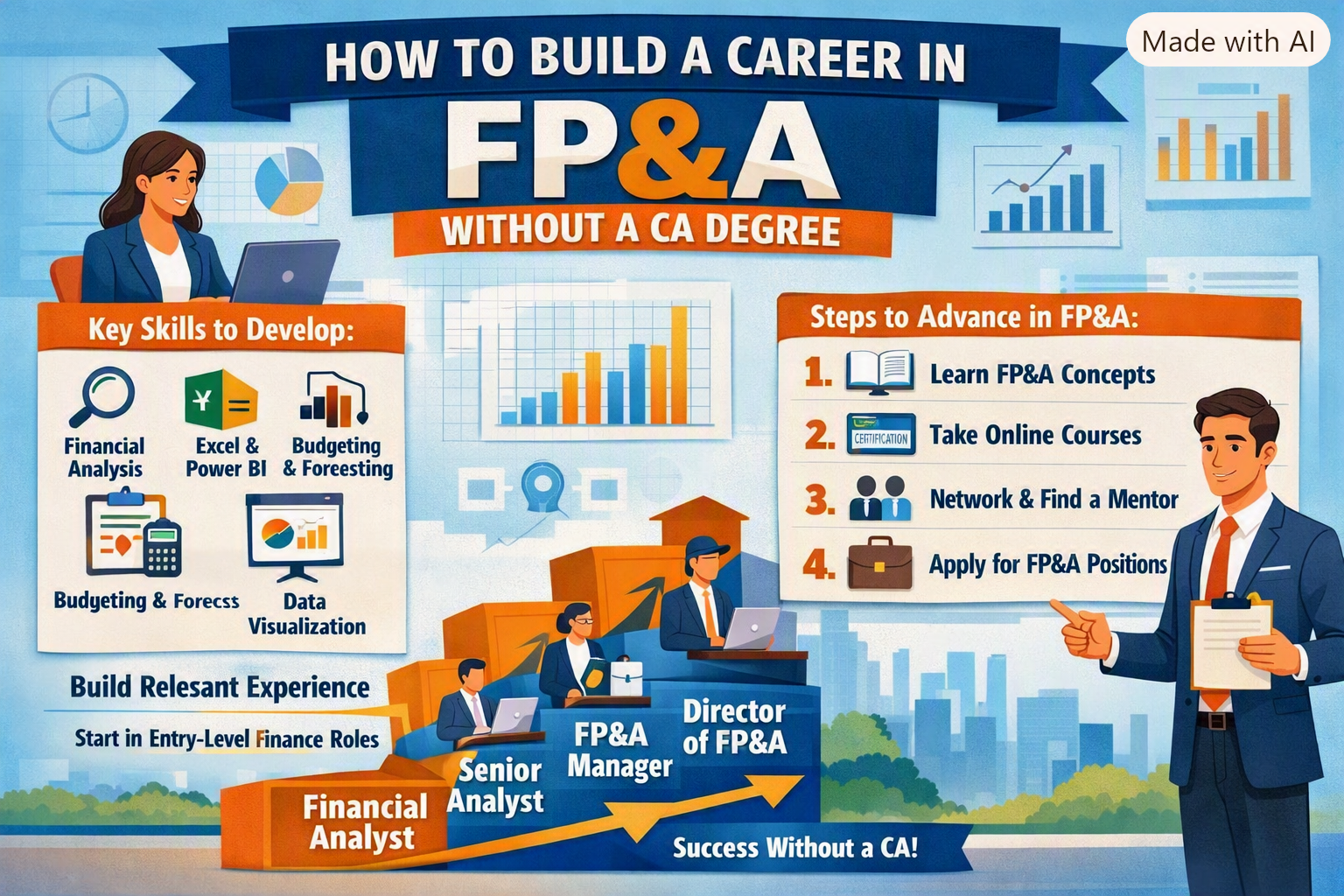
Introduction: Career in FP&A
Financial planning and analysis is an essential function in the modern business world. FP&A Professionals support organizations to analyze financial performance, budgeting and forecasting, control costs, and make informed business decisions. Given the strong link with finance, many believe that completing a course to become a Chartered Accountant is mandatory to build a career in financial planning and analysis.
However, it is entirely possible to gain experience and expertise in FP&A without obtaining a CA degree.
How to build a career in FP&A without a CA degree is a common question asked by young graduates and working professionals who are interested in transitioning to corporate finance. With the right financial knowledge, practical skills, and business mindset, anyone can contribute effectively to the financial planning and analysis process in an organization.
How to Build a Career in FP&A without a CA Degree?
1. Understand What FP&A Professionals Do
The first step towards building a career in FP&A is to understand the actual scope of work of these professionals. They support the organization to analyze its financial performance and make informed business decisions based on these insights. While accountants record and report financial transactions, FP&A professionals use these figures to take a forward-looking perspective.
They typically carry out budgeting and forecasting, variance analysis and monitoring, expense management, and report preparation among other responsibilities.
Once you understand what FP&A professionals do, align your learning plans around the skills they use in these processes.
2. Build Strong Financial Knowledge
To build a career in FP&A, you do not need a CA qualification, but you need a solid understanding of finance. Begin by studying core financial concepts like income statements, balance sheets, cash flow statements, working capital, profit margins, operating expenses, and revenue.
The financial analysis and modeling process will also require good knowledge of related concepts like budgeting, forecasting, variance analysis, and financial ratios.
Consider learning online courses, reading books, and completing practice sets. The aim should be to understand the fundamentals rather than just memorizing these concepts. For instance, you need to know the link between financial statements and how business decisions impact them.
3. Become Highly Skilled in Excel
Spreadsheets are the foundation of financial planning and analysis. All FP&A professionals use Excel to build budgets, conduct scenario modeling, report financial results, and carry out financial analysis.
Apart from formulas and PivotTables, the key skills include data cleansing, lookup functions, conditional formatting, charts, and macros. You should also learn the basics of financial modeling, including DCF, LBO, and M&A modeling.
The best way to master Excel and financial modeling is by completing practice sets. For instance, use Excel to develop a three-year revenue projection of a fictional company. You can begin with historical revenue, specify assumptions for revenue growth, determine future revenue, and complete the process by developing an expense and income statement forecast. Apart from mastering Excel, this example demonstrates how you could demonstrate your skills creatively to get a job in FP&A.
4. Learn Financial Modeling
Although Excel forms the foundation of FP&A, Financial modeling is also an extremely useful skill to have. A financial model is a valuable tool that a business uses to make financial projections and make informed business decisions. These professionals typically make assumptions and analyze the impact on revenue, expenses, and profits.
To master this skill, start with the basics and gradually progress to advanced concepts. Begin by completing the steps involved in projecting revenue, expenses, and cash flow for a new business. You can take it a step further by including scenarios and conducting sensitivity analysis.
For instance, you can build a model that shows the revenue, expenses, and profits of a business under three different scenarios: conservative, moderate, and aggressive growth. Make sure to vary assumptions for revenues, expenses, and new hires.
5. Develop Business Understanding
To be a valuable contributor to an organization, an FP&A professional needs to have a sound business sense and judgment. Simply put, these are the skills that enable one to make informed business decisions based on financial results and projections. For instance, if marketing expenses increase, you should be able to explain what drives the changes and their impact on the business.
Similarly, if revenues decline, it should be possible to conduct an insightful variance analysis to identify what drives the changes. Develop this skill by practicing financial analysis. It is important to remember that even without a CA qualification, a strong business sense and judgment can help an individual progress faster.
6. Consider Relevant Qualifications
Although a CA qualification is not mandatory for FP&A, it is crucial to pursue relevant qualifications and certifications to become a competitive financial planning and analysis professional. The options include relevant courses and certifications in financial analysis, management accounting, corporate finance, power BI, Excel, and financial modeling.
A bachelor’s degree in commerce, finance, economics, mathematics, business, or a related discipline can also be valuable for an aspiring FP&A professional. However, as you advance in your career, the importance of practical experiences and skills increases.
Conclusion: Career in FP&A
A CA qualification is not mandatory to build a career in FP&A. Given the right financial knowledge, Excel and financial modeling skills, business sense, and data skills, you can prepare a strong portfolio and get a good job in financial planning and analysis. The key is to understand what FP&A professionals do and focus on developing the skills that will help you become a valuable contributor to an organization.
Ready to build your FP&A career without a CA degree? Focus on developing the right financial skills, gaining practical experience, and finding roles that match your strengths. Use the best job tool platform to discover relevant FP&A opportunities and take the next step toward your finance career.

Leave a Reply