Introduction: Resume Tips
Changing from a creative career path to a corporate one can be exciting but writing the resume for such transitions can sometimes be challenging. Creative professionals typically have careers revolving around writing, designing, photography, video, branding, social media, or content creation, among many others.
These professionals operate in various capacities such as project-based and extremely visual roles. Meanwhile, corporate employers typically seek candidates who can demonstrate their ability to operate in roles with clear responsibilities, impactful outcomes, teamwork, and general business impact.
The good news for creative professionals is that their experience is highly likely to be an asset in corporate environments. The major challenge is to present this experience in a way that demonstrates its relevance to the desired corporate role.
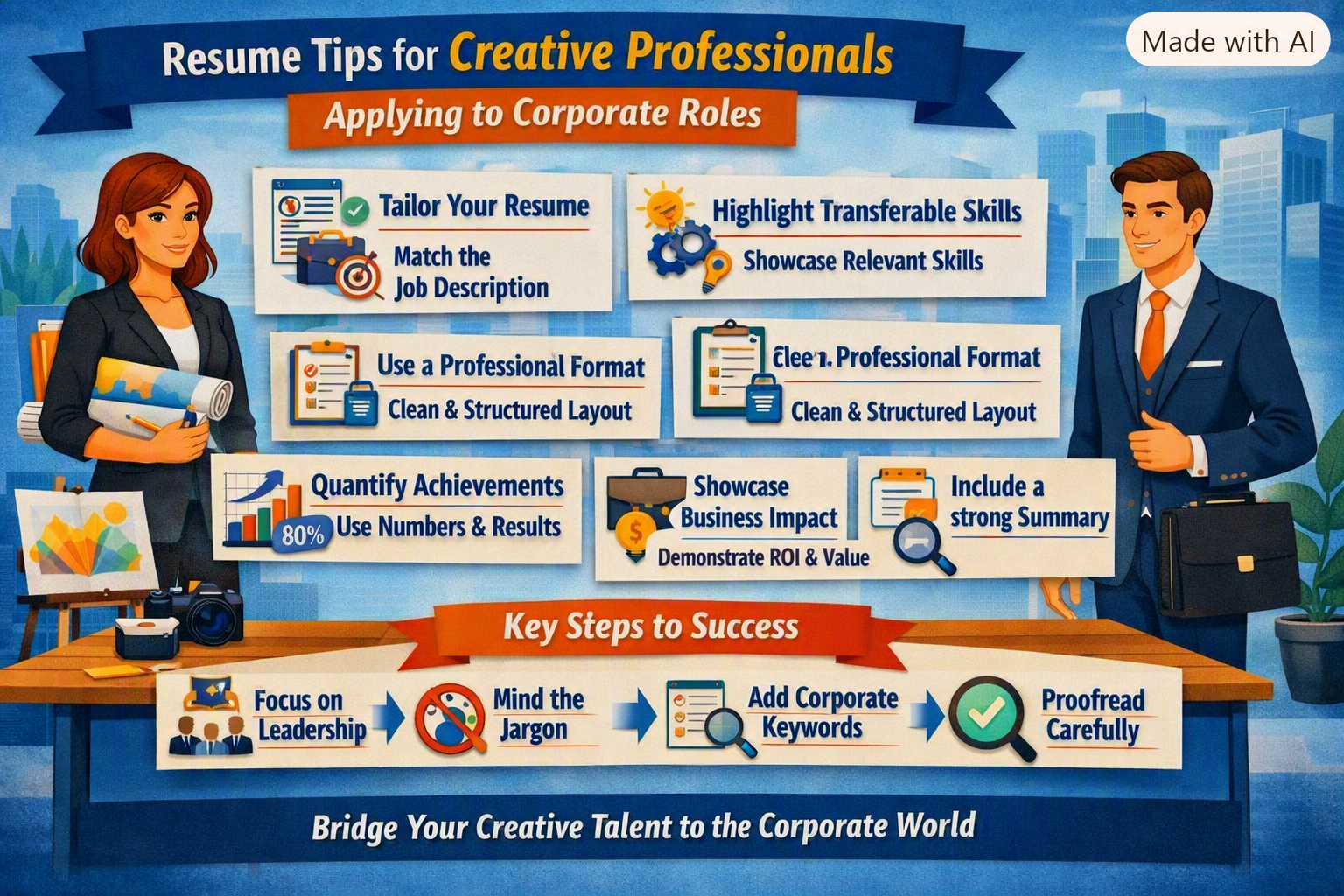
Resume Tips for Creative Professionals Applying to Corporate Roles
1. Understanding What Corporate Employers Are Seeking
It is critical to identify the nature of a corporate job role that one would like to occupy. A resume for a marketing role would be significantly different for a creative professional applying for a position in project coordination, operations, communications, or customer success.
It is critical to thoroughly understand the job description, the skills required, and the responsibilities attached to the role. For instance, if the job requires strong communication, project management, stakeholder management, or presentation skills, the resume should highlight relevant evidence of these competencies.
2. Focus on Transferable Skills
Creative professionals often have more transferable skills than they realize. While it is true that their work often revolves around highly specialized and specific areas, there are key ancillary skills that come with the territory. For instance, a designer might have to deal with a variety of stakeholders and therefore demonstrate enhanced communication and feedback management competencies.
A content writer, on the other hand, might have to demonstrate research, editing, communication, SEO, project management, and audience-analysis skills. These ancillary proficiencies can be highlighted on the resume, and in many cases, might be more relevant for the corporate employer.
While it might be typical to write “Experience creating and conceptualizing social media content”, it might be more relevant to write “Experience conceptualizing and executing content strategies including the management of diverse stakeholders”.
In short, it is critical to emphasize the business impact of the creative work.
3. Replace Responsibilities with Achievements
One of the most common recommendations when it comes to resume building is to replace generic responsibilities with specific achievements. This entails highlighting the impact that one has had while fulfilling certain duties. While using formulas such as “Action Taken” and “Business Outcome”, it is critical to use numbers where possible since they bring more objectivity and specificity to the resume.
Using the above example, “Created Instagram content for the company”, could be changed to: “Created and managed Instagram content to drive engagement and achieve monthly targets”.
Where relevant, specific figures can be used to demonstrate the extent of the business outcome. This could include improvements to traffic, engagement, leads, sales, shortlisting, project completion time, audience growth, retention, and so on.
4. Focus on Simplicity
At times, creative professionals are tempted to make their resumes stand out by making them too flashy. This approach, however, is counterintuitive when applying for corporate jobs since simplicity is often the best approach. Unless the job role specifically requires design expertise, recruiters would prefer a resume that is easy to read and is not full of distractions such as unnecessary graphics, formats, colors, and so on. It is important to use white space, use simple formatting and font sizes, and generally create resumes that are easy on the eyes.
While a creative portfolio, website, or LinkedIn profile might be a good place to demonstrate more creative approaches, the resume should always focus on being simple.
5. Create an Impactful Professional Summary
The professional summary is a critical component of a resume, particularly for creative professionals seeking to make a transition to a corporate role. The summary gives an overview of the candidate’s expertise and the value they can deliver. As such, it should be brief, ideally 2-3 lines.
It should also focus on a specific career objective. For instance, a summary for a creative professional seeking to transition to a marketing role could read: “Results-driven content and communication professional with diverse experience in research, audience development, project management, and execution of successful marketing campaigns”.
Avoid generic statements such as “Creative professional with diverse experience and a strong work ethic”.
6. Demonstrate Collaborative Working Experience
Most corporate roles are team-based, and as such, it is important to demonstrate collaborative working experience, even for creative professionals seeking to change from solo-based entrepreneurial ventures to corporate setups. Wherever the scope of work allowed, it is important to highlight such collaborations, including the nature of the work, the stakeholders involved, and the outcomes achieved.
This approach is especially pertinent since most corporate roles have a significant stakeholder management component that is often not present in many creative projects. Employers want to see how well a candidate can collaborate, listen to feedback, respond, manage pushback, and generally operate in a team-centered corporate environment.
Conclusion: Resume Tips
Changing from a creative career path to a corporate role is not a requirement for success but it certainly brings with it the opportunity to leverage creative expertise in a corporate environment. Resume tips for creative professionals applying to corporate roles should focus on emphasizing the transferable skills that can enhance the value proposition of such a transition.
The focus should remain on emphasizing the business impact of the creative work, leveraging ancillary skills, technology proficiency, and collaboration competencies to enhance the overall value proposition.
Ready to take your creative career into the corporate world? Update your resume, highlight transferable skills, and explore relevant opportunities on Best Job Tool to move one step closer to your next role.

Leave a Reply