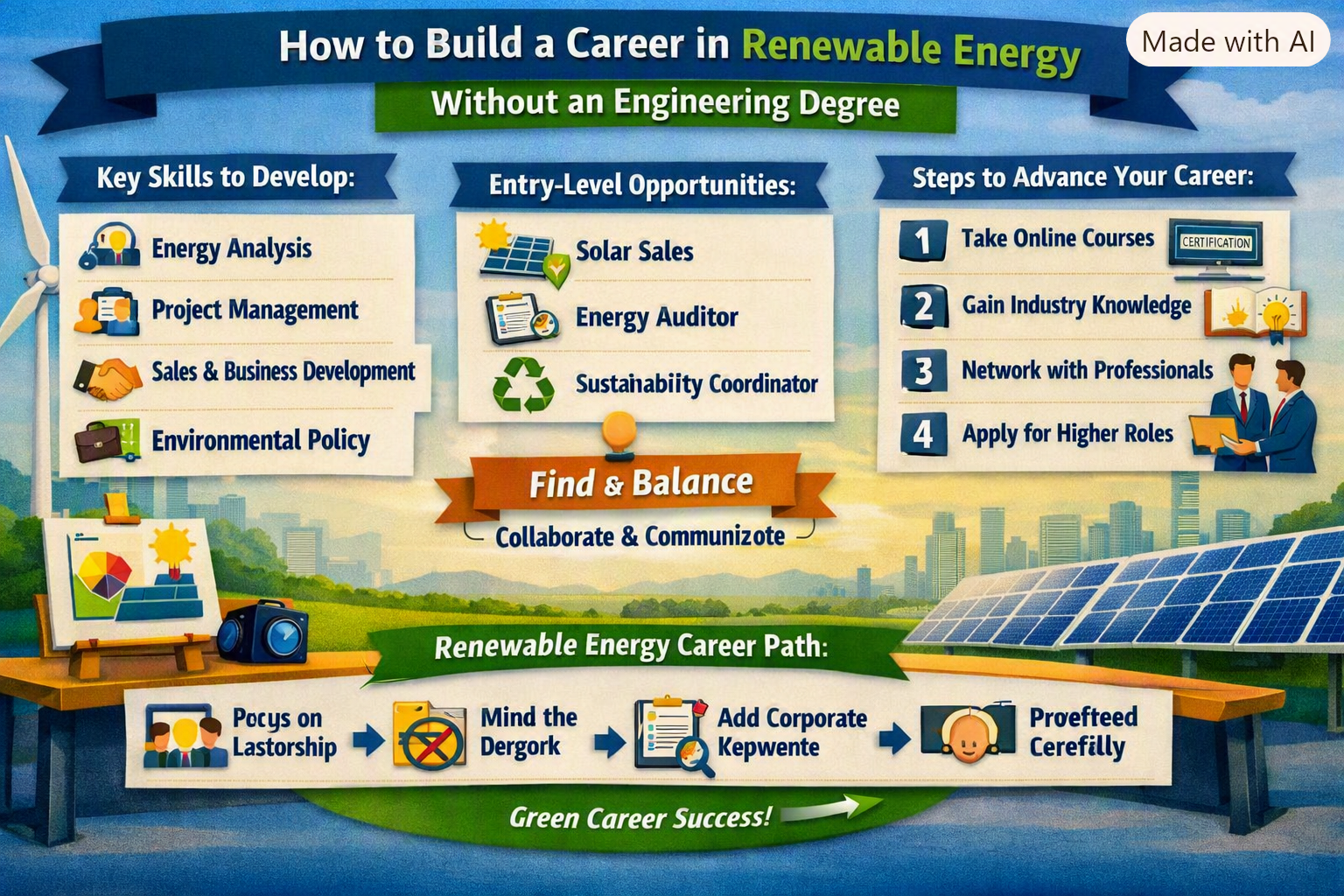
Introduction: Renewable Energy Career
The renewable energy sector is growing exponentially. Solar, wind, batteries, electric vehicles, green hydrogen, and a host of other technologies is enabling hundreds of thousands of new jobs to be created each year. Thus, there is a lot of buzz around building a career in the field. Although certain engineering roles require an engineering background, you can build a successful career in renewable energy without a four-year engineering degree.
How to build a career in renewable energy without an engineering degree, therefore, begins with identifying the various career options and building core competencies relevant to the chosen field. Renewable energy companies require people from diverse disciplines, including non-engineering fields, to fill up critical roles.
How to Build a Career in Renewable Energy Without an Engineering Degree Essay?
1. Understand the Industry First
Prior to identifying the various job roles that one could fill up with a non-engineering background, it is critical to understand the business and how the technologies used in the different sectors works.
It is, therefore, recommended that one begins their career journey by acquainting themselves with the industry by understanding solar, wind, hydropower, batteries, electric vehicles, energy efficiency, and green hydrogen.
How projects in these fields are structured as well as how value is created throughout the supply chain should also be understood. Webinars, online courses, whitepapers, and related blogs are excellent resources to learn the technical lexicon of the industry. This ensures that non-engineers do not encounter any substantial impediments while working in tandem with engineers and recruiters.
2. Non-Engineering Jobs in the Renewable Energy Sector
There are several jobs in renewable energy that do not require a technical background. There are several business development roles, operations and project-management functions, and support positions that require human skills, conceptual skills, and interpersonal skills. It is, therefore, recommended that one identifies the most interesting job description and build relevant competencies pertinent to the job role.
For instance, business development, sales, and similar functions require market-savviness, presentation skills, negotiation skills, and client relationship management skills. Jobs in human resources require a fundamental understanding of people and how they function.
Finance roles entail a basic comprehension of budgeting and preparation of financial statements. Similarly, there are numerous operation support roles that constitute an integral part of the renewable energy value chain.
3. Build Necessary Skills
How to Build a Career in Renewable Energy Without an Engineering Degree, furthermore, entails building relevant skill sets. It is, therefore, necessary to ensure that the competencies one builds for the job role align with the qualifications stipulated by employers for the identified career path.
If a clean energy co ordinator position requires leadership skillset and project management experience, it is recommended to build these proficiencies. You may also need to develop computer skills in Power BI, MS Excel, and other software relevant to the position.
Communicative skills, which are generally applicable across all jobs in the renewable energy space, should also be honed. Most organizations within the clean energy sector have to constantly communicate with governments, customers, suppliers, and other stakeholders in the value chain. Thus, people with these core skills are in demand.
4. Consider Getting Qualified
Obtaining relevant certifications and qualifications are an excellent way of demonstrating one’s readiness to engage in productive work in the field. It is, however, important to remember that while a formal engineering qualification is not mandatory to work in the renewable energy space, certifications help demonstrate one’s competence and familiarity with the working principles of the industry as well as basic technical lexicon.
Therefore, How to Build a Career in Renewable Energy Without an Engineering Degree also involves identifying the most relevant qualifications that would strengthen one’s candidacy for a given job position or career path. The learner could, therefore, enroll for relevant trainings, certifications, and short courses in the clean energy space. It is important not to get overwhelmed by too many accreditations.
Rather, certificates should be obtained after identifying the shortest route to the selected career destination. For instance, while it is not possible to master finance, engineering, marketing, management, and a host of other disciplines in business development for the renewable energy sector, a working knowledge of the fundamentals of certain fields like clean energy finance and project finance could prepare one for the fundamentals of clean energy business development.
5. Gaining Experience Helps
Acquiring work experience is extremely important when building a career in renewable energy. The learner should, therefore, make every effort to obtain any experience related to the identified field of work.
Experience in the absence of a technical background in the renewable energy sector might require individuals to obtain prior work experience or demonstrate one’s proficiency through the completion of related projects such as research projects. If someone is considering a career as a business developer or sales person in a renewables company, they could complete a research project identifying the feasibility of solar products in their local community with demonstrable financial yields. Alternatively, an academic student could complete a presentation on the potential of electric vehicles.
This demonstrates how individuals can identify transferable skills that match interesting roles in their chosen careers and use those skills to pursue new career opportunities. Networking also helps you gain knowledge and valuable insights into available jobs, required skills, and relevant qualifications.
The learner should use social media sites such as Linkedln to identify companies and individuals that could provide them with useful insights into the most appropriate place to begin their careers in the renewable energy space.
6. Transferable Skills Can Help
Many jobs in the renewable energy sector require a set of specific skills and competencies. Thus, if somebody is considering a career in solar sales, there is a fundamental understanding of solar products. If someone is considering a career in human resources within the renewable energy space, there are certain core proficiencies that would prepare such a person for the fundamental challenges of the role. A sales professional can transfer their expertise from the automotive or insurance sector to renewable energy and build a successful career in the solar industry.
Conclusion: Renewable Energy Career
Building a career in renewable energy does not require an engineering degree. The industry needs professionals across project management, finance, policy, sales, communications, research, and sustainability.
By developing relevant skills, gaining practical experience, and understanding the renewable energy sector, you can create valuable career opportunities. Focus on building industry knowledge alongside your existing strengths, and pursue roles that match your skills and interests.
Ready to build a career in renewable energy without an engineering degree? Explore the right roles, develop relevant skills, and use the Best Job Tool platform to discover opportunities that match your career goals.

Leave a Reply