Introduction: Strategic Pausing
Most of us would tremble in horror at having to endure another job interview. We all remember those times when we did not handle them well. We stuttered out answers, used too many uhums, or just answered before we had properly understood the question. However, there is a trick to mastering an intelligent pause in conversations, and in an interview, it can make a huge difference.
How to use strategic pausing to sound more confident in interviews is a vital skill for job interviewees across the globe, since confidence is not always measured by how much you talk.
How to Use Strategic Pausing to Sound More Confident in Interviews Essay?
1. Why a Pause Can Make You Sound More Confident at a Job Interview
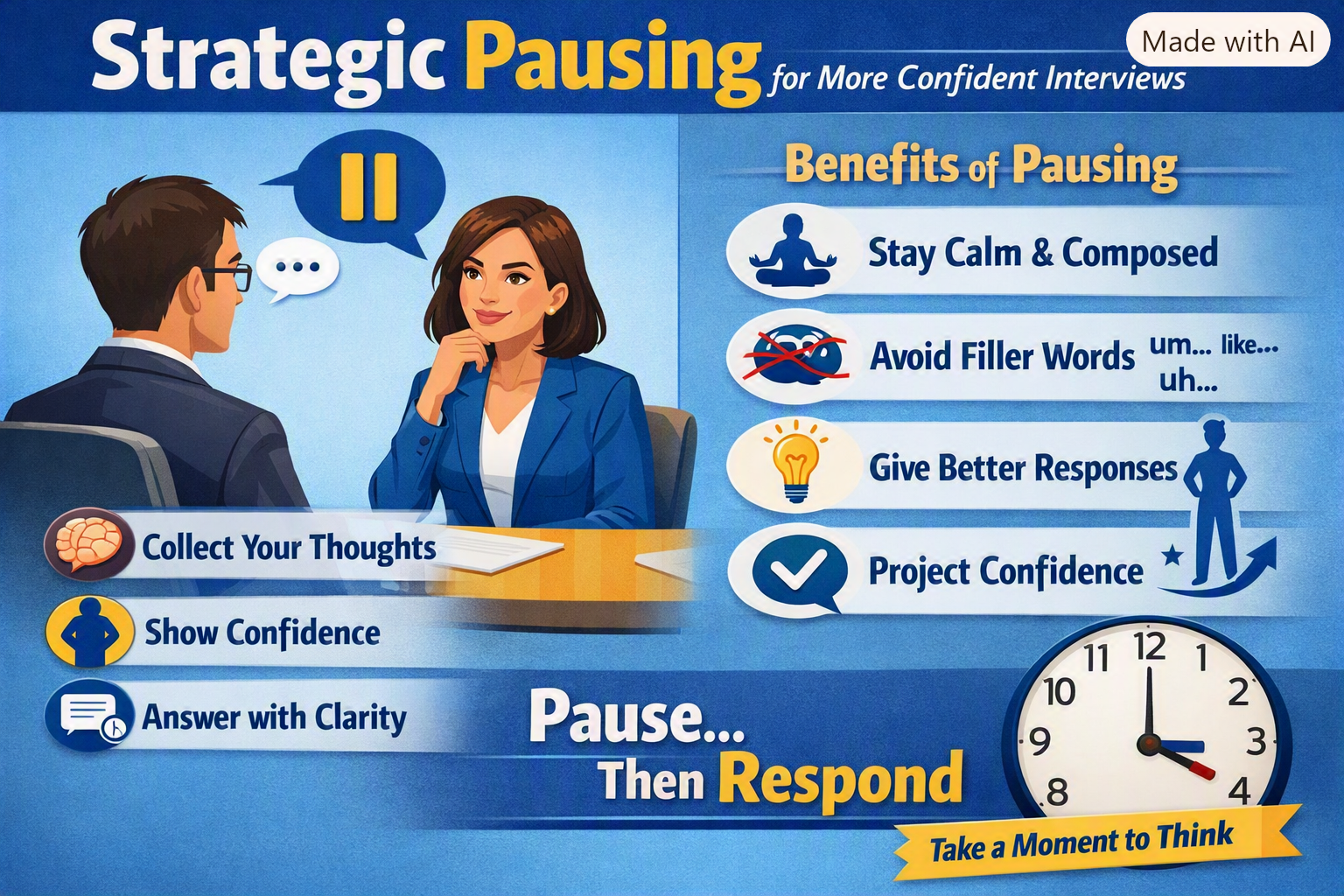
Contrary to popular belief espoused by most candidates, confident and composed job seekers will use well-timed pauses to collect their thoughts. The best tactic to deploy during a job interview is to take a deep breath and think about your response.
One easy way to begin practicing strategic pausing is before you answer a challenging question. Imagine, for instance, that you are asked to describe a time when you made a mistake at work. There is no shame in needing a second to compose yourself before you reply. Just take a pause of 2 or 3 seconds before you begin.
A short pause conveys to the interviewer that you are deliberately weighing the response rather than blurting out the first thoughts that come to mind. It is also necessary for emphasizing what you want to say and keeping unimportant information out.
However, as an important rule of thumb, the pause should never be too long. A short 2- or 3-second break will help you formulate the reply without being too obvious. The best time to practice strategic pausing is when you have to describe a challenging work experience or discuss a weakness or salary expectations.
One helpful way to deploy strategic pausing is before your reply to a challenging question. For instance:
“That’s a good question. Let me think of the best answer.”
This allows you a couple of extra seconds to come up with a response, and then you should deliver it confidently.
Another great technique for job interview pausing is using them between important points. Let’s say that you are sharing a success story during your interview. Instead of delivering it in one long monolog, try splitting it up.
“My work entailed improving the customer follow-up process. [Pause] The central problem involved late client notifications. [Pause] The solution was a simple follow-up tracking system.”
It will afford you natural breaks in the story while still presenting it coherently and concisely.
2. Strategic Pausing to Sound More Confident in Interviews
One final way that interview pausing can improve your answers is by reducing your reliance on verbal fillers. Word fillers are those “umms,” “basicallys,” “actuallys,” and “alike” that pepper your speech while searching for the right word. One or two of these during an interview are not a big deal. However, overusing word fillers will convey uncharacteristic doubt to the interviewer. Instead of saying,
“Umm, basically, I think, you know, I handled the project…”
try
“I handled the project by understanding the primary issue.”
This will still sound natural without the word “umm” and “actually.”
3. Use Strategic Pausing to Emphasize Your Achievements
An alternative way of using strategic pausing is to emphasize your accomplishments during the reply. For instance:
“I raised customer responses by 25% during my first 6 months. [Pause] I accomplished this by improving the follow-up procedure and developing a simple tracking system.”
This will highlight important information to the interviewer.
Again, using strategic pausing to underline your achievements does not mean you have to sound dramatic. Just pause a second to draw the interviewer’s attention to a specific part of your reply.
4. Avoid Memorizing Responses for Interview Pausing
The most important rule of thumb when it comes to using pauses during an interview is not to memorize your answers. Reciting responses will inevitably lead to unnatural, rehearsed delivery, regardless of whether you pause or not. Instead, consider preparing a few major points you want to cover in each reply and practicing them with pauses.
For standard interview questions, write down 3-4 important ideas to ensure that you cover them all and pause before delivering each one. Additionally, you can record yourself responding to practice questions, paying particular attention to how you sound after a pause. With enough training, your natural pauses will improve dramatically.
5. Avoid Excess Pauses
Although pausing before an interview can be exceedingly beneficial, it should be done only occasionally. Too many pauses will draw attention to themselves and affect the flow of the conversation. If you stop after each sentence, your response will begin to sound artificial. As a rule of thumb, only use pauses when you need to collect your thoughts, switch to a new topic, or emphasize a particular point. Above all else, keep your answers conversational.
6. Strategic Pausing in an Interview and Non-Verbal Cues
Your body language should reflect your pauses to enhance your overall confidence during the interview. Maintain steady eye contact and a composed facial expression, regardless of whether you pause or not. If you are too tense, your interviewer might misinterpret your non-verbal signals as nervousness that you do not actually feel. Do not look scared – keep your posture and breathing steady, the longer the pause, the steadier the.
Sometimes interviewers will ask you an additional question in the middle of your reply to an interview question. In such a case, make sure to pay close attention to their question and confirm that you have understood it correctly. You could even ask them to clarify if you are not confident in your response. If needed, you can always pause for a second before replying:
“Just to confirm that I understand, are you asking about the approach that I used to resolve the issue with the clients?”
That way, you will be able to give the correct answer in the context of your main reply.
Conclusion: Strategic Pausing
Strategic pausing for job interviews is best practiced before your reply and between major points in the answer. This could help you to convey confidence and poise in the eyes of your interviewer.
In addition, avoiding unnecessary pauses and word fillers will help you sound composed. Above all else, the answer should sound natural and reflective of your personality. The main advantage of strategic pausing is that it allows you to control your story in the interview. However, remember that confidence sounds most natural when you are not preoccupied with thinking about how to form your sentence.
Ready to make a stronger impression in your next interview? Practice strategic pausing, speak with intention, and let your confidence come through naturally. For more career guidance and opportunities, explore the Best Job Tool platform and take the next step toward your career goals.



Leave a Reply