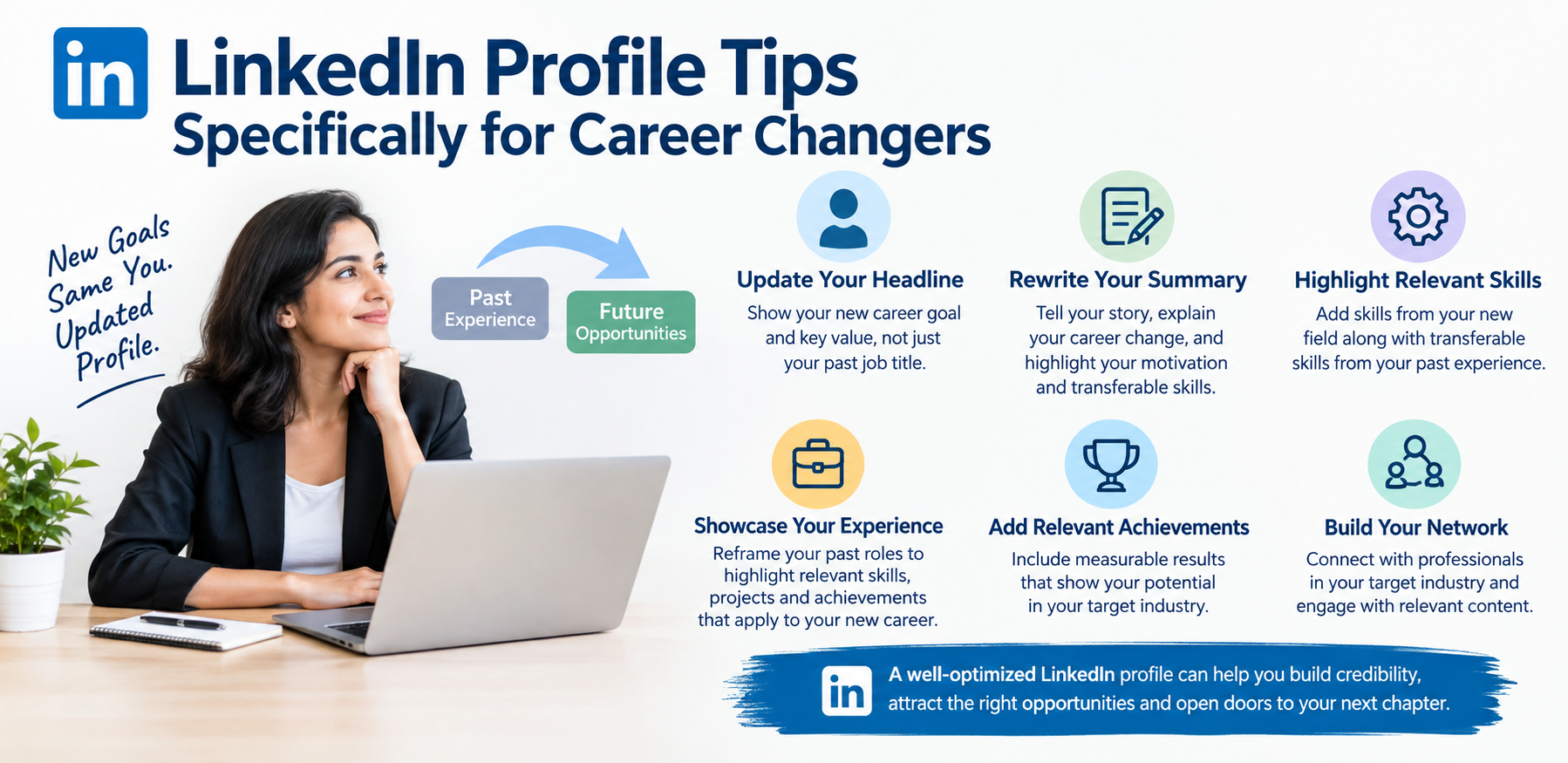
Introduction: LinkedIn Profile Tips
Changing careers can create a dilemma when presenting your professional image. You may feel that your previous job title does not reflect the type of work that you are interested in pursuing. Recruiters may raise questions regarding the reason for your career change. Therefore, your LinkedIn profile must be able to explain your career direction.
A good LinkedIn profile can help transition your previous experience into a new career path. You should not attempt to hide your previous work history. Instead, present your past qualifications as transferable skills to achieve your career goals.
LinkedIn Profile Tips Specifically for Career Changers
1. Update Your Headline
Your LinkedIn headline is the first thing that recruiters will see. Career changers often make the mistake of leaving their old headline. For example, if you used to work as an accountant, your headline may say something along the lines of “Accountant at XYZ Company” and will fail to communicate your professional direction.
Instead, you could write “Finance Professional | Aspiring Business Analyst | Data Analysis & Business Insights.”
Your headline should be able to communicate your skills and aspirations.
2. Rewrite Your About
The About section is a great opportunity to explain your career transition. You should not write an elaborate story that has nothing to do with the career that you want to pursue. However, you could write a brief paragraph regarding your professional background, skills that you have developed, and the type of work that you would like to achieve.
For example, if you want to transition from teaching to corporate training, you could explain that your experience has equipped you with communication, presentation, teaching, and people-management expertise.
3. Focus on Transferable Skills
Career changers often worry that their previous qualifications fail to meet the requirements of a new industry. In most cases, this is not true. In fact, you may possess a number of transferable skills that are valuable in your desired field. Communication, project management, problem-solving, research, customer service, management, data handling, collaboration, and time management are just a few examples of generic skills that are valued in a wide range of industries.
Identify transferable skills that match your career goals.
4. Change the Way You Describe Previous Jobs
Your old resume does not necessarily describe your new career aspirations. Similarly, you should rephrase your previous positions to highlight responsibilities and skills relevant to your career goals. For example, if you are a customer service rep trying to pivot to sales, you should not focus on the fact that you responded to customer requests or resolved client issues.
Instead, you could emphasize your understanding of the client needs, ability to solve problems, and how you could provide the right information to promote a product or service.
5. Add Relevant Skills
Your Skills section should be consistent with your career goals and updated accordingly. You should also remove irrelevant skills and add new ones. If you are changing to a digital marketing role, for example, you could add content marketing, SEO, social media marketing, email marketing, Google Analytics, and campaign management if you possess the required expertise.
Avoid adding dozens of unrelated skills just to increase the number of skills that you have.
6. Show Your Learning
If you are making a career change, recruiters will be interested in seeing that you have the necessary learning or experiences to make the transition successfully. You could do that by adding relevant courses, certifications, presentations, projects, and workshops that you have completed. You could also update your LinkedIn profile with your learning experiences by publishing articles, sharing ideas, and discussing your career change journey.
For example, you could publish a post about your data analytics certification and write a brief post about what you learned while building a spreadsheet in Excel or another analytics tool.
Conclusion: LinkedIn Profile Tips
In conclusion, career changers should use their LinkedIn profiles to clearly connect their past experience with their new career goals. By updating their headline, summary, skills, experience, and achievements, they can highlight transferable skills and present a clear professional direction. A well-optimized LinkedIn profile can help career changers build credibility, attract relevant opportunities, and connect with professionals in their target industry.
Ready to make your career change stand out? Apply these LinkedIn profile tips to showcase your transferable skills, highlight your experience, and attract the right opportunities. For additional career support, explore the Best Job Tool platform to discover job opportunities and take the next step in your professional journey.
Leave a Reply