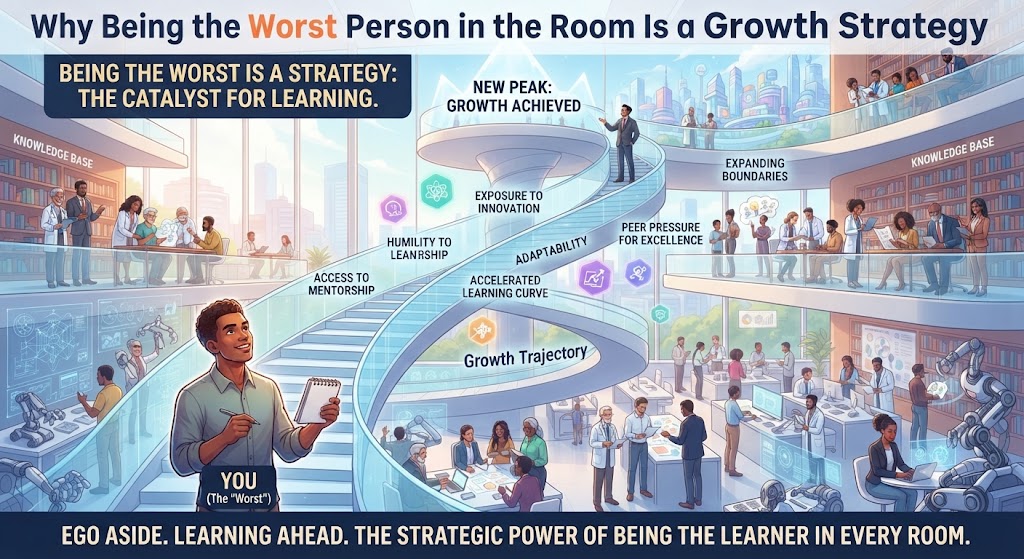
Career growth is often associated with being recognized as the most capable person on a team. However, consistently being the strongest person in the room can eventually limit learning. When professionals work only with people who have similar or lower levels of expertise, they may gain confidence but lose exposure to new ideas, advanced methods, and unfamiliar challenges.Person
Being the “worst person in the room” does not mean being unqualified or incapable. It means deliberately placing yourself in environments where other people have more experience, knowledge, or specialized skills than you do. These environments can create productive pressure to learn faster and think differently.
For professionals, this approach can influence career decisions, networking, mentorship, remote work, productivity, and long-term financial planning. The objective is not to compare yourself negatively with others. Instead, it is to use proximity to stronger professionals as a practical learning strategy.
1. Choose Environments That Stretch Your Current Skills
A comfortable workplace can become a professional comfort zone. If your responsibilities rarely require you to learn something new, your existing skills may remain useful while your development slows.
A growth-oriented environment should introduce challenges that are slightly beyond your current capabilities.
Look for opportunities where you can:
- Work with experienced professionals
- Participate in complex projects
- Learn unfamiliar tools
- Take responsibility for new processes
- Observe advanced decision-making
- Receive direct feedback
- Collaborate with specialists from other departments
The goal is not to enter an environment where you cannot contribute. Instead, find a setting where you can contribute while still having significant room to improve.
For example, a junior marketing professional working with experienced performance marketers may initially struggle to understand campaign attribution, customer acquisition costs, and conversion analysis. However, regular exposure to those discussions can accelerate learning.
The same principle applies across industries.
2. Learn by Observing How Experienced People Work
One of the fastest ways to develop professional judgment is to observe people who already have it.
Experienced professionals often make decisions based on patterns that beginners have not yet encountered. Watching how they approach problems can reveal processes that are difficult to learn from textbooks alone.
Pay attention to:
- How they prioritize tasks
- How they communicate difficult information
- How they prepare for meetings
- How they evaluate risks
- How they handle disagreements
- How they explain complex subjects
- How they respond when plans fail
Do not simply observe outcomes. Study the reasoning behind them.
After an important meeting, ask yourself:
What did this person notice that I missed?
That question can turn ordinary workplace interactions into learning opportunities.
3. Use Mentorship to Shorten the Learning Curve
Being around highly experienced people does not automatically produce growth. Professionals need to actively engage with their environment.
Mentorship can make this process more structured.
A useful mentor does not necessarily need to have the same job title or career path. What matters is relevant experience and a willingness to share practical knowledge.
When approaching a potential mentor, avoid vague questions such as “Can you teach me about your career?”
Instead, ask specific questions:
- How did you develop this particular skill?
- What mistakes did you make early in your career?
- Which skills became more valuable as you progressed?
- How would you approach this problem?
- What would you learn first if you were starting again?
- Which professional habits have had the greatest impact on your work?
Specific questions generally produce more actionable answers.
Professionals can also create informal mentorship through communities, industry events, professional groups, and online networks.
4. Turn Discomfort Into a Learning System
Being surrounded by highly skilled people can initially feel uncomfortable. You may discover gaps in your knowledge that were not obvious in your previous environment.
Instead of interpreting those gaps as evidence of failure, treat them as a learning map.
Create three categories:
Know:
Skills and concepts you can confidently apply.
Understand:
Topics you recognize but cannot yet apply independently.
Need to learn:
Skills or concepts that regularly appear in your target environment but remain unfamiliar.
This simple framework can turn uncertainty into a practical development plan.
For example, a professional moving toward data-driven marketing might discover that colleagues frequently discuss SQL, attribution models, dashboards, and customer lifetime value. Rather than attempting to master everything immediately, they can identify which skill has the greatest relevance to their current responsibilities and begin there.
The objective is consistent progress rather than instant expertise.
5. Find Stronger People Even When Working Remotely
Remote work can make professional learning more difficult because spontaneous workplace interactions happen less frequently.
However, remote professionals can deliberately create learning environments.
Consider:
- Joining industry communities
- Attending virtual conferences
- Participating in professional workshops
- Scheduling short knowledge-sharing calls
- Following specialists in your field
- Joining cross-functional projects
- Participating in online professional discussions
Remote work can also expand access to professionals outside your geographic area. A person working from India, for example, may collaborate with colleagues in the United States, United Kingdom, Germany, Canada, or other markets.
This creates exposure to different work cultures, communication styles, technologies, and business practices.
Travel can also be used as a professional learning experiment. If your role allows location flexibility, spending a short period working from another city or country can expose you to different professional communities and working environments.
Before doing so, test practical factors such as:
- Internet reliability
- Time-zone differences
- Workspace quality
- Meeting schedules
- Travel costs
- Employer policies
- Productivity levels
A short travel test can reveal whether a location genuinely supports your working style before you commit to a longer stay.
6. Measure Growth Through Capability, Not Comparison
Being surrounded by exceptional professionals can create an unhealthy habit of comparing yourself with others.
That is not the purpose of this strategy.
The objective is to compare your current capabilities with your previous capabilities.
Track measurable progress such as:
- Projects you can now manage independently
- Skills you have developed
- Problems you can solve faster
- Responsibilities you have taken on
- Feedback you have acted upon
- Professional certifications completed
- Business results you have contributed to
For example, instead of thinking, “My colleague is much better at presentations,” identify the specific capability gap.
Perhaps your colleague structures presentations more clearly, explains data more effectively, or handles questions better.
Those are learnable skills.
Breaking a broad comparison into specific behaviors makes professional development much more practical.
7. Connect Professional Growth With Long-Term Career and Financial Goals
Learning from stronger professionals becomes more valuable when it connects to a clear career direction.
Before investing significant time in a new skill, ask:
Where could this capability take me in three to five years?
A skill may help you qualify for higher-responsibility roles, transition into another function, work with international companies, or develop an additional income stream.
Career planning should also include financial planning.
Consider:
- Expected salary progression
- Cost of training or certifications
- Potential return on education
- Emergency savings
- Relocation expenses
- Travel costs
- Freelance or consulting opportunities
- Long-term career demand
Professionals can also use a global job platform such as a best job tool to research what employers are actually requesting for their target positions.
Reviewing job descriptions can help identify recurring skills, qualifications, technologies, and experience requirements. This creates a practical connection between learning today and employment opportunities later.
Conclusion
Being the “worst person in the room” can be a useful growth strategy when it means deliberately surrounding yourself with people who challenge your current level of knowledge.
The value comes from exposure. You see better processes, encounter unfamiliar problems, receive stronger feedback, and discover skills that you may not have realized were important.
However, professional growth should not be based on constant comparison. The purpose is to identify capability gaps and systematically close them.
Start by finding environments that stretch your skills. Observe experienced professionals, ask specific questions, seek mentorship, and document what you learn. If you work remotely, create additional opportunities for collaboration and professional interaction. At the same time, connect your learning priorities to realistic career and financial goals.
A strong career is rarely built by knowing everything already. It is built by repeatedly entering environments where there is something valuable left to learn.
A best job tool, as a global job platform, can also help professionals explore roles and identify the skills employers are seeking across different markets. This can turn career development from a vague ambition into a more structured process based on real opportunities.




Leave a Reply