
Industry experience can become more than a line on your resume. It can become a structured learning product that helps other professionals build skills while creating an additional source of income for you. If you have spent years solving problems, managing projects, working with clients, analyzing data, leading teams, or developing specialized knowledge, you may already have the foundation for an online course.
Creating a course does not mean you need to become a full-time content creator. Instead, you can turn knowledge gained through real work into practical lessons, frameworks, examples, and exercises. This approach can also strengthen your professional reputation and create opportunities beyond traditional employment.
For professionals exploring new career options, an online course can complement a job search, consulting work, freelancing, or remote career. A global job platform such as best job tool can help professionals discover opportunities while they build independent income streams around their expertise.
The key is to avoid trying to teach everything you know. A successful course solves a specific problem for a specific audience. Therefore, the process should begin with identifying valuable knowledge and turning it into a clear learning experience.
Identify the Knowledge People Actually Need
The first step is to examine your industry experience and identify knowledge that other people struggle to learn.
You may know how to perform certain tasks because you have done them repeatedly at work. However, beginners or professionals entering a new role may not understand the process. That gap can become the foundation of an online course.
Start by listing areas where colleagues frequently ask for your help.
Consider:
- Processes you can explain clearly
- Problems you have solved repeatedly
- Industry tools you use confidently
- Skills that took years to develop
- Mistakes you learned to avoid
- Workflows that improved your productivity
- Technical or professional concepts that confuse beginners
- Career skills that are rarely explained practically
For example, an experienced recruiter could create a course about structured interviewing. A financial analyst could teach financial modeling fundamentals. A project manager could teach professionals how to manage cross-functional projects.
The strongest course ideas usually come from real problems rather than broad subjects.
Instead of teaching “Marketing,” consider “How to Build a B2B Content Strategy for a Small Business.”
Instead of “Project Management,” consider “How to Build a Practical Project Plan for Cross-Functional Teams.”
This narrower approach makes the course easier to position and easier for potential learners to understand.
Choose a Specific Audience and Outcome
Once you identify your expertise, decide who should learn it.
A course becomes more useful when the target audience is specific. Your audience could include recent graduates, career changers, junior professionals, managers, freelancers, entrepreneurs, or experienced workers moving into a new specialization.
Ask yourself three questions:
- Who has this problem?
- What do they currently struggle with?
- What should they be able to do after completing the course?
The third question is especially important.
People generally do not purchase information simply because it exists. They invest in a learning experience because they want a result.
For example, a course could help a learner:
- Build their first professional portfolio
- Create a marketing plan
- Analyze business data
- Prepare for a specific type of interview
- Use an industry software tool
- Develop a professional workflow
- Create a project proposal
- Understand a complicated industry process
Therefore, define your course around an outcome rather than a collection of information.
A clear outcome also helps you decide what to remove. If a topic does not contribute to the promised result, it may not belong in the course.
Turn Your Experience Into a Course Framework
Your industry knowledge may feel obvious to you because you use it every day. However, learners need a structured path.
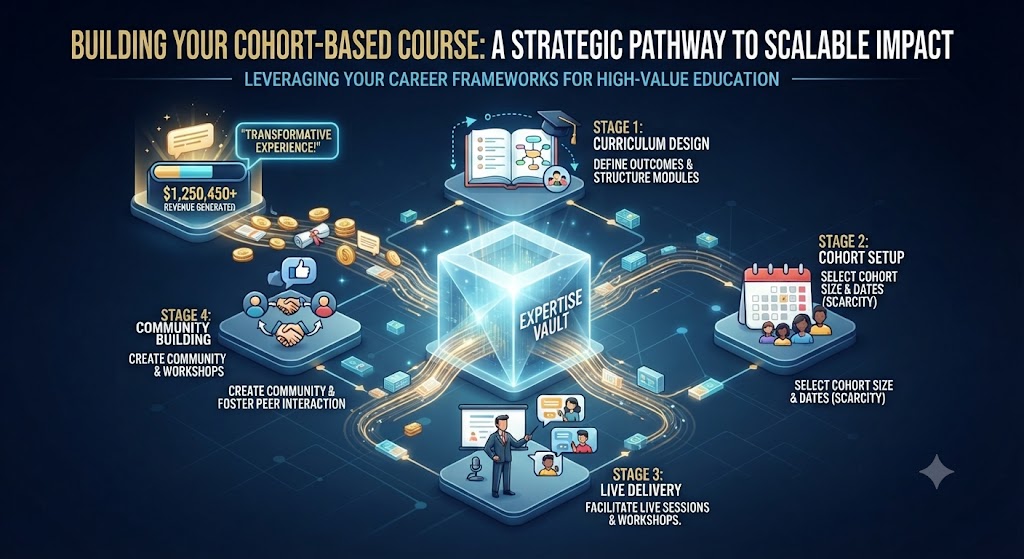
Start by dividing your knowledge into several logical stages.
A simple framework could include:
- Introduction to the problem
- Essential concepts
- Tools and processes
- Practical demonstration
- Common mistakes
- Real-world application
- Final project or assessment
For instance, an experienced sales professional creating a course for new B2B sales representatives could structure the program around prospecting, qualification, discovery calls, proposals, objections, follow-ups, and account management.
Do not simply record yourself talking about these subjects. Instead, design each lesson around a specific learning objective.
A useful lesson should answer:
“What will the learner be able to do after completing this lesson?”
This approach makes your course more practical and improves the learner experience.
You can also include worksheets, templates, checklists, case studies, quizzes, and assignments. These resources transform passive information into practical learning.
Use Real Industry Examples Without Sharing Confidential Information
Your professional experience can make your course much more valuable because you can explain how concepts work in real situations.
However, you should protect confidential information.
Never include private customer information, internal company documents, proprietary processes, passwords, confidential financial information, or sensitive business data.
Instead, anonymize examples or create fictional scenarios based on common industry situations.
For example, instead of showing a confidential client presentation, create a sample presentation that demonstrates the same principle.
You can also explain:
- What went wrong in a typical situation
- How professionals identify the problem
- Which options they consider
- How they evaluate those options
- What a successful process looks like
- What mistakes beginners commonly make
This makes your course practical without exposing information that should remain private.
Furthermore, real-world examples can help differentiate your course from generic educational content. Your professional experience becomes part of the value proposition.
Design a Production Process That Fits Your Career
Creating an online course while working full-time can become overwhelming if you try to produce everything at once.
Instead, build the course gradually.
For example, dedicate a few hours each week to course development. You could use one session for research, another for writing lessons, and another for recording.
A simple production workflow could look like this:
- Week 1: Define the audience and course outcome
- Week 2: Create the course outline
- Week 3: Write lesson scripts and exercises
- Week 4: Record the first modules
- Week 5: Edit and organize the materials
- Week 6: Test the course with a small group
- Week 7: Improve weak sections
- Week 8: Launch the course
You do not need expensive equipment to begin. A reliable microphone, clear presentation slides, good lighting, and organized teaching materials can be enough for an initial version.
If you work remotely, you can also record lessons from your existing workspace. However, test your setup before recording the entire course.
This is where travel testing can be useful. If you expect to work while traveling, test your microphone, internet connection, backup connectivity, workspace, and recording environment before relying on them.
That small test can prevent technical problems later.
Use the Course to Strengthen Your Professional Brand
An online course can become more than an educational product. It can demonstrate your expertise.
Publishing useful lessons can help you create professional content for LinkedIn, industry communities, newsletters, and other channels.
For example, a professional teaching project management could publish short posts about project planning mistakes. A data analyst could share practical data interpretation tips. A recruiter could explain common interview preparation mistakes.
These smaller pieces of content can introduce people to your expertise and direct interested learners toward the full course.
Your course can also become part of your professional portfolio.
It demonstrates that you can:
- Explain complex concepts clearly
- Organize information
- Communicate with different audiences
- Create educational resources
- Apply industry knowledge
- Build a professional product
- Work independently
This can be especially valuable when transitioning into consulting, training, freelancing, or other knowledge-based careers.
At the same time, continue developing your core career. A global job platform such as best job tool can help you explore remote, hybrid, and onsite opportunities while your course develops alongside your professional work.
Plan the Financial and Long-Term Strategy
An online course should not automatically be treated as immediate passive income.
Building an audience, creating useful content, improving the course, and attracting learners can take time. Therefore, financial planning should be part of the process.
Avoid depending on course revenue before it becomes consistent.
Instead:
- Maintain an emergency fund
- Track course-related expenses
- Set a realistic production budget
- Separate business and personal finances
- Monitor revenue and marketing costs
- Reinvest selectively
- Review results regularly
You should also decide what role the course will play in your career.
It could become:
- A small additional income stream
- A lead generator for consulting
- A professional portfolio project
- A foundation for workshops
- A training product for companies
- A pathway into coaching or education
- A long-term independent business
Your first course does not need to become a major business immediately. It can begin as a controlled experiment.
After launch, collect feedback from learners. Look for repeated questions, incomplete assignments, confusing lessons, and topics learners want explained differently.
Then update the course based on evidence.
Over time, one course can become an ecosystem of related resources, workshops, templates, newsletters, and professional services.
Turn Expertise Into a Sustainable Career Asset
Industry knowledge becomes more valuable when you can communicate and package it effectively.
An online course allows professionals to transform experience into something that can be taught, shared, improved, and potentially monetized. More importantly, the process forces you to organize what you know.
Start with one specific problem. Identify the audience that experiences it. Build a clear learning outcome. Organize your knowledge into practical lessons, add real-world examples, and test the course before expanding it.
At the same time, protect your financial stability and continue developing your primary career. Your course can grow alongside employment, freelancing, consulting, or a job search rather than replacing those activities immediately.
The best job tool approach to career development is not limited to finding a position. Professionals can also build skills, develop expertise, and create new opportunities around what they already know.
Ultimately, your industry experience can become a long-term career asset when you stop treating knowledge as something that only belongs inside your current job. With the right structure, that knowledge can become a course that teaches others, strengthens your professional reputation, and creates additional career possibilities.




Leave a Reply