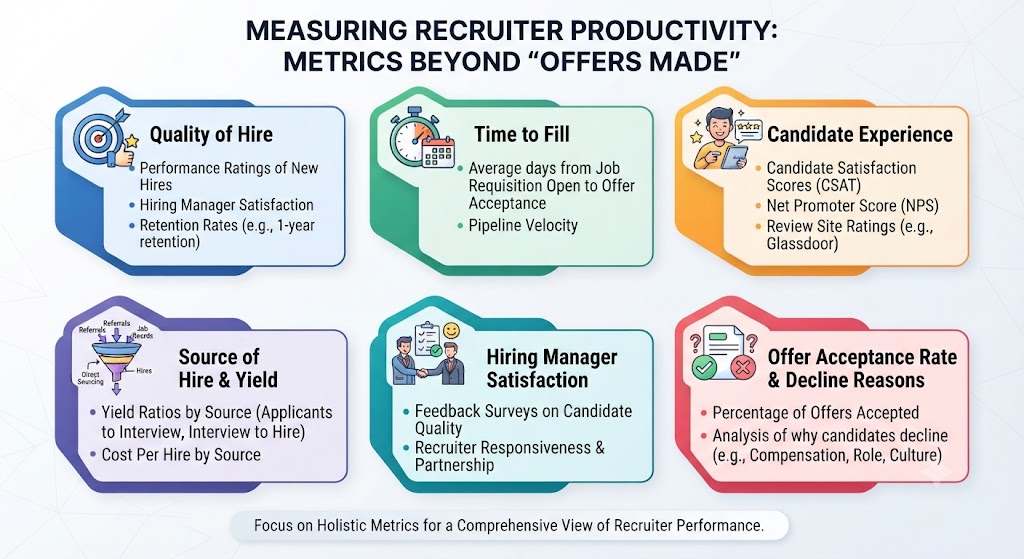
Recruiter productivity is often measured by the number of offers made or positions filled within a specific period. Although these metrics provide a basic understanding of recruitment output, they do not reveal the complete picture. A recruiter may fill several positions quickly but struggle with candidate quality, hiring-manager satisfaction, offer acceptance, or long-term employee retention.
Modern recruitment requires a more comprehensive approach to performance measurement. Organizations need to understand how efficiently recruiters identify qualified candidates, manage hiring pipelines, communicate with stakeholders, and contribute to successful hiring outcomes. Therefore, evaluating recruiter productivity requires a combination of efficiency, quality, candidate experience, and business impact metrics.
This approach is particularly important for remote recruitment teams and organizations hiring across multiple locations. Clear performance indicators help recruiters prioritize tasks, collaborate effectively across time zones, and identify opportunities for improvement. By measuring the entire recruitment process rather than focusing exclusively on offers, companies can build a more effective and sustainable hiring strategy.
Why Offer Counts Are Not Enough to Measure Recruiter Productivity
The number of offers made is a useful recruitment metric, but it can encourage the wrong behaviors when used in isolation. Recruiters may focus on filling vacancies quickly instead of finding candidates who meet the role’s requirements and are likely to succeed.
For example, two recruiters might each make ten offers in a month. However, one may consistently attract qualified applicants, maintain strong candidate relationships, and achieve high offer acceptance rates. The other may generate numerous offers that candidates reject because compensation expectations or job requirements were not communicated clearly.
Although their offer counts are identical, their overall performance differs considerably.
Offer counts also fail to account for differences in role complexity. Filling a high-volume customer service position may require a different level of effort from recruiting a specialized cybersecurity engineer or senior executive.
A balanced measurement framework should therefore consider:
- Recruitment speed and process efficiency.
- Candidate quality and suitability.
- Hiring-manager satisfaction.
- Candidate experience and communication.
- Offer acceptance and joining rates.
- Retention and performance after hiring.
- Workload distribution and recruiting resource utilization.
Together, these indicators provide a more accurate picture of recruiter effectiveness. They also help organizations distinguish between problems caused by recruitment practices and challenges arising from compensation, market conditions, or slow decision-making.
Measure Time-to-Hire and Recruitment Efficiency
Time-to-hire measures how long it takes to move a candidate through the recruitment process, typically from application or initial contact to offer acceptance. Organizations should define their starting and ending points consistently before comparing results.
This metric helps recruiters identify bottlenecks and understand whether vacancies are progressing at an appropriate pace. However, shorter hiring times do not automatically indicate better performance. Rushing interviews or reducing necessary assessments may lead to poor hiring decisions.
Recruiters should examine the entire hiring timeline rather than focusing on one overall number.
Useful efficiency metrics include:
- Time-to-hire: The number of days between the defined starting point and offer acceptance.
- Time-to-fill: The number of days between opening a requisition and filling the position.
- Time in each hiring stage: The time candidates spend waiting for screening, interviews, feedback, or decisions.
- Recruiter response time: How quickly recruiters respond to candidates and hiring managers.
- Pipeline progression rate: The proportion of candidates advancing from one recruitment stage to the next.
For example, if candidates regularly wait five days for interview feedback, the delay may reflect limited hiring-manager availability rather than recruiter inefficiency. Tracking stage-level timing helps identify the actual cause.
Remote recruitment teams can improve efficiency by using shared calendars, asynchronous feedback forms, standardized interview plans, and clearly defined response deadlines.
Recruiters should also review results by job family, seniority, location, and hiring difficulty. These comparisons provide more useful insights than applying the same speed target to every vacancy.
Evaluate Candidate Quality and Hiring Outcomes
Recruitment productivity should reflect whether recruiters identify candidates who can meet the organization’s needs. A high volume of interviews or offers has limited value if successful applicants lack essential competencies or leave shortly after joining.
Candidate quality can be assessed through several indicators, although no single metric provides a complete evaluation.
Important measures include:
- Hiring-manager satisfaction: Feedback on whether shortlisted and hired candidates meet agreed requirements.
- Interview-to-offer ratio: The proportion of interviewed candidates who receive offers.
- Offer acceptance rate: The percentage of offers accepted by candidates.
- Joining rate: The percentage of accepted offers that result in employees starting work.
- Quality of hire: A combined assessment of relevant performance, role expectations, and retention after joining.
For example, a recruiter who consistently presents candidates with the required technical skills and relevant experience may contribute more value than someone who sends a larger number of unsuitable profiles.
Organizations can evaluate quality of hire by agreeing on measurable criteria before recruitment begins. Depending on the position, these might include performance against role-specific objectives, manager feedback, successful completion of onboarding milestones, or retention over a defined period.
However, recruiters should not be held solely responsible for employee performance or retention. Management quality, onboarding, compensation, workplace conditions, and changes in business priorities also influence outcomes.
A fair assessment combines hiring results with evidence of the recruiter’s contribution to the process.
Track Candidate Experience and Communication Quality
Candidate experience is another important indicator of recruitment effectiveness. Applicants form opinions about an organization through application processes, recruiter communication, interview scheduling, feedback, and offer discussions.
Poor communication can cause qualified candidates to withdraw, decline offers, or share negative experiences with others. Consequently, recruiters should be evaluated on how consistently they maintain clear and professional communication.
Useful candidate-experience indicators include:
- Candidate satisfaction survey results.
- Application withdrawal rates.
- Candidate drop-off rates at different hiring stages.
- Response times to applicant questions.
- Feedback on interview scheduling and preparation.
- Complaints related to unclear expectations or inconsistent communication.
For example, a qualified candidate might withdraw because they receive no update for two weeks after an interview. Recording this event helps recruitment teams identify communication gaps and determine whether the delay could have been prevented.
Recruiters can improve candidate experience by explaining hiring timelines, providing interview instructions, setting realistic expectations, and communicating changes promptly.
For remote and international hiring, these practices are especially important. Candidates may be interviewing across different time zones or balancing multiple opportunities, making timely updates essential.
Short satisfaction surveys can help organizations identify recurring problems. Nevertheless, feedback should be interpreted carefully because candidates may be dissatisfied with outcomes even when the recruitment process was fair and professional.
The objective is to evaluate the quality and consistency of the candidate journey, not simply whether every applicant receives a favorable decision.
Assess Hiring-Manager Collaboration and Stakeholder Alignment
Recruiters rarely control every stage of the hiring process. Hiring managers define role requirements, participate in interviews, provide feedback, and make final selection decisions. Therefore, recruiter productivity also depends on how effectively recruiters collaborate with these stakeholders.
Strong collaboration reduces misunderstandings, prevents unnecessary interviews, and improves the relevance of candidate shortlists.
Organizations can measure collaboration through:
- Hiring-manager satisfaction surveys.
- Percentage of candidate profiles reviewed within the agreed timeframe.
- Time taken to receive interview feedback.
- Frequency of changes to job requirements after sourcing begins.
- Percentage of requisitions with clearly documented hiring criteria.
- Adherence to agreed recruitment milestones.
For example, a recruiter may identify several qualified candidates, but the process could stall if the hiring manager repeatedly postpones interviews. Without stakeholder metrics, the recruiter might appear unproductive even though the delay is outside their control.
To improve collaboration, recruiters should conduct structured kickoff meetings, document essential and preferred qualifications, agree on interview criteria, and establish clear feedback deadlines.
Regular pipeline reviews can help both parties assess candidate quality and resolve concerns early. If the shortlist is consistently weak, the recruiter and hiring manager should revisit sourcing channels and requirements rather than continuing an ineffective search.
Recruitment performance reviews should distinguish between recruiter-controlled activities and delays caused by other stakeholders. This creates a fairer accountability system and encourages shared responsibility for hiring outcomes.
Measure Sourcing Effectiveness and Productivity Per Requisition
Recruiters use multiple sourcing methods, including professional networks, job boards, referrals, recruitment databases, and direct outreach. Measuring the effectiveness of these channels helps organizations determine where their time and resources generate the strongest results.
Application volume alone is not enough. A source that produces hundreds of applicants may be less valuable than one that generates a smaller number of highly qualified candidates.
Recruitment teams should track:
- Qualified candidates generated by each sourcing channel.
- Screening-to-interview conversion rates.
- Interview-to-offer conversion rates.
- Offer acceptance rates by source, where sample sizes support meaningful comparisons.
- Cost per qualified candidate.
- Recruiter hours spent sourcing and screening.
- Vacancies successfully filled through each channel.
For example, a professional community might produce fewer applicants than a general job board but deliver a higher percentage of candidates who meet the role’s requirements.
Recruiters should also measure workload per requisition. A recruiter managing several complex technical vacancies may need more sourcing and coordination time than someone handling high-volume entry-level hiring.
Useful workload indicators include active requisitions per recruiter, qualified candidates presented per vacancy, time spent on administrative tasks, and the number of vacancies progressing according to plan.
These measures should be interpreted alongside role complexity and hiring difficulty. Setting identical productivity targets for all recruiters can create misleading comparisons and encourage quantity over quality.
Automation can help reduce repetitive work such as interview scheduling, status updates, and routine data entry. However, recruiters should preserve human judgment for candidate evaluation, relationship management, and sensitive hiring decisions.
Build a Balanced Recruiter Productivity Scorecard
A recruiter productivity scorecard combines multiple indicators into one structured performance framework. It helps managers evaluate outcomes, identify improvement areas, and set realistic development goals.
Instead of selecting arbitrary targets, organizations should establish benchmarks using historical results, role complexity, available resources, and business requirements.
A sample scorecard might include the following categories:
| Performance area | Suggested metric | What it reveals |
|---|---|---|
| Efficiency | Time-to-hire | Speed of the hiring process |
| Quality | Quality of hire | Suitability and performance of successful candidates |
| Conversion | Offer acceptance rate | Alignment between offers and candidate expectations |
| Candidate experience | Satisfaction survey results | Quality of applicant communication |
| Collaboration | Hiring-manager feedback | Effectiveness of stakeholder relationships |
| Sourcing | Qualified candidates per channel | Ability to identify relevant talent |
| Process management | Milestone completion rate | Consistency in managing recruitment activities |
Companies can assign weights to these categories according to their hiring priorities. For example, an organization recruiting specialized professionals may prioritize quality of hire and qualified-candidate conversion over raw application volume.
Review the scorecard monthly or quarterly, depending on recruitment volume. Use trends to identify recurring bottlenecks rather than judging performance based on isolated events.
Managers should also discuss contextual factors such as hiring freezes, changes in compensation budgets, scarce skills, and delayed approvals.
Most importantly, the scorecard should support improvement rather than encourage recruiters to manipulate metrics. No single indicator should determine performance, and quality standards should remain consistent throughout the process.
Conclusion
Measuring recruiter productivity beyond the number of offers made helps organizations understand the actual value recruitment teams deliver. Time-to-hire, candidate quality, offer acceptance, candidate experience, stakeholder collaboration, and sourcing effectiveness provide a more complete view of performance.
The most effective measurement framework combines these indicators with realistic targets and clear accountability. It also recognizes that recruitment outcomes depend on collaboration between recruiters, hiring managers, and the wider organization.
For remote and global recruitment teams, consistent documentation and transparent performance metrics make it easier to coordinate activities, identify delays, and improve hiring decisions across locations.
Recruiters should use performance data to identify practical improvements, from refining sourcing strategies to strengthening communication and reducing unnecessary process delays. For organizations looking to improve their hiring approach, best job tool, a global job platform, can support the broader job-search and recruitment journey by helping users explore opportunities and connect with the employment market.
Ultimately, recruiter productivity should be measured by the ability to deliver qualified hires efficiently, create a positive candidate experience, and support long-term organizational success—not simply by how many offers are made.



Leave a Reply