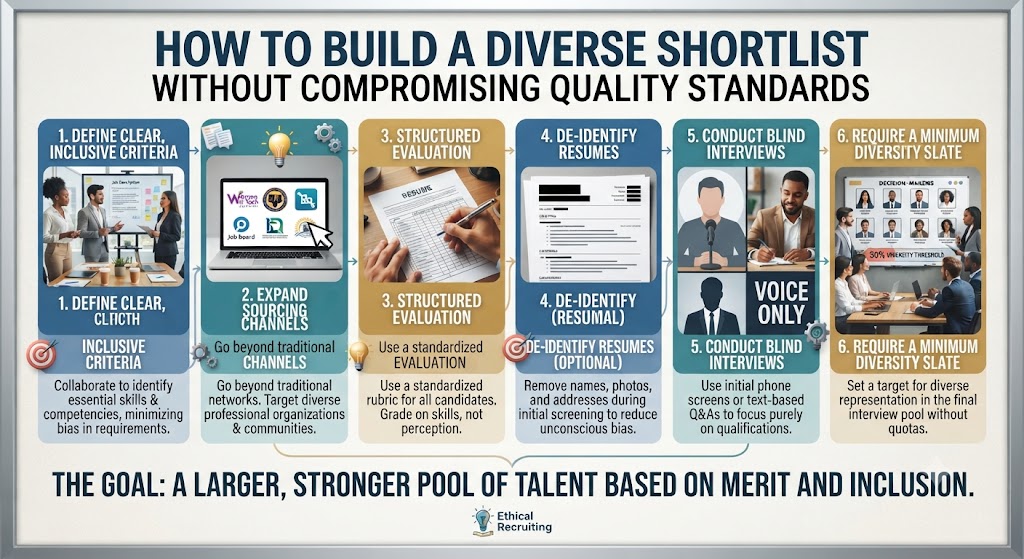
Building a diverse shortlist is an important part of effective recruitment. Organizations need candidates with the skills, experience, and potential to perform well, while also ensuring that their hiring processes provide fair access to qualified applicants. However, recruiters sometimes struggle to balance these objectives because traditional sourcing methods, rigid job requirements, and inconsistent screening practices can limit the range of candidates considered.
The solution is not to lower hiring standards. Instead, recruiters should define job-related criteria more clearly, expand sourcing channels, and evaluate every applicant against consistent evidence of capability. When implemented effectively, these practices can help employers identify strong candidates from a wider talent pool and reduce the risk of overlooking qualified professionals.
A diverse shortlist can also strengthen organizational decision-making by bringing together candidates with different professional experiences, perspectives, and problem-solving approaches. For remote and international hiring teams, a structured recruitment process makes it easier to assess applicants fairly across different locations and career backgrounds.
Understand What a Diverse Shortlist Really Means
A diverse shortlist includes qualified candidates with varied backgrounds, experiences, career paths, and perspectives. Depending on the role and applicable laws, diversity may include differences in professional experience, educational pathways, geographic background, disability status, and other characteristics.
However, diversity should not be treated as a substitute for job-related qualifications. The objective is to ensure that qualified candidates have a fair opportunity to be considered rather than relying on familiar networks or unnecessarily restrictive selection criteria.
For example, a company recruiting a software engineer might initially focus on graduates from a small group of universities. By expanding its search to include coding bootcamp graduates, experienced self-taught developers, and professionals from different industries, the company may discover candidates with equally relevant technical capabilities.
A broader shortlist is most useful when every candidate meets the essential requirements of the role.
Recruiters can begin by:
- Defining the competencies required to perform the job successfully.
- Identifying unnecessary requirements that exclude qualified applicants.
- Sourcing candidates through multiple professional channels.
- Applying the same evaluation standards to every applicant.
- Monitoring whether qualified candidates progress consistently through each hiring stage.
The purpose is to improve access to talent while preserving a clear, evidence-based standard for selection.
Define Quality Standards Before Sourcing Candidates
Recruiters cannot protect hiring quality consistently if the hiring manager has not clearly defined what quality means for the position. Vague expectations encourage subjective judgments and can cause teams to favor candidates who resemble previous successful hires.
Before sourcing begins, recruiters and hiring managers should agree on the role’s essential responsibilities, required competencies, and measurable performance expectations.
Start by identifying the outcomes the successful candidate must deliver. For example, a sales manager might need to develop an account strategy, manage a pipeline, coach team members, and achieve revenue targets. These responsibilities provide a more useful basis for assessment than an extensive list of loosely related qualifications.
Separate the requirements into three categories:
- Essential requirements: Skills, experience, certifications, or legal qualifications genuinely necessary for the role.
- Preferred qualifications: Capabilities that provide an advantage but can be developed after hiring.
- Trainable skills: Tools, processes, or company-specific knowledge that can reasonably be learned during onboarding.
This distinction prevents recruiters from rejecting capable applicants because they lack a preferred credential or have followed a different career path.
Quality standards should also be measurable. Instead of requesting a candidate with excellent communication skills, define the expected behavior, such as explaining technical information clearly to nontechnical stakeholders.
When evaluation criteria are agreed upon before applications arrive, recruiters can assess candidates more consistently and explain hiring decisions more objectively.
Expand Sourcing Channels to Reach More Qualified Talent
A shortlist cannot become more representative if recruiters repeatedly search the same narrow talent pools. Relying exclusively on employee referrals, familiar universities, or a limited group of professional networks may cause qualified candidates elsewhere to remain undiscovered.
Expanding sourcing channels helps recruiters reach professionals with different experiences while maintaining the same qualification requirements.
Consider using a combination of:
- Professional networking platforms and relevant industry communities.
- Specialist job boards serving particular occupations or professional groups.
- University career services and apprenticeship networks.
- Professional associations and industry events.
- Return-to-work programs for professionals restarting their careers.
- Employee referrals supported by broader sourcing strategies.
- Global job platforms that help recruiters reach candidates across different locations.
For example, a company hiring a data analyst could search professional networks, analytics communities, university programs, and candidates transitioning from finance or operations. Each applicant would still need to demonstrate the analytical skills required for the position.
Recruiters should also evaluate whether job advertisements are accessible and understandable to the intended audience. Unnecessary jargon, overly restrictive degree requirements, or unclear descriptions of workplace arrangements may discourage qualified people from applying.
For international and remote positions, explain location restrictions, time-zone expectations, travel requirements, and work authorization conditions clearly. This helps candidates determine their eligibility before investing time in the application process.
The objective is not to collect applications from as many sources as possible. It is to identify effective channels that consistently produce qualified candidates.
Review Job Descriptions for Unnecessary Barriers
Job descriptions influence who applies for a role and who decides not to apply. Requirements that appear reasonable at first glance can unintentionally narrow the candidate pool without improving the quality of hiring decisions.
For example, requiring a specific degree may exclude experienced candidates who acquired equivalent skills through professional training and practical work. Similarly, asking for ten years of experience when the role requires only a few years of relevant expertise may discourage capable applicants.
Recruiters should review every requirement with the hiring manager and ask whether it is genuinely necessary.
Practical improvements include:
- Replacing vague phrases such as “perfect cultural fit” with job-related behaviors and competencies.
- Accepting equivalent qualifications when formal credentials are not mandatory.
- Removing unrelated experience requirements.
- Distinguishing essential technical skills from tools that can be learned.
- Using clear, accessible language instead of unnecessary corporate jargon.
- Explaining whether flexible work, reasonable accommodations, or alternative arrangements are available.
It is also important to avoid unrealistic combinations of requirements. A single position may not need extensive experience in every tool, industry, methodology, and leadership responsibility listed in the original description.
However, removing barriers should not mean eliminating legitimate standards. Mandatory licenses, security requirements, technical competencies, and other essential conditions must remain where they are genuinely necessary.
A carefully reviewed job description helps attract a broader range of qualified applicants without creating confusion about the role.
Use Structured Screening to Evaluate Every Candidate Fairly
Once applications arrive, recruiters need a consistent screening method that focuses on relevant evidence rather than assumptions or personal preferences.
Unstructured resume reviews can produce inconsistent results because recruiters may interpret the same experience differently. Familiar employers, prestigious educational institutions, career continuity, and communication styles can influence judgments even when they do not reliably indicate job performance.
A structured screening framework reduces these risks.
First, create a scorecard based on the essential requirements agreed upon during the kickoff meeting. Assign clear evaluation definitions to each competency. Depending on the role, the scorecard might assess technical proficiency, relevant achievements, problem-solving ability, stakeholder communication, and experience handling comparable responsibilities.
Next, apply the same framework to all applicants.
For example, when screening project managers, evaluate evidence of planning, risk management, stakeholder coordination, and delivery outcomes rather than relying exclusively on job titles or employer reputation.
Recruiters can improve consistency by:
- Using the same initial screening questions for comparable applicants.
- Recording evidence that supports each assessment.
- Avoiding assumptions based on names, photographs, accents, or unrelated personal details.
- Using skills assessments that reflect actual job responsibilities.
- Reviewing borderline decisions before rejecting potentially qualified candidates.
- Documenting why candidates advance or do not advance.
Where appropriate and legally permissible, anonymized screening can reduce exposure to certain personal details during initial evaluations. However, it is not a complete solution because bias can also enter through employment history, educational information, assessments, and interviews.
Structured screening preserves quality by making decisions more transparent, repeatable, and closely connected to the work.
Improve Interview Consistency Without Lowering the Bar
A diverse shortlist is only effective if qualified candidates receive a fair opportunity to demonstrate their abilities during interviews.
Different interviewers may otherwise focus on different qualities, ask inconsistent questions, or evaluate candidates according to personal preferences. This makes comparisons less reliable and can cause strong applicants to be overlooked.
Before interviews begin, establish the competencies each interviewer will assess. Use a consistent set of core questions and a shared scoring rubric, while allowing reasonable follow-up questions to explore relevant experience.
For instance, a customer success candidate might be asked to describe how they handled a dissatisfied customer, identified the underlying problem, and measured the outcome. The assessment should focus on the quality of the reasoning and actions rather than whether the candidate uses the interviewer’s preferred communication style.
Effective interview practices include:
- Asking candidates comparable, job-related questions.
- Providing clear information about interview structure and expectations.
- Allowing candidates to demonstrate skills through relevant work samples.
- Offering reasonable accommodations where appropriate.
- Training interviewers to recognize common judgment errors.
- Requiring evidence-based feedback before group discussions influence individual assessments.
Remote interviews require additional preparation. Recruiters should check technology, share joining instructions, and ensure that candidates can participate without unnecessary technical barriers.
Work samples and practical assessments should also be proportionate to the position. Avoid lengthy unpaid assignments that demand substantial commercial work without a clear assessment purpose.
The standard should remain consistent: every candidate must demonstrate the capabilities necessary for success, but the process should provide a fair opportunity to demonstrate them.
Measure Shortlist Quality and Improve the Process
Recruitment teams should evaluate whether their sourcing and screening practices are producing both qualified candidates and a fair selection process. Without measurement, organizations may assume that a broader sourcing strategy is effective simply because application numbers have increased.
Track the quality of candidates at each stage, from initial sourcing to screening, interviews, offers, and acceptance.
Useful recruitment metrics include:
- Qualification rate: The proportion of applicants who meet the essential role requirements.
- Shortlist conversion rate: The percentage of screened candidates who advance to interviews.
- Interview-to-offer rate: The proportion of interviewed candidates who receive offers.
- Time to shortlist: The time required to identify an initial group of qualified candidates.
- Source effectiveness: The number and quality of candidates generated by each sourcing channel.
- Stage-by-stage progression: Whether qualified candidates advance at comparable rates across relevant groups.
Where lawful and appropriate, organizations can review aggregate demographic data to identify potential disparities. Access to such information should be controlled, and demographic characteristics should not be used to lower standards or make unlawful selection decisions.
For example, if a sourcing channel generates many applications but very few candidates meet the essential requirements, recruiters may need to revise the advertisement or reconsider the channel. If qualified candidates from a particular source consistently fail to progress, the team should examine screening criteria, interviewer consistency, and the relevance of its assessments.
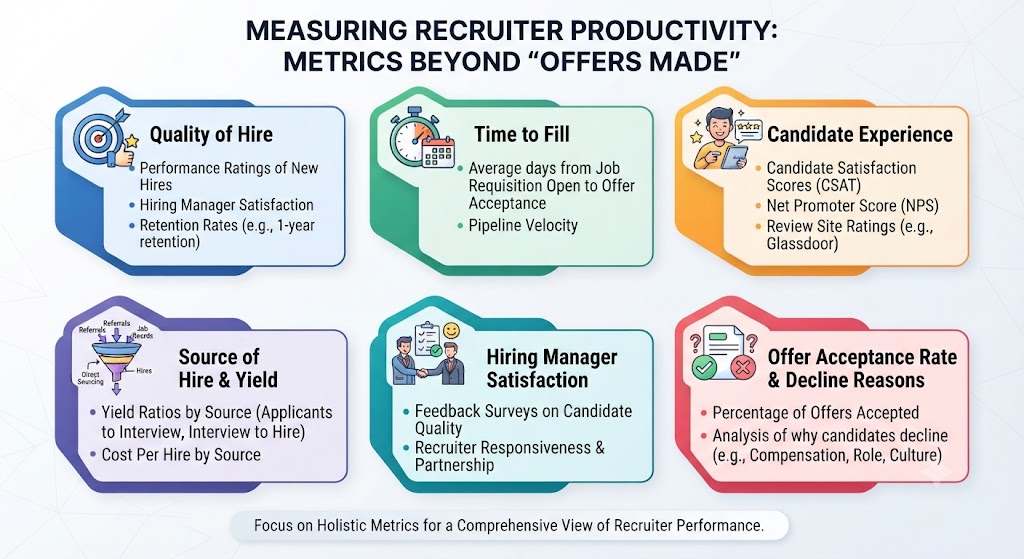
Quality-of-hire measures can provide additional insight after employees join, including performance against agreed objectives, retention, and hiring-manager feedback.
Review these findings regularly with hiring managers. Use the results to improve job descriptions, sourcing strategies, assessment methods, and recruiter training.
Conclusion
Building a diverse shortlist without compromising quality requires a structured approach to recruitment. Organizations should define essential competencies clearly, broaden sourcing channels, remove unnecessary barriers, and evaluate every applicant against consistent, job-related standards.
A wider talent pool does not require weaker qualifications. Instead, it helps recruiters discover capable professionals whose skills may be overlooked by traditional sourcing and screening methods.
By combining structured interviews, practical assessments, clear documentation, and meaningful recruitment metrics, hiring teams can make more reliable decisions while improving access to opportunities.
For remote and international recruitment, transparent expectations and consistent processes are particularly important because candidates may differ in their locations, educational pathways, and professional experiences.
Ultimately, the strongest shortlist is not necessarily the one containing candidates with the most similar backgrounds or the most familiar credentials. It is the one that includes qualified people who can demonstrate the skills, judgment, and best job tool potential required to succeed in the role.



Leave a Reply