Introduction
Finding a suitable job in India can be time-consuming, especially when candidates need to search multiple job portals, customise resumes, complete application forms, and prepare for interviews. Artificial intelligence (AI) tools can simplify many of these tasks, helping job seekers organise their search and spend more time pursuing relevant opportunities.
From fresh graduates and early-career professionals to experienced candidates, job seekers can use AI to identify relevant vacancies, improve resume content, draft cover letters, and practise interview questions. However, the objective should not be to submit the highest number of applications. It should be to apply efficiently for jobs that match your qualifications, skills, experience, and career goals.
When used thoughtfully, AI can make the job application process faster without compromising accuracy or personalisation. This guide explains how to use AI tools effectively throughout your job search in India.
Use AI to Find Relevant Job Opportunities
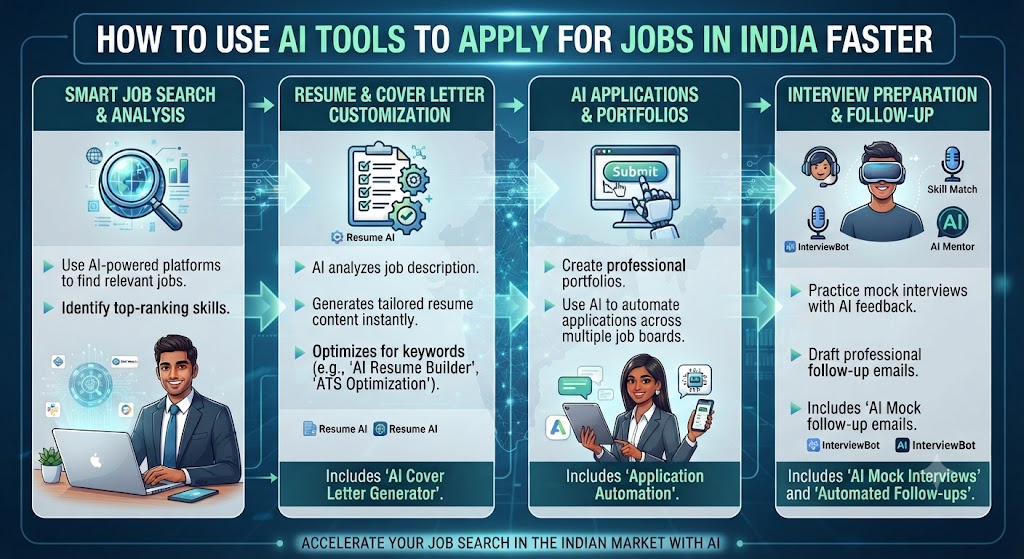
Searching for jobs manually across multiple platforms can take hours. AI-assisted search tools can help candidates discover suitable roles by interpreting job titles, skills, experience levels, and career preferences.
Start by defining the type of job you want. Consider your preferred industry, location, experience level, salary expectations, and work arrangement. You can then use AI to generate relevant job titles and search phrases.
For example, a digital marketing professional might search for SEO Executive, Content Marketing Specialist, Digital Marketing Analyst, and Growth Marketing Associate rather than relying on one title.
AI can also help identify transferable skills. A customer service professional with strong communication and data-handling abilities might explore customer success, sales operations, or support analyst roles.
To make your search more effective:
- Use job portals such as LinkedIn Jobs, Naukri, Indeed India, and the National Career Service.
- Create alerts for relevant job titles and locations.
- Ask AI to suggest alternative job titles based on your existing skills.
- Compare job descriptions to identify recurring qualifications.
- Prioritise vacancies that match your experience and employment preferences.
For example, you can ask an AI assistant: “Suggest 15 job titles in India that match my experience in digital marketing, SEO, and content creation. Group them by entry-level and mid-level opportunities.”
AI can help expand your search, but verify each vacancy on the employer’s official website or a reputable job platform before applying.
Optimise Your Resume With AI Tools
A relevant resume helps recruiters understand your qualifications quickly. AI tools can improve clarity, structure, grammar, and alignment with a particular job description.
Begin with an accurate master resume containing your employment history, education, technical skills, certifications, projects, and measurable achievements. Use this document as the source for creating tailored versions.
Next, provide the job description to an AI assistant and ask it to identify the most important skills and responsibilities. Compare those requirements with your actual experience, then revise the resume to highlight the strongest matches.
For example, if a job description emphasises SEO, keyword research, content optimisation, and analytics, a candidate with genuine experience in these areas should make those skills easy to find.
AI can help you:
- Improve your professional summary.
- Rewrite unclear bullet points in simple, professional language.
- Highlight relevant achievements.
- Identify missing information or inconsistent formatting.
- Correct spelling and grammatical errors.
- Adapt your resume for different job categories.
Use measurable achievements wherever possible. Instead of writing “Responsible for social media,” explain the campaigns you managed, the content you created, or the results you achieved, provided those details are accurate.
Do not add skills, qualifications, employment dates, or achievements simply because AI suggests them. False information may damage your credibility during interviews and background verification.
Generate Tailored Cover Letters and Application Messages
Writing a new cover letter for every application can slow down your job search. AI can help create a first draft using your resume and the job description.
The most effective cover letters explain why the role suits your background and how your experience relates to the employer’s needs. Avoid generic introductions that could be sent to any company.
Give the AI tool three pieces of information: the job description, your relevant experience, and the reason you want the role. Ask it to produce a concise, professional draft that highlights your strongest matching qualifications.
For example, a candidate applying for an HR Executive position could ask AI to emphasise their experience in interview coordination, candidate communication, recruitment documentation, and employee records.
AI can also assist with short application messages for recruiters and hiring managers.
A useful prompt is:
“Write a concise LinkedIn message for a recruiter about this vacancy. Use my real experience, mention two relevant skills, express interest professionally, and avoid exaggerated claims.”
Before sending the message, check the employer’s name, job title, and other details. Personalise the final version so that it sounds natural and reflects your actual motivation.
For applications that do not require a cover letter, avoid adding unnecessary documents. Follow the employer’s instructions and focus on the information requested.
Use AI to Match Your Skills With Job Descriptions
One of the most practical uses of AI is comparing your experience with a vacancy before applying. This helps you decide where your application has a reasonable chance of success.
Paste the job description and your resume into an AI assistant. Ask it to divide the requirements into three groups: skills you clearly demonstrate, skills you partially demonstrate, and requirements you do not currently meet.
This comparison can reveal relevant experience you may have overlooked. It can also show when a vacancy requires qualifications or technical expertise that you do not possess.
For example, a marketing role may require content planning, SEO, analytics, and campaign reporting. If you have experience in content planning and SEO but limited analytics experience, you can highlight your strengths while identifying an area for improvement.
Use AI to answer questions such as:
- Which three requirements are most important for this role?
- Which achievements in my resume provide evidence of those skills?
- What relevant experience should I highlight more clearly?
- Which requirements do I not currently meet?
- Is this role a realistic match for my experience level?
Remember that AI-generated match scores are estimates, not guarantees of recruiter interest or selection. Different employers use different screening criteria, and AI may misunderstand the information provided.
Apply when you meet the essential requirements or have credible transferable skills. Avoid rejecting yourself automatically because you do not satisfy every preferred qualification.
Automate Repetitive Tasks Without Losing Control
Job applications often require candidates to enter the same information repeatedly, including contact details, education, employment history, notice period, and salary expectations.
You can save time by preparing a standard set of accurate application details in advance. Keep your resume, employment dates, qualifications, professional summary, and frequently requested answers organised in one secure location.
Some job platforms allow candidates to save resumes or reuse previously entered application information. LinkedIn, for example, provides application settings that can help users reuse certain saved details and resumes, which may reduce repetitive data entry.
AI tools and form-filling assistants can also help organise information, but their capabilities vary. Always check whether a tool supports the specific platform you use and review its privacy practices before sharing personal data.
A practical workflow includes:
- Prepare a master resume and a few role-specific versions.
- Save accurate answers to common screening questions.
- Maintain a professional cover letter template.
- Use job alerts to identify new vacancies.
- Keep a spreadsheet or application tracker.
- Review every completed application before submitting it.
Avoid blindly submitting applications through automation. Incorrect answers about salary, location, experience, work authorisation, or notice period can undermine an otherwise suitable application.
The aim is to automate repetitive administration while retaining personal oversight of every submission.
Practise Interviews With AI Before Meeting Recruiters
Applying faster is useful only if you can also prepare effectively for interviews. AI tools can help candidates practise responses, organise examples, and identify areas where their explanations need improvement.
Start by sharing the job description and asking AI to generate likely interview questions for that position. Request a mix of technical, behavioural, and role-specific questions based on your experience level.
For behavioural questions, use the STAR method: Situation, Task, Action, and Result. This structure helps you explain what happened, what you were responsible for, what you did, and what you achieved.
For example, if you are applying for a project coordinator role, prepare an example of how you handled competing deadlines or resolved a communication problem.
AI can also help you practise answers to common questions such as:
- Tell me about yourself.
- Why are you interested in this position?
- What are your strongest professional skills?
- Describe a challenge you handled successfully.
- What are your salary expectations?
- When can you join the organisation?
Ask the AI assistant to evaluate your answers for clarity, relevance, structure, and evidence. Then revise them using your actual experiences and speak them aloud.
Do not memorise fabricated answers or depend on AI during a live interview unless the employer explicitly permits it. The purpose is to build confidence and prepare your own responses, not to replace your judgment.
Track Applications and Follow Up Efficiently
When you apply to several jobs each week, it becomes easy to forget application dates, recruiter conversations, and follow-up commitments. An application tracker helps you manage the process systematically.
You can create a spreadsheet with columns for company name, job title, location, application date, source, resume version, status, recruiter contact, and next action.
AI can help organise job descriptions, summarise role requirements, draft polite follow-up messages, and identify patterns in your search. For instance, if many suitable applications require a skill you lack, you can prioritise learning that skill.
Review your tracker regularly and use it to decide where to focus your time.
A simple weekly routine might include:
- Monday: Review job alerts and shortlist suitable vacancies.
- Tuesday: Tailor resumes and prepare application materials.
- Wednesday: Submit targeted applications and contact relevant recruiters.
- Thursday: Practise interviews and improve skills relevant to target roles.
- Friday: Review application progress and follow up where appropriate.
Adjust this schedule according to your availability. The important point is to create a repeatable process rather than searching randomly whenever you have free time.
A global job platform can help you explore vacancies across industries and locations, while an organised tracker ensures that your applications and follow-ups remain manageable. Choosing the best job tool for your needs means focusing on useful features, reliability, privacy, and the quality of opportunities rather than the number of automated actions it performs.
Use AI Responsibly and Protect Your Personal Information
AI can produce incorrect statements, misunderstand job requirements, or recommend irrelevant opportunities. Candidates should treat its output as a starting point that requires verification.
First, confirm that every job listing is genuine and currently open. Check the employer’s website, recruiter identity, location, and application instructions.
Second, protect sensitive information. Avoid uploading identity documents, bank details, passwords, or other unnecessary personal information to unverified tools. Review the data policies of any AI service before uploading your resume or employment information.
Third, maintain accuracy throughout the application process. Never ask AI to invent experience, create false certificates, exaggerate achievements, or misrepresent your qualifications.
Finally, follow the employer’s rules regarding AI use in assessments and interviews. AI may be appropriate for resume editing and interview practice, but some employers restrict its use during technical assessments or live interviews.
A responsible approach builds trust and ensures that your application represents your genuine skills and experience.
Conclusion
AI tools can help job seekers in India apply for jobs faster by simplifying job discovery, resume customisation, cover letter writing, skills matching, interview practice, and application tracking. The greatest benefit comes from building a consistent workflow that reduces repetitive tasks while keeping applications relevant and accurate.
Start with a reliable master resume, use AI to identify suitable vacancies, and customise your application for each promising role. Verify job details, protect your personal information, and prepare to discuss every claim you make during an interview.
Using the best job tool as part of a wider search strategy can help you discover opportunities through a global job platform and manage your applications more efficiently. Combine AI assistance with professional networking, continuous learning, and thoughtful follow-ups to make your job search more focused and productive.


Leave a Reply