Introduction
When applying for jobs in the United States, one of the first questions candidates face is whether to submit a resume or a curriculum vitae (CV). Although these terms are sometimes used interchangeably in other countries, American employers generally distinguish between the two documents based on their purpose, length, and content.
Choosing the correct document can help you present your qualifications more effectively. A resume is typically used for corporate, business, technical, and most non-academic positions. A CV is generally expected for academic, research, scientific, and certain medical roles.
However, the distinction is not universal. Some employers specifically request a CV, and international organisations may follow different conventions. Therefore, understanding the expectations of your target industry is essential before submitting an application.
This guide explains the differences between a resume and a CV in the USA, what employers look for in each document, and how to choose the right format for your next job application.
Understanding the Difference Between a Resume and a CV
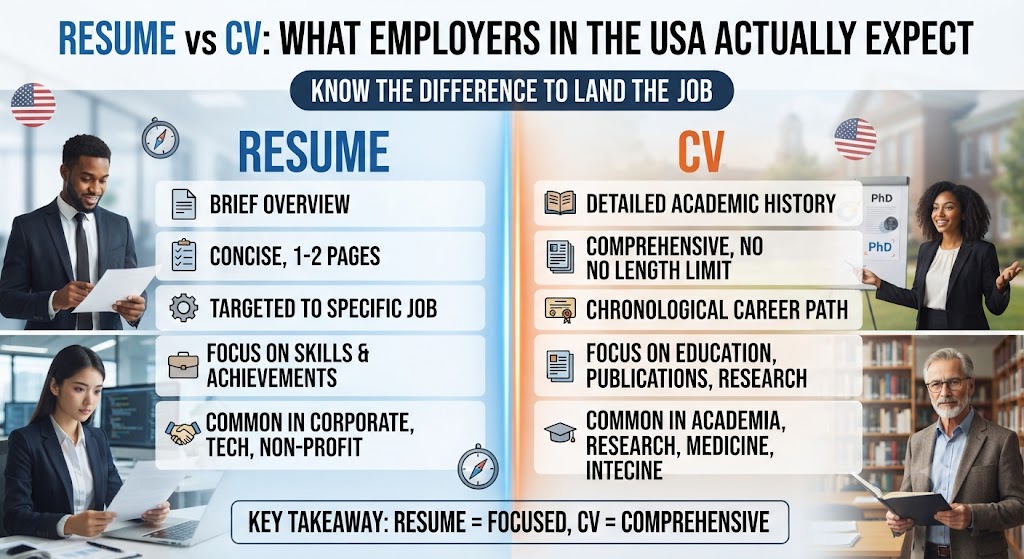
A resume is a concise summary of your professional experience, education, skills, and achievements. Its purpose is to demonstrate why you are qualified for a specific position. Most American employers expect a resume that highlights relevant information rather than documenting every detail of your career.
A CV, by contrast, provides a more comprehensive record of academic and professional accomplishments. It may include research experience, publications, conference presentations, teaching responsibilities, grants, awards, and academic appointments.
The main differences include:
- Purpose: A resume supports applications for most non-academic jobs, while a CV is commonly used for academic and research positions.
- Length: A resume is often one or two pages, depending on experience. An academic CV can be several pages long.
- Content: A resume prioritises relevant skills and achievements, whereas a CV documents a broader professional or academic history.
- Customisation: Resumes are usually tailored to individual vacancies. Academic CVs are updated as new qualifications, research, and publications are added.
- Industry expectations: Corporate employers generally request resumes, while universities and research institutions often request CVs.
These distinctions help candidates understand which document to prepare. Nevertheless, always follow the terminology and instructions used in the actual job advertisement.
When American Employers Expect a Resume
For most private-sector jobs in the United States, a resume is the standard application document. Employers in business, technology, marketing, finance, sales, operations, customer service, and many other fields typically use resumes to evaluate candidates.
Recruiters often review numerous applications, so they need to identify relevant qualifications quickly. A focused resume makes it easier to understand your professional background and assess your suitability for the role.
For example, a marketing manager applying to a US company should prioritise campaign performance, customer acquisition, brand development, and measurable business outcomes. A software engineer should highlight relevant programming languages, technical projects, system improvements, and development experience.
A strong resume usually includes:
- Contact information and relevant professional links.
- A concise professional summary, when useful.
- Relevant work experience.
- Measurable achievements and responsibilities.
- Education and relevant certifications.
- Technical and transferable skills.
The most important information should appear near the top of the document. Candidates with extensive experience do not need to describe every previous responsibility in equal detail. Instead, they should emphasise achievements that relate directly to the target position.
For entry-level applicants, academic projects, internships, volunteering, and relevant coursework can demonstrate potential when professional experience is limited.
When Employers in the USA Expect a CV
A CV is more common in academic, scientific, and research-focused environments. Universities, research institutes, and certain healthcare or specialist organisations may request a CV to understand a candidate’s complete professional and academic record.
For example, someone applying for a university faculty position may need to document teaching experience, research projects, scholarly publications, conference presentations, and academic awards. A short corporate-style resume may not provide enough information for this type of assessment.
An academic CV can include:
- Education and academic qualifications.
- Research interests and research experience.
- Publications and scholarly presentations.
- Teaching experience and academic appointments.
- Grants, fellowships, and awards.
- Professional memberships and relevant service.
- Licences or certifications where applicable.
The order of these sections depends on the position and the candidate’s background. Researchers may place publications and research experience prominently, while teaching-focused applicants may emphasise instructional experience and curriculum development.
Some employers outside traditional academia also request a CV. In these cases, do not assume that the organisation expects a short resume simply because it is based in the United States.
Read the application instructions carefully. If the employer explicitly requests a CV, submit the document that matches its stated requirements.
How to Structure a Resume for the US Job Market
American employers generally value resumes that are easy to scan, relevant to the vacancy, and supported by evidence. The document should make your professional value clear without unnecessary personal details or lengthy explanations.
Start with your name and professional contact information. Include your city and state if relevant, a professional email address, and links to LinkedIn or a portfolio when they support your application. A full street address is usually unnecessary.
Next, consider a short professional summary. This section can identify your experience level, areas of expertise, and most relevant strengths. Avoid vague statements that could describe almost any applicant.
The work experience section should focus on contributions and results. Instead of listing only routine responsibilities, explain how your work improved a process, supported a project, increased efficiency, or helped achieve a business objective.
For example, “Managed social media accounts” provides limited detail. “Managed social media content across three channels and improved audience engagement through performance-based content planning” communicates more about the work performed. Include specific results only when they can be verified.
Keep the formatting consistent. Use clear section headings, readable fonts, and simple layouts. Complex graphics, excessive colours, and unusual formatting can distract from the information or create parsing difficulties in applicant tracking systems.
Finally, review the document carefully for grammar, dates, formatting, and consistency. A polished resume signals attention to detail and makes it easier for employers to evaluate your qualifications.
Resume and CV Length, Formatting, and Personal Information
There is no single length that works for every applicant. However, a one-page resume can be effective for students and recent graduates, while experienced professionals may need two pages to communicate their relevant achievements. Senior executives and specialists should prioritise relevance rather than forcing their experience into an arbitrary page limit.
Academic CVs have different expectations. Their length depends on research output, teaching responsibilities, publications, professional appointments, and other accomplishments. Including relevant details is more important than keeping the document short.
Formatting should reflect the document’s purpose. Resumes benefit from a clean, organised structure that allows recruiters to identify qualifications quickly. Academic CVs can contain more detailed sections, especially when documenting research and scholarly work.
Candidates applying in the United States should also be careful with personal information. For most standard job applications, avoid including:
- Date of birth or age.
- Marital status or family details.
- Social Security number.
- Photograph, unless specifically required for a legitimate reason.
- Sensitive personal information unrelated to the position.
Employers generally need to evaluate your qualifications, not unnecessary personal details. Including such information can create privacy risks and may be inconsistent with common US hiring practices.
If a position requires a licence, security clearance, or specific work authorisation, provide the relevant information when requested through the appropriate process rather than placing sensitive details unnecessarily on your resume.
How to Tailor Your Resume or CV for Each Application
Submitting the same document for every vacancy can weaken your application. Different employers prioritise different qualifications, even when the job titles appear similar.
Begin by reviewing the job description. Identify the essential qualifications, key responsibilities, technical skills, and experience requirements. Then compare them with your background and highlight the strongest matches.
For a corporate resume, this may mean reordering skills, refining your professional summary, and selecting achievements that relate directly to the role. For an academic CV, it may mean bringing relevant publications, research methods, teaching experience, or grants to the forefront.
Applicant tracking systems may help employers organise applications and identify relevant information. Therefore, using standard headings and naturally including accurate terms from the job description can improve clarity. However, keyword repetition does not guarantee selection.
To tailor your document effectively:
- Prioritise experience that matches the target role.
- Use relevant terminology where it accurately describes your skills.
- Quantify achievements when reliable figures are available.
- Remove outdated or unrelated details that add little value.
- Keep employment dates, qualifications, and job titles consistent.
- Save a separate version for each significant application.
You can also use AI tools to improve grammar, compare a resume with a job description, or identify missing details. Review all suggestions carefully and never add qualifications or achievements you do not possess.
A well-tailored document helps recruiters understand not only what you have done, but also why your experience is relevant to their organisation.
Common Resume and CV Mistakes to Avoid
Even qualified candidates can weaken their applications through avoidable mistakes. Some problems relate to formatting, while others involve inaccurate information or a lack of relevance.
One common mistake is submitting an academic CV for a corporate position when the employer expects a concise resume. The opposite can also occur when candidates submit a short resume for an academic role that requires detailed research and publication records.
Other mistakes include:
- Using the same generic document for unrelated jobs.
- Listing responsibilities without explaining contributions.
- Including irrelevant personal information.
- Using complicated formatting that makes the document difficult to read.
- Adding unsupported claims or exaggerated achievements.
- Failing to check spelling, dates, and contact information.
- Ignoring the employer’s instructions about document type or submission format.
Another frequent problem is focusing too much on length. A longer resume is not necessarily stronger, and a short CV may omit important academic accomplishments. The appropriate document should provide enough relevant evidence for the employer to assess your qualifications.
Before submitting an application, review the document from the recruiter’s perspective. Can the reader identify your key qualifications quickly? Are your achievements credible? Does the document follow the requested format?
These simple checks can make your application clearer and more professional.
Conclusion
Understanding the difference between a resume and a CV is an important step when applying for jobs in the United States. A resume is generally the right choice for corporate and most non-academic roles, while a CV is commonly expected in academic, research, and certain specialised fields.
The most effective document is not necessarily the longest or most visually elaborate. It is the one that follows the employer’s instructions, highlights relevant qualifications, and presents your achievements clearly.
Before applying, research the expectations of your target industry, tailor your document to the vacancy, and verify that all information is accurate. Use reputable job-search resources and a global job platform to explore opportunities that match your experience and professional goals. Choosing the best job tool for your search can help you discover relevant vacancies and organise applications more efficiently, while a well-prepared resume or CV helps you communicate your value to employers.

Leave a Reply