Introduction: Data and Analytics Jobs
In Canada, there is a demand for people who can help organizations gather, analyze, and interpret data and information to drive business decisions. Firms in technology, healthcare, the economy, retail, and manufacturing use data insights to understand clients better, optimize processes, detect key trends, and grow their market share.
Canadian job markets for Data and Analytics specialists offer opportunities for graduates, experienced workers, and those seeking to immigrate to Canada. Even though good salaries are available in the field, it is critical to highlight relevant competencies, skills, and work experience during the hiring process.
This article discusses the main positions, required abilities, salary details, and job-search strategies for landing Data and Analytics jobs in Canada.
How to Explore Data and Analytics Jobs in Canada?
1. List of Popular Data and Analytics Jobs in Canada
Data and Analytics jobs in Canada are grouped into different areas based on the required education, skillset, seniority level, and working conditions. Understanding the main responsibilities for each position type is essential in determining which role to apply for.
Data analyst – organizes, visualizes, and interprets information, identifies patterns, and prepares reports. Business analyst – understands organizational requirements concerning data and drives recommendations. Analytics consultant – helps firms leverage data and analytics to resolve business issues and drive growth.
Junior data analyst roles are the most accessible for newcomers with little or no experience. More complex jobs require additional programming and analytics knowledge. By exploring the list of Data and Analytics jobs in Canada, soon-to-be employees gain insight into the responsibilities and choose a suitable area to specialize in.
2. Required Technical and Soft Skills for Data and Analytics Jobs in Canada
Most employers look for candidates who can work with data, derive meaningful insights and convey the results clearly and concisely. Additionally, analytical thinkers should also have excellent communication and problem-solving skills.
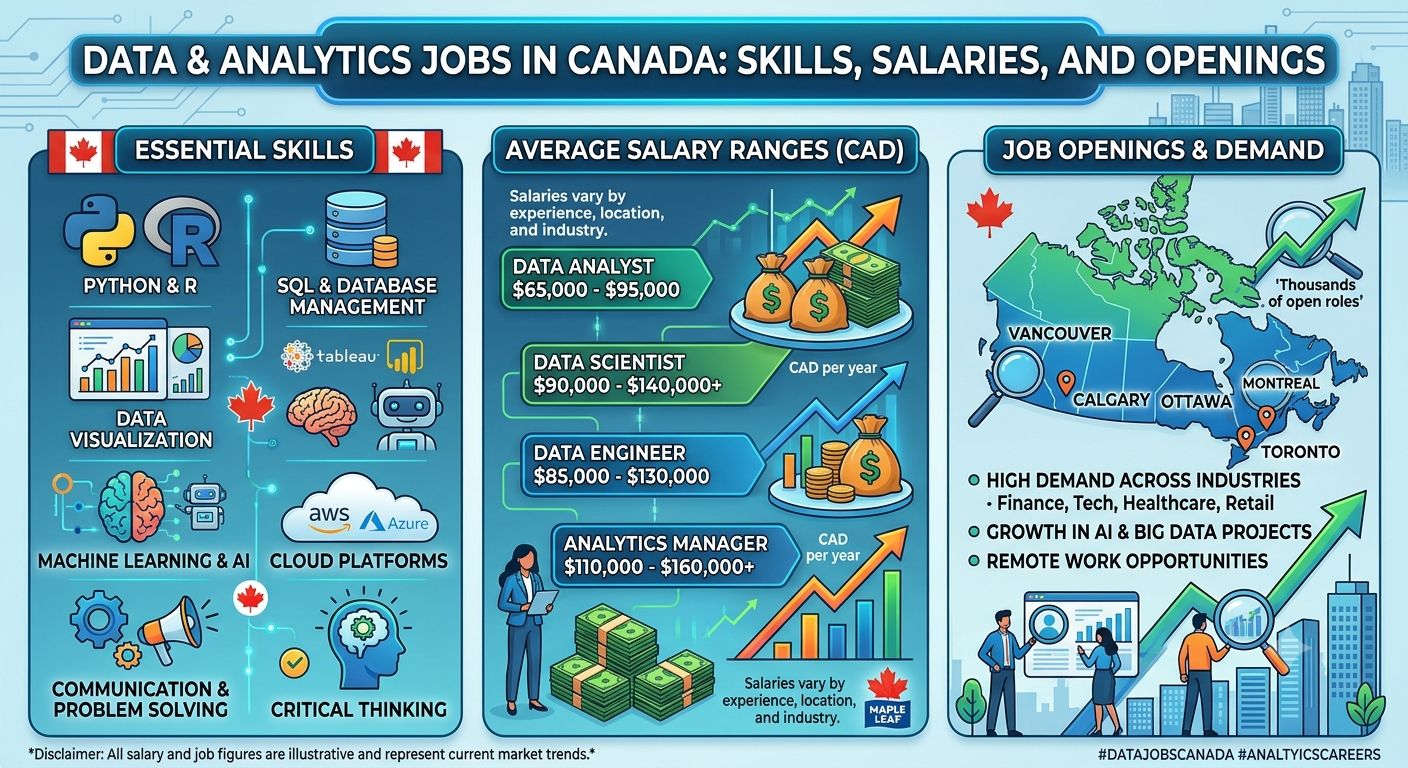
SQL helps manage and manipulate large sets of organized data and is used extensively by Data and Business Analysts. Python and R programming languages offer functionalities such as data cleaning, statistical data analysis, and graphic visualization. Similarly, Microsoft Excel, Power BI, and Tableau enable spreadsheet organization and dashboard creation. Strong statistical and data visualization expertise allows professionals to present reports, charts, and graphs in an attractive and informative manner that supports evidence-based business decisions.
Apart from technical competencies, job applicants should have soft skills such as analytical and critical thinking, problem-solving, presentation, and communication abilities to succeed in the role. Individuals who want to get Data and Analytics jobs in Canada should hone these skills further through training and practice.
3. Salary Insights for Data and Analytics Jobs in Canada
Apart from salary details, other benefits and extra perks influence job candidates’ decisions significantly. Usually, entry-level jobs require at least a bachelor’s degree, and employers offer lower wages to inexperienced workers. Higher-level analytical positions usually demand advanced skills and working knowledge of Python, R, or other statistical software, which comes with better compensation. Senior Data and Analytics roles pay well, both in Calgary, Toronto, Montreal, Edmonton, and Vancouver, as the positions continue to be in high demand.
For example, the average wage for data scientists is approximately $46.15 Canadian dollars per hour, according to Canada’s job bank. Hourly rates vary between organizations and locations due to differences in the workforce’s skill level and the employers’ budget. Additionally, job-specific pay is often determined by the number of years spent in the profession, geographic location, the type of business, and the company’s size. Generally, here is the list of average salaries for Data and Analytics jobs in Canada.
Entry-level analyst: Lower pay scales since such workers typically have little or no work experience and contribute minimally to the firm. Mid-level analyst: Typically, individuals with fundamental SQL and Python knowledge and business analytics experience make more significant salaries.
Senior roles: More involved and require an advanced expertise in statistics, data science, data engineering, and related disciplines. These professionals can make excellent incomes.
Data Engineering and analytics managerial roles: This is a popular level among Data and Analytics workers in Canada, and experience and knowledge determine wages. The salaries listed above are only guidelines for determining the expected income for Data and Analytics jobs in Canada. In reality, each employer sets its compensation terms depending on the candidate’s fit, qualifications, and years of working experience..
4. Where to Find Data and Analytics Jobs in Canada
In Canada, organizations in the banking, healthcare, retail, technology, and other industries hire data analysts, data engineers, business analysts, scientists, and other specialists. Banking institutions use analytics to understand and assess financial risks, while hospitals employ analytics experts to study the firm’s operations, enhance the delivery of services, and reduce costs. At the same time, retail stores analyze client behaviors to optimize the supply chains and offer convenience. In addition, the technology industry uses data analysts and scientists to develop new products, support existing ones, and boost revenue. Individuals searching for Data and Analytics jobs in Canada can consider the following popular platforms:
Canada Job Bank advertises thousands of Data and Analytics job vacancies, including business analyst, data scientist, and data analyst opportunities. It also provides useful information regarding the job market and labor trends in the field. Searching for Data and Analytics jobs in Canada can also be done on LinkedIn Jobs. In addition to job listings, the platform has valuable tools to network with recruiters and fellow professionals in the industry. Similarly, Indeed Canada is popular among job hunters for scanning the job market, comparing relevant offers, and seeing the associated salary details.
Finally, applying directly to employers is always recommended if a specific organization has caught an individual’s eye. Some of the best Data and Analytics jobs in Canada are found in Toronto, Vancouver, Montreal, Calgary, and Ottawa, but there are more opportunities in other regions as well. It is worth noting that different areas have varying vacancies, so it is essential not to overlook smaller towns and cities.
5. Education and Certifications for Data and Analytics Jobs in Canada
Having an analytics certification in Power BI, Tableau, cloud computing, or another discipline adds credibility to an individual’s qualifications and helps stand out from the competition. In most cases, such training complements formal education, but it is not a guaranteed way to land a job. Individuals who want to get Data and Analytics jobs in Canada should consider both avenues.
6. Tips for Landing a Data and Analytics Job in Canada
Finding Data and Analytics jobs in Canada is just one step; there are still several things to do after identifying job offers. Here are some helpful tips for securing a position in data and analytics: Create a strong portfolio that contains the most relevant projects and showcases analytical competencies in an impressive manner.
Improve a resume and ensure it is error-free, and it emphasizes the best analytical skills, tools, and past performance. Additionally, it should be customizable according to the specific job offer. Practice solving sample SQL questions and brushing up on statistics, data analytics fundamentals, and business analysis concepts.
This way, it will be easier to impress a potential employer during interviews. Expand the professional network and engage with other business analysts, recruiters, and data analysts on social media and other platforms. Finally, consider legal requirements and documentation when applying for Data and Analytics jobs in Canada. Although such restrictions and legal formalities vary between employers, it is essential to highlight those things upfront and avoid any unpleasant surprises at the end.
7. Resume Tips for Data and Analytics Jobs in Canada
Make sure to include relevant technical skills and qualifications in your resume and create an ATS-friendly resume to get past the initial screening process. Mention any relevant databases, software, and programming languages you’re experienced with, such as SQL, Python, Excel, and Power BI.
8. Interview Preparation for Data Analytics Roles
Practice your technical skills, such as writing SQL queries and creating visualizations, for your data analytics job interview. Research the company and be prepared to explain how you’ve used your skills in your previous projects and how they can be applied to solve business problems in the company industry.
Conclusion: Data and Analytics Jobs
This article shows that there are plenty of Data and Analytics job opportunities for motivated and talented individuals. Moreover, such positions have great career progression and competitive salaries for those with the right skillsets and experience. However, landing a Data and Analytics job in Canada can be challenging and requires a person to invest effort and time.
In particular, individuals should learn about Data and Analytics jobs in Canada, understand what employers are looking for in a candidate, and consider their own abilities, motivations and experiences while choosing the ideal position. People should research the job market, explore the relevant salaries and benefits, and then submit an application for Data and Analytics jobs in Canada. This way, each aspiring analyst has a slightly better chance of making valuable career moves and advancing toward their professional goals.
Ready to advance your career? Use the Best Job Tool to explore the latest Data and Analytics Jobs in Canada, find suitable openings, and take the next step toward your professional goals. Start your job search today!



Leave a Reply