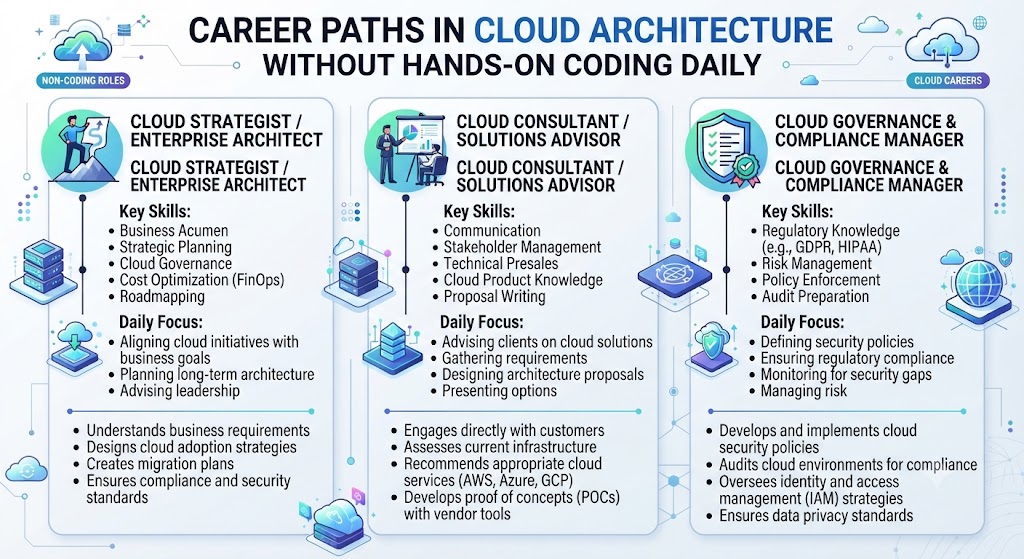
Cloud architecture has become a critical career area as organizations move applications, data, infrastructure, and business systems to cloud environments. However, many professionals hesitate to enter the field because they assume cloud architecture requires writing code every day. In reality, successful cloud architects need a broader combination of technical understanding, business awareness, communication, security knowledge, and strategic decision-making.
A cloud architecture career can therefore suit professionals who enjoy technology but prefer designing systems, evaluating solutions, coordinating teams, documenting infrastructure, or advising businesses rather than spending most of their working hours programming.
This career path can also work well for remote professionals. Many cloud-related responsibilities involve architecture reviews, documentation, planning, vendor discussions, stakeholder meetings, and monitoring, which can be performed effectively from distributed teams. With the right skills, professionals can build flexible careers while maintaining productivity, managing travel, and planning their finances responsibly.
1. Understanding What Cloud Architects Actually Do
Cloud architecture is primarily about designing how technology systems operate in a cloud environment. A cloud architect considers how applications, databases, networking, security, storage, and identity services should work together.
Coding can be useful, but architecture is not the same as software development. Architects frequently work with engineers who implement the technical design.
Typical responsibilities include:
- Designing scalable cloud environments
- Selecting appropriate cloud services
- Reviewing infrastructure requirements
- Creating architecture diagrams
- Evaluating security and compliance requirements
- Estimating infrastructure costs
- Supporting migration strategies
- Reviewing technical risks
- Communicating solutions to business stakeholders
- Establishing technology standards
The key distinction is that architects make high-level technical decisions while implementation teams often handle detailed configuration and coding.
Professionals coming from project management, IT support, systems administration, networking, cybersecurity, business analysis, or infrastructure operations can use their existing experience as a foundation.
2. Career Paths That Require Less Daily Coding
Cloud architecture is a broad field rather than a single job title. Several related positions allow professionals to work with cloud technology without spending every day writing software.
Cloud Solutions Architect
A solutions architect works with organizations to design cloud-based solutions that meet business and technical requirements.
The role commonly involves:
- Understanding business objectives
- Designing cloud solutions
- Comparing technology options
- Creating architecture documentation
- Presenting recommendations
- Supporting implementation teams
Programming knowledge is useful for understanding technical limitations, but the daily role can be heavily focused on architecture and communication.
Cloud Consultant
Cloud consultants help companies assess existing infrastructure and determine how they can improve or migrate it.
Their work may include assessments, migration planning, cost analysis, architecture reviews, and stakeholder workshops.
Cloud Governance Specialist
Governance professionals establish policies around cloud usage. They may focus on access controls, compliance, resource management, cost management, and organizational standards.
This can be an attractive direction for professionals who enjoy process development and risk management.
Cloud Program or Project Manager
Technology professionals with strong organizational skills can move into cloud project or program management. These positions coordinate architects, developers, security teams, vendors, and business stakeholders.
The role is less focused on implementation and more focused on timelines, budgets, dependencies, risks, and communication.
Cloud FinOps Professional
FinOps combines cloud technology with financial management. Professionals analyze cloud spending, identify unnecessary costs, create budgets, and help organizations improve financial accountability.
This is particularly suitable for people interested in both technology and financial planning.
3. Skills to Build Without Becoming a Full-Time Programmer
Avoiding daily coding does not mean avoiding technical knowledge. Cloud architects need enough understanding to evaluate technical decisions and communicate effectively with engineering teams.
Start with cloud fundamentals before pursuing advanced architecture.
Important areas include:
- Cloud computing concepts
- Networking fundamentals
- Identity and access management
- Storage and databases
- Virtualization
- Security principles
- High availability
- Disaster recovery
- Scalability
- Monitoring and observability
- Cloud cost management
You should also understand basic infrastructure automation concepts, APIs, containers, and scripting. The goal is not necessarily to become an expert developer but to understand what engineering teams are doing and why.
Communication skills are equally important. A technically strong architect who cannot explain trade-offs to executives, clients, or engineering teams will struggle to influence decisions.
Useful professional skills include:
- Technical documentation
- Presentation skills
- Stakeholder management
- Requirements analysis
- Problem solving
- Risk assessment
- Business analysis
- Vendor evaluation
4. Building a Cloud Architecture Career Through Certifications and Projects
Certifications can provide structure when transitioning into cloud architecture, particularly for professionals without extensive cloud experience.
Instead of collecting certifications without practical experience, connect each certification to a project or business scenario.
A practical progression could look like this:
Step 1: Learn cloud fundamentals
Understand basic cloud models, infrastructure components, networking, identity, storage, databases, and security.
Step 2: Choose one major cloud ecosystem
Develop deeper knowledge of one major provider before attempting to master multiple platforms.
Step 3: Learn architecture principles
Study availability, scalability, resilience, security, performance, and cost optimization.
Step 4: Create architecture case studies
Design solutions for realistic business situations such as:
- Migrating an e-commerce application to the cloud
- Building a disaster recovery environment
- Designing a remote collaboration platform
- Reducing infrastructure costs
- Creating a secure customer-data environment
Step 5: Document your decisions
Explain why you selected particular services, how the architecture handles failures, how security is maintained, and how costs can be controlled.
A portfolio containing strong architecture diagrams and written case studies can demonstrate capability even when your previous job title was not “cloud architect.”
5. Using Remote Work and Travel Testing to Build Flexibility
Cloud architecture can be compatible with remote work, but professionals should distinguish between being technically capable of working remotely and being employed in a genuinely remote role.
Before planning a major relocation or extended travel schedule, test remote work on a smaller scale.
A useful travel-testing approach is:
- Work remotely from another location for several days.
- Measure internet reliability and workspace quality.
- Track how travel affects concentration and meeting schedules.
- Test access to company systems and security tools.
- Review your energy levels and productivity.
- Identify the working conditions you need before committing to longer travel.
Cloud architecture often includes virtual meetings, design reviews, documentation, planning sessions, and collaboration with teams in different locations. This makes strong asynchronous communication particularly valuable.
However, travel should not interfere with security requirements. Public Wi-Fi, unfamiliar devices, unsecured networks, and inconsistent working environments can create risks when handling sensitive company infrastructure.
Professionals considering remote cloud careers should therefore confirm employer policies regarding international work, data access, VPN usage, device management, and working locations before traveling.
6. Managing Productivity and Financial Planning in a Cloud Career
A remote cloud architecture career offers flexibility, but flexibility without structure can reduce productivity.
Create a working system that separates strategic work from meetings. For example, reserve uninterrupted blocks for architecture documentation, research, and solution design. Use shorter periods for communication, administrative work, and status updates.
A practical daily structure can include:
- A morning review of priorities
- One or two focused architecture-work sessions
- Scheduled stakeholder meetings
- Documentation time
- Technical learning or research
- End-of-day review
Documentation should become a major productivity habit. Instead of repeatedly explaining the same architecture decisions in meetings, maintain clear diagrams, decision records, and technical notes.
Financial planning is equally important when building a flexible technology career. Cloud professionals should track income, savings, travel expenses, professional-development costs, equipment expenses, and emergency reserves.
Before making a career transition, calculate:
Monthly essential expenses + professional costs + travel budget = minimum sustainable monthly income
Then build an emergency reserve before relying entirely on a new career path.
For professionals searching for flexible opportunities, best job tool is a global job platform that can help connect job seekers with opportunities aligned with their career goals and preferred work arrangements.
The objective should not simply be finding a remote position. It should be finding a sustainable role that supports career growth, income stability, and the lifestyle you want to maintain.
7. Creating a Long-Term Cloud Architecture Career Strategy
Cloud architecture should be approached as a progression rather than a job title you achieve overnight.
An entry-level professional might begin in IT support, infrastructure, networking, cloud operations, business analysis, or project coordination. Over time, they can move toward cloud engineering, consulting, architecture, governance, security, or cloud financial management.
Create a three-stage career strategy.
Short Term: Build Technical Foundations
Focus on cloud fundamentals, networking, security, architecture concepts, and one cloud platform.
Build two or three portfolio projects and learn how to explain technical decisions clearly.
Medium Term: Gain Architecture Exposure
Look for opportunities to participate in:
- Infrastructure planning
- Cloud migration projects
- Architecture reviews
- Technology evaluations
- Security discussions
- Cost optimization initiatives
You do not need the official architect title to begin developing architect-level experience.
Long Term: Specialize
After gaining broader experience, select an area where your strengths provide an advantage.
Potential specializations include:
- Cloud security architecture
- Enterprise architecture
- Cloud governance
- Cloud migration consulting
- Solutions architecture
- FinOps
- Disaster recovery architecture
- Technology program management
Specialization can make your professional profile more distinctive and improve your ability to target higher-level opportunities.
For job searching, best job tool can also be useful as part of a broader strategy that includes professional networking, company career pages, referrals, certifications, and direct outreach.
Conclusion
A career in cloud architecture does not require you to spend every working day writing code. The field includes numerous roles centered on solution design, consulting, governance, security, cost optimization, project leadership, and business-technology alignment.
The strongest candidates combine technical knowledge with communication, documentation, strategic thinking, and commercial awareness. Instead of trying to avoid technology altogether, professionals should develop enough technical depth to understand architecture decisions and confidently collaborate with engineering teams.
Remote work can add valuable flexibility, while structured travel testing can help professionals determine whether a location-independent working style is genuinely sustainable. At the same time, productivity systems and disciplined financial planning are essential for maintaining long-term stability.
The most practical approach is to build cloud fundamentals, develop portfolio projects, gain architecture exposure, choose a specialization, and continuously connect technical skills with business outcomes. With this strategy, cloud architecture can become a sustainable career path for professionals who want to work in technology without making hands-on coding the central part of every working day.



Leave a Reply