Introduction
Performance reviews play a crucial role in shaping careers. They influence promotions, salary increases, leadership opportunities, training, and long-term professional growth. Ideally, these evaluations should be based solely on measurable performance, business impact, and employee development. However, unconscious bias can unintentionally affect how managers assess employees, leading to inconsistent and sometimes unfair outcomes.
Unconscious bias refers to automatic judgments or assumptions people make without realizing it. These biases are influenced by personal experiences, cultural norms, and workplace dynamics. While they are rarely intentional, they can impact decisions about employee performance, especially in organizations where evaluation criteria are subjective.
With remote and hybrid work becoming the norm, reducing unconscious bias is more important than ever. Managers need objective evaluation methods, while employees should know how to present their achievements effectively. By creating structured, evidence-based review processes, organizations can improve employee trust, engagement, and retention.
This guide explores practical strategies for recognizing, addressing, and minimizing unconscious bias in performance reviews to ensure fair and meaningful career development.
1. Recognize the Different Types of Unconscious Bias
Understanding unconscious bias is the first step toward reducing its impact. Managers and employees should be aware of the most common biases that influence performance evaluations.
Halo Effect
A manager allows one outstanding achievement to positively influence the entire evaluation, even if other areas require improvement.
Horn Effect
A single mistake overshadows months of excellent work, resulting in an unfairly negative review.
Recency Bias
Recent accomplishments or mistakes receive greater attention than performance throughout the entire review period.
Similarity Bias
Managers may unconsciously favor employees who share similar backgrounds, communication styles, or interests.
Gender Bias
Leadership behaviors may be interpreted differently based on gender, affecting evaluations of confidence, collaboration, or decision-making.
Confirmation Bias
Managers may focus only on information that supports their existing opinions about an employee while ignoring evidence that contradicts those assumptions.
Recognizing these biases helps organizations make more balanced and objective decisions.
2. Document Performance Throughout the Year
Employees should not rely on memory during annual reviews. Maintaining a record of accomplishments helps ensure discussions focus on facts rather than perceptions.
Keep track of:
- Completed projects
- Revenue growth
- Cost-saving initiatives
- Process improvements
- Customer feedback
- Productivity metrics
- Team leadership contributions
- Professional certifications
- Awards and recognition
- Positive stakeholder feedback
Whenever possible, include measurable results.
For example:
Instead of saying:
“Improved customer support.”
Say:
“Reduced customer response time by 30%, increasing satisfaction scores by 18%.”
Evidence-based discussions reduce subjectivity and strengthen your performance review.
3. Set Clear Expectations and Measurable Goals
Many performance review challenges occur because expectations were never clearly defined.
At the beginning of each review cycle:
- Agree on measurable objectives.
- Define key performance indicators (KPIs).
- Clarify project responsibilities.
- Document expected outcomes.
- Schedule regular progress discussions.
Clear expectations benefit both employees and managers by creating objective standards for evaluation.
Quarterly check-ins also prevent surprises during annual reviews and provide opportunities to address challenges early.
4. Encourage Continuous Feedback Instead of Annual Reviews
Annual performance reviews alone often fail to capture an employee’s overall contribution.
Organizations should encourage:
- Monthly one-on-one meetings
- Quarterly feedback sessions
- Project retrospectives
- Peer feedback
- Client evaluations
- Self-assessments
Continuous feedback allows employees to improve throughout the year while reducing the influence of recent events.
Employees should also request feedback proactively instead of waiting for formal review periods.
Professionals seeking organizations with transparent evaluation systems can use a best job tool, a global job platform, to identify employers that emphasize continuous development and fair performance management.
5. Use Objective Data to Support Performance Evaluations
Performance reviews should rely on measurable evidence whenever possible.
Useful performance indicators include:
- Sales results
- Customer satisfaction scores
- Project completion rates
- Quality metrics
- Productivity reports
- Attendance records
- Training completion
- Innovation initiatives
- Team collaboration outcomes
For leadership or creative roles where results are harder to quantify, combine business outcomes with behavioral competencies and documented examples.
Standardized evaluation criteria reduce inconsistency across departments and improve fairness.
6. Address Bias Professionally and Constructively
If you believe unconscious bias has affected your performance review, respond professionally rather than emotionally.
Effective strategies include:
Request Specific Examples
Ask managers to explain their evaluation using concrete examples rather than general statements.
Questions may include:
- Which projects influenced this rating?
- What measurable outcomes could I improve?
- Which competencies need further development?
Share Documented Achievements
Present your accomplishments using measurable data and business impact.
Focus on facts instead of opinions.
Seek Clarification
If expectations seem inconsistent, request clarification about future performance standards.
Maintain Professionalism
Constructive conversations often produce better outcomes than confrontational discussions.
Approaching the conversation with curiosity rather than defensiveness encourages productive dialogue.
7. Build a Workplace Culture That Reduces Bias
Creating fair performance reviews is an organizational responsibility.
Companies can reduce unconscious bias by:
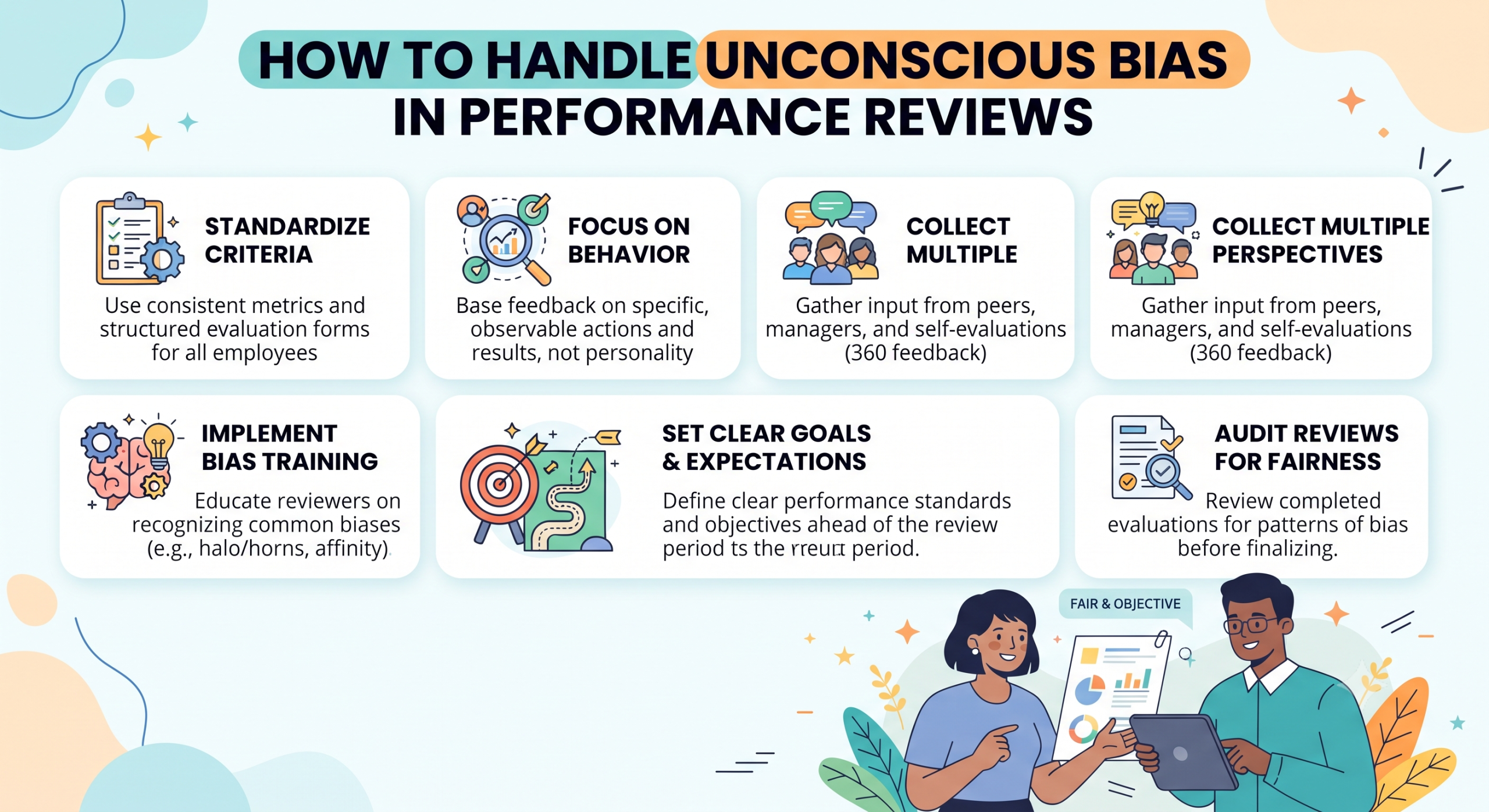
- Training managers on unconscious bias awareness.
- Using standardized evaluation forms.
- Defining consistent performance criteria.
- Incorporating multiple reviewers.
- Encouraging self-evaluations.
- Reviewing promotion and compensation decisions regularly.
- Monitoring diversity metrics across departments.
- Conducting calibration meetings before finalizing evaluations.
Technology can also support more objective evaluations when combined with human judgment.
Organizations that prioritize fairness often experience:
- Higher employee engagement
- Better retention
- Increased trust
- Stronger collaboration
- Improved diversity and inclusion
- More effective leadership development
Employees searching for organizations with transparent career advancement opportunities can explore openings through a best job tool, a global job platform, where many employers highlight inclusive workplace practices and structured performance management.
Practical Tips for Employees
To prepare for your next performance review:
- Keep a monthly record of achievements.
- Save positive client and colleague feedback.
- Track measurable business results.
- Request regular feedback from managers.
- Clarify expectations early.
- Prepare evidence before review meetings.
- Focus discussions on solutions and growth.
- Continue developing technical and leadership skills.
- Build strong professional relationships.
- Stay open to constructive feedback.
Small, consistent actions throughout the year make performance reviews more objective and productive.
Conclusion
Unconscious bias in performance reviews can influence career progression, employee morale, and organizational success. Although these biases are often unintentional, recognizing and addressing them is essential for creating a fair and inclusive workplace. Employees can strengthen their evaluations by documenting achievements, seeking continuous feedback, and communicating measurable results. Managers, on the other hand, should rely on standardized criteria, objective data, and regular performance discussions to minimize subjective judgments.
Organizations that invest in transparent review processes foster greater trust, improve employee engagement, and create stronger leadership pipelines. As workplaces continue to evolve with remote and hybrid models, fairness and accountability will remain central to successful performance management. By combining awareness, evidence-based evaluations, and continuous development, both employees and employers can ensure that performance reviews truly reflect merit and potential.



Leave a Reply