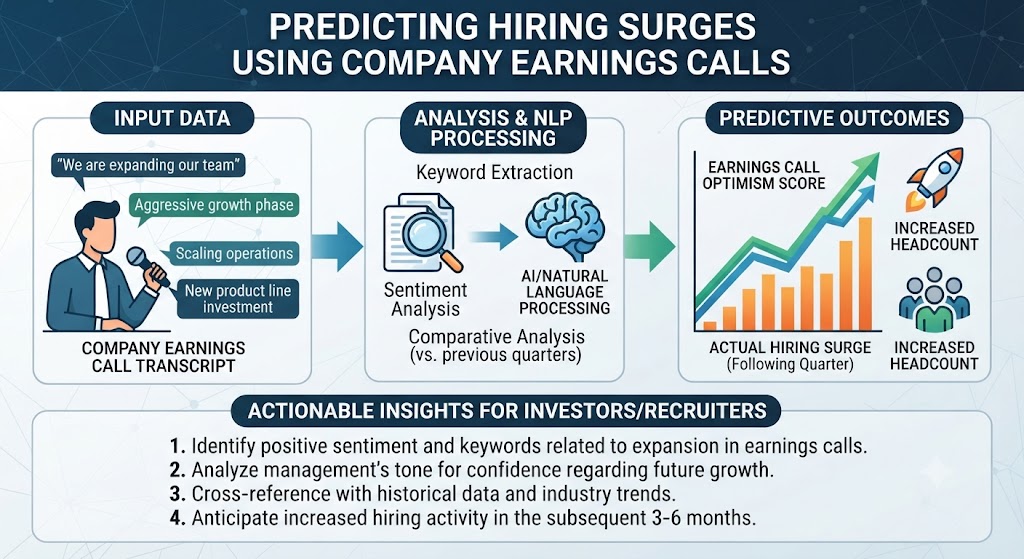
Predicting hiring surges can give job seekers an advantage over candidates who wait for vacancies to appear. One useful source of early information is a company’s earnings call. During these calls, executives and analysts discuss revenue, business demand, expansion plans, investments, headcount, and future priorities.
These conversations can reveal whether a company is preparing to expand its workforce before large numbers of jobs appear on its careers page. For example, Infosys said during its Q1 FY2027 earnings call that it planned to recruit 20,000 college graduates and had already recruited more than 4,000 in the first quarter.
However, earnings calls should not be treated as guaranteed hiring forecasts. Companies can change hiring plans because of economic conditions, automation, restructuring, or changes in customer demand. The most effective approach is to combine earnings-call signals with job postings, headcount data, business expansion, and financial performance.
1. Understand Why Earnings Calls Matter for Job Seekers
Public companies regularly discuss financial performance and future business priorities during earnings calls. Although these conversations are primarily designed for investors, they can also provide useful information about workforce planning.
Listen for comments about:
- Revenue growth
- New customer demand
- Large contract wins
- Geographic expansion
- New business units
- Technology investments
- Capacity requirements
- Employee headcount
- Attrition
- Campus hiring
- Lateral recruitment
These signals can help you identify companies that may need additional employees.
For example, if a company reports strong demand and says it needs additional capacity to deliver new contracts, hiring could increase in the following quarters.
On the other hand, if management emphasizes cost reduction, automation, restructuring, or stable headcount, hiring may remain limited.
Therefore, the objective is not simply to listen for the word “hiring.” Instead, look for evidence that business growth is creating a need for additional workforce capacity.
2. Track Revenue Growth and Business Demand
Revenue growth is one of the most useful signals when you want to predict hiring surges.
When revenue increases because a company is winning more customers or expanding existing operations, additional employees may eventually be required to support that growth.
During an earnings call, pay attention to statements about:
- Strong customer demand
- Increased orders
- New contracts
- Growing sales pipelines
- Higher bookings
- Expansion into new markets
- Increased production capacity
Large contract wins can be particularly important. They may create future delivery requirements even when the additional revenue has not yet appeared in financial results.
For example, a technology company reporting strong bookings and multiple large contracts may need additional engineers, project managers, consultants, sales professionals, and support staff.
However, revenue growth does not automatically mean hiring growth. Automation and productivity improvements can allow companies to increase revenue without adding employees at the same rate.
That is why revenue should always be evaluated alongside headcount and management commentary.
3. Watch Headcount and Employee Metrics
Headcount is another important indicator when trying to predict hiring surges.
Compare a company’s current employee count with previous quarters and the same period in the previous year.
Look for patterns such as:
- Increasing headcount
- Stable headcount despite revenue growth
- Declining headcount
- Rising employee turnover
- Increasing recruitment activity
- Changes in contractor usage
For example, Accenture reported 357,600 employees as of March 31, 2026, up 6,000 from the previous quarter and 21,300 from the same quarter a year earlier. Its disclosure also reported bookings growth and large deals.
This type of information becomes more useful when combined with management commentary.
If revenue, bookings, and headcount are all moving upward, the probability of continued hiring may be stronger than when only one indicator is positive.
At the same time, stable or declining headcount can indicate that management is prioritizing productivity or automation rather than workforce expansion.
4. Listen for Specific Hiring Language
Management commentary can provide some of the clearest hiring signals.
During earnings calls, listen for phrases related to:
- Hiring plans
- Campus recruitment
- Fresh graduate hiring
- Lateral recruitment
- New positions
- Workforce expansion
- Capacity building
- Talent requirements
- New teams
- Regional hiring
Specific numbers are especially valuable.
For example, Infosys stated that it planned to recruit around 20,000 college graduates during FY2026-27 and indicated continued demand for lateral talent.
Specific hiring targets are stronger signals than vague statements such as “we continue to invest in talent.”
Create a simple record for every company you track:
| Signal | What to Record |
|---|---|
| Revenue | Growth or decline |
| Headcount | Quarterly and annual change |
| Hiring | Planned number of employees |
| Demand | Strong, stable, or weak |
| Expansion | New markets or facilities |
| Deals | Major contracts or bookings |
| Skills | Roles management expects to need |
This makes it easier to compare companies over time.
5. Look for Expansion and Major Investments
Hiring often follows business expansion. Therefore, pay close attention to management discussions about new facilities, markets, products, technology programs, and business units.
Potential hiring signals include:
- New offices
- Manufacturing facilities
- Data centers
- Global capability centers
- New product launches
- Acquisitions
- Market expansion
- Technology investments
- Infrastructure projects
For example, investment in artificial intelligence may create demand for specialized technical talent even when overall hiring remains controlled.
This is increasingly relevant because companies are balancing AI-driven productivity gains with new skill requirements. Current workforce discussions show that companies may reduce hiring in some traditional roles while increasing demand for specialized AI, cybersecurity, and technology skills.
Therefore, job seekers should look beyond total hiring numbers and identify which functions are likely to receive investment.
6. Combine Earnings Calls With Job Market Signals
Earnings calls are most useful when combined with other evidence.
After identifying a potential hiring surge, check the company’s careers page and job platforms.
Look for:
- Increasing numbers of job postings
- New departments hiring
- Multiple openings for the same role
- Jobs appearing across several locations
- Senior leadership recruitment
- New remote positions
- Recruiter activity
- Expansion into new cities
You can also compare job postings across several weeks.
Suppose an earnings call indicates strong demand for a company’s cloud services. If you subsequently see multiple cloud engineering, sales, consulting, and implementation positions appearing, the evidence for a hiring increase becomes stronger.
This approach is more reliable than predicting hiring based on a single statement.
A global job platform such as best job tool can help job seekers monitor relevant opportunities after identifying companies with positive hiring signals.
7. Build a Hiring-Surge Tracking System
You do not need complicated financial software to create a practical hiring-surveillance system. A spreadsheet can be enough.
Create columns for:
- Company
- Industry
- Earnings date
- Revenue growth
- Headcount trend
- Hiring comments
- Major deals
- Expansion plans
- Priority skills
- Current job openings
- Hiring confidence
- Follow-up date
Give each company a simple rating.
High potential: Strong financial growth, explicit hiring plans, increasing job postings, and expansion.
Medium potential: Positive demand but limited hiring information.
Low potential: Declining revenue, restructuring, falling headcount, or explicit hiring restrictions.
Review the list after every earnings season.
Financial planning should also be part of your job-search strategy. Do not assume that a potential hiring surge will immediately result in an offer. Continue applying across several companies and maintain an emergency fund while changing jobs.
If you work remotely or plan to travel while job searching, test your setup before committing to a location. Check internet reliability, time-zone differences, workspace quality, interview schedules, and travel expenses.
Conclusion
Learning to predict hiring surges from company earnings calls can give job seekers a valuable early-warning system. Earnings calls reveal information about revenue growth, demand, expansion, headcount, major contracts, technology investments, and workforce plans before some of these changes become obvious in job listings.
Start by tracking revenue and business demand. Then examine headcount trends and listen carefully for specific hiring language. Management statements about campus recruitment, lateral hiring, new teams, and workforce expansion can provide particularly useful signals.
Next, look for expansion plans and major investments that could require additional employees. Finally, confirm your predictions by monitoring job postings, recruiter activity, and new roles across departments and locations.
Remember that no single earnings-call statement guarantees a hiring surge. Economic conditions, automation, restructuring, and changing customer demand can alter workforce plans quickly.
The strongest strategy is therefore to combine earnings-call research with job-market data and disciplined application planning. By identifying companies with strong demand, expanding operations, and clear workforce requirements, job seekers can approach the market earlier and focus their efforts where hiring momentum is most likely to develop.







Leave a Reply