Introduction: Professional Reputation
Books are one of the best ways to raise and promote your professional reputation. No matter what occupation you are in, it is always a smart idea to publish a book that demonstrates your professionalism, specialization, and the quality of your work. It gives potential clients and employers a closer look at your thought process and tells them what services you are capable of providing.
Yet, not every book has the power to boost your image in the field. It is only a small percentage of books that ultimately result in new business opportunities for the authors. That is why, in order to get your book published successfully, you need to consider a few crucial points.
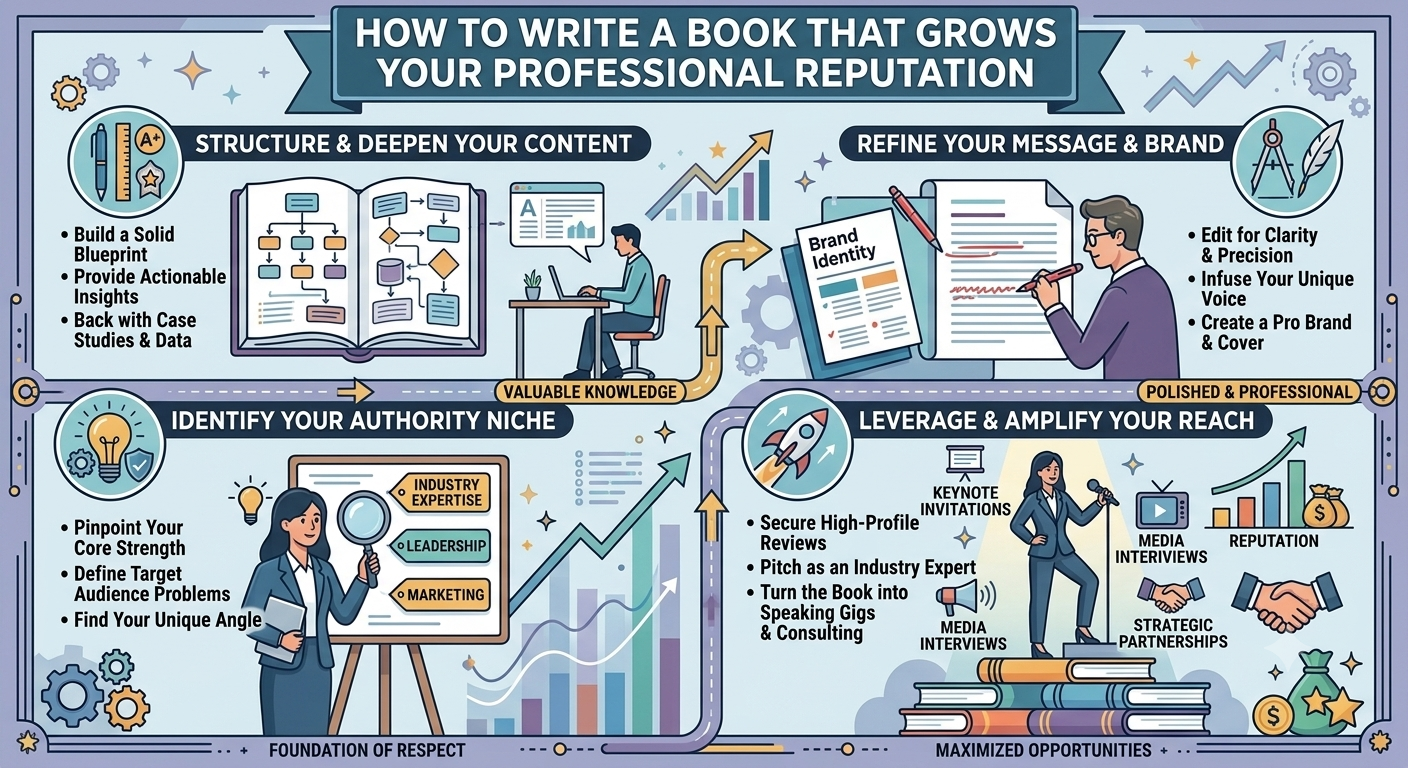
How to Write a Book That Grows Your Professional Reputation?
1. Define Your Objectives
Prior to starting your writing, you need to decide on the main purpose of your book. Many professionals publish books in order to advertise their services and attract new clients. Others want to become recognized figures in their field or educate newcomers on the basics of a specific profession. No matter what your final goal is, it must represent your professional expectations and have a major impact on the structure of your book.
For instance, one book could show professional content writers trade secrets, while another is aimed to give business owners an in-depth understanding of consulting services. The book’s structure and subject matter depend on the objectives set by the author.
In any case, your manuscript needs to contribute to your professional development. By doing that, you can get more opportunities for career growth and build your personal brand on a solid foundation.
2. Pick Topics Worth Sharing
Your professional reputation will greatly benefit from the book’s topics. It is essential to understand that the main purpose of your writing is to represent you as a competent expert in your field. It does not mean you need to have extensive knowledge and experience in each and every subject of your industry, but rather have in-depth understanding of the specific issue that your future clients are facing.
That way, a marketing professional can decide to focus on teaching people how to build a successful content strategy. Meanwhile, a career coach can discuss ways to improve one’s professional reputation. In any case, the subject of your book should represent your professional background and provide solutions to the problems you know people are struggling with.
First of all, you need to analyze the demands of the readers in your professional niche. Choose a niche and research the hottest issues people in your field have discussed recently.. Find the things your readers want to know about and take it from there. A good book does not only represent and promote the author’s knowledge – it also provides readers with clear answers and explains the things they want to learn about.
3. Consider Your Audience
A book can help you grow your professional reputation, but it should always be intended for a particular group of people. That is why it is essential to define your target audience prior to writing your book. Understand what professional background your readers need to have, what knowledge level they are at, and what issues they are interested in. Are you writing for beginners who need your help in gaining basic knowledge? Are you going to train experienced specialists who know almost everything about their field but are still looking to improve? All of these details matter because, ultimately, the book’s structure and language style have to be convenient for your readers.
That is why it is vital to define the level of expertise among your target audience. Depending on it, you will decide whether you need to use simple language for explaining things you know well and provide extra details to help your readers master the material.
Another important thing to consider is what your readers want to learn about. Are they looking for ways to improve their professional reputation? Do they want to find solutions to their professional issues? By providing clear answers to these questions, you will make your readers more sure about what they want to achieve by studying your book. Furthermore, when you manage to reach your audience and help them positively affect their professional image, they will most likely share their positive experience and recommend you on your page.
4. Structure Your Information Clearly
Your book needs to have a clear structure that makes sense and connects well. It helps people follow the main subject and stay interested in reading more and learning more. The structure also demonstrates your knowledge and understanding of the subject. As you begin writing your manuscript, try breaking the large subject into several topics. Then, break these topics into smaller subtopics. After you have done that, organize the information you gathered in a proper way so that it is easy to understand.
For instance, the book on shaping and improving professional reputation has to contain such chapters as ‘Professional Identification’, ‘Learning to Communicate’, ‘Producing Valuable Content’, ‘Developing Connections’, and many other interesting and relevant subjects. Remember that no book is perfect if it only states facts and lacks clear explanations. That is why it is a good idea to add relevant examples and cases, share your professional knowledge, and provide any valuable information you have gathered that might be useful for your audience.
At the same time, it is a mistake to overinflate your book with unnecessary information when you can provide more relevant explanations. The professional image of the book’s author depends on how valuable that information is and how well it is explained. In addition to providing facts, you may want to add stories and experiences that helped you understand the subject. However, when discussing difficult issues, you need to stay objective and honest and explain the things you know clearly. Moreover, when citing valuable facts and pieces of knowledge, make sure to credit the authors that contributed to your writing, and ask for permission to use those materials if it is needed.
As you publish information that represents your professional background and makes you look like a reliable source of information, you also want to make sure the book is well-written. That way, you can positively impact the professional reputation of the book’s author.
5. Make Necessary Edits and Proofread
Your manuscript has to be edited and proofread so that it produces the result you want it to. Any book published in electronic or print format is bound to gain or lose your audience’s trust based on its quality. That is why it is vital to invest enough time in editing. If you are not confident in your writing skills or simply want to receive more useful feedback, you can send your manuscript to professional editors for review.
Once you make the necessary edits and revisions, it is time to focus on your book’s appearance. Make it look nice and professional. Use good-to-read standard fonts and avoid any unnecessary underlining or coloring. Your book’s design is an inseparable aspect of your authorship and, once again, the professionalism of your image. If there are any images, diagrams, or tables in your manuscript, make sure they are relevant and helpful.
6. Market Your Publication
A book always has a primary target audience. In order for your book to gain recognition among your potential readers, you need to make sure they can quickly find relevant information and benefit from your publication. One of the best ways to do that is to share valuable resources from your book on professional social media networks, such as Linked In. You can post useful articles, study and analyze relevant subjects, and educate your audience on the topic you chose for your book. Invite specialists from your field to comment on your posts and participate in professional interactions.
You can use your book to gain a better spot in your professional niche and attract more clients. When you contact new potential employers or clients, you can send them a link to your publication. This will allow them to see your personality, professionalism, and the quality of your services. You can also ask your readers to leave feedback and recommend you on their social media pages. Altogether, by actively promoting your publication, you can improve your professional reputation among your primary target audience.
7. Convert the Book into New Opportunities
You might have published a great book, but it only has limited effect on your professional reputation if you do nothing else. In addition to being a learning tool for new professionals and a helpful guide for experienced specialists, your book has to be your main source of connections and new opportunities. After you publish your book, try converting it into seminars for businesses, teaching materials for new professionals, or online webinars.
A book on building a strong professional reputation can become an ultimate guide for developing your image as an expert, and a book on content writing can convert into a workshop for business owners on how to improve and strengthen their content strategy. Your book will also help you establish a dialogue with other professionals, as they now have a common subject to rely on. Altogether, when choosing the right way to support your book, you greatly benefit from new clients, greater professional reputation, and valuable connections.
Moreover, it is essential to remember that no book guarantees you customers or financial stability. Although a book represents your professional competence and knowledge, it still has to be actively promoted. In addition, no matter how helpful it is, no book can replace years of valuable professional experience.
Conclusion: Professional Reputation
Writing a book for professional reputation can be a challenging and rewarding experience. You need to clearly define your goals, conduct thorough research, and properly structure your publication. Your manuscript has to be written in a clear professional manner that demonstrates your language skills and attention to detail. Additionally, it is vital to actively promote your book and share it with your target audience so that they can benefit from it and eventually choose you for your professional services.
Turn your knowledge and experience into a powerful professional asset by writing a book that delivers real value to readers. Define your expertise, share your insights, and use your book to attract potential clients and new career opportunities. Explore the Best Job Tool to discover opportunities that match your skills and professional goals, and take the next step toward building a stronger personal brand.



Leave a Reply