Marketing has become increasingly data-driven. Businesses no longer rely only on creative campaigns and intuition to understand what works. They use customer behavior, campaign performance, website activity,Non Technical sales data, and audience insights to determine where marketing investment should go and how strategies should improve.
This shift has created opportunities in marketing analytics for professionals who may not have advanced technical or programming backgrounds. Marketing analytics is not limited to data scientists or highly technical analysts. Many roles require a combination of marketing knowledge, analytical thinking, communication, spreadsheet skills, visualization, and business judgment.
For professionals coming from marketing, sales, communications, customer service, operations, or administration, marketing analytics can provide a practical path into a more data-focused career. The transition can also support remote work, international opportunities, and flexible career development when combined with effective productivity and financial planning.
1. Understand Marketing Analytics Before Choosing a Career Path
Marketing analytics involves using data to evaluate marketing activities and make better business decisions.
A marketing analytics professional might investigate:
- Which campaigns generate the most leads
- Which channels produce the best return
- How customers move through a sales funnel
- Which audience segments respond to specific campaigns
- Why website conversions have increased or declined
- Which content produces the most engagement
- How customer acquisition costs are changing
- Which campaigns contribute to revenue
The role is not simply about creating reports.
The real objective is to answer business questions.
For example, instead of reporting that an email campaign generated a 4% click-through rate, an analyst might investigate whether those clicks resulted in qualified leads, purchases, or repeat customers.
This distinction is important for non-technical professionals. You do not need to become a programmer to add value. You need to learn how to connect marketing activity with measurable business Technical outcomes.
2. Explore Marketing Analytics Career Options
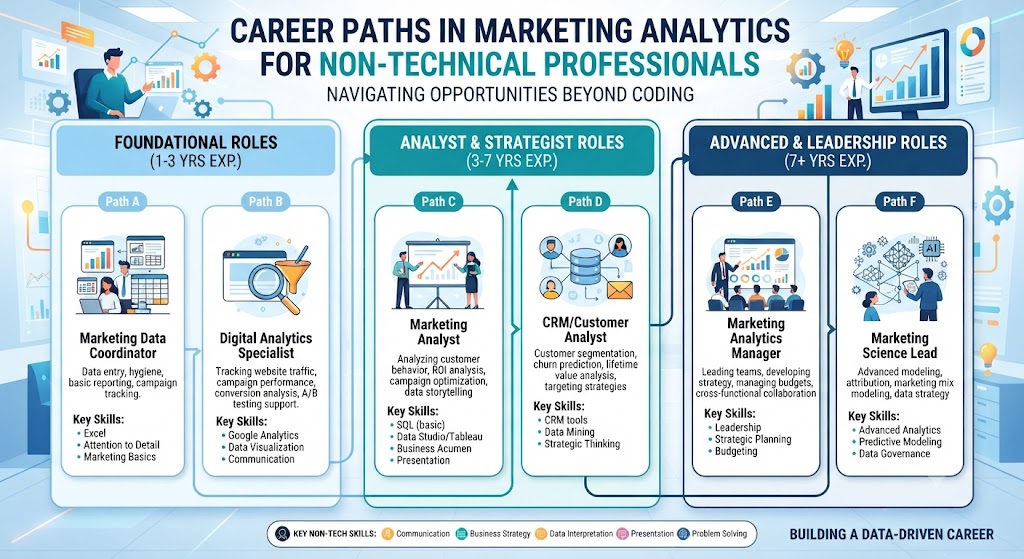
There are several career paths within marketing analytics, and each requires a slightly different skill combination.
Marketing Analyst
Marketing analysts evaluate campaign performance, customer behavior, and marketing channels. They often create reports and dashboards for marketing teams.
Digital Marketing Analyst
Digital marketing analysts focus on online channels such as websites, search, paid advertising, email, and social media.
They may analyze:
- Traffic
- Conversions
- Cost per acquisition
- Engagement
- Campaign performance
- Landing-page effectiveness
Marketing Performance Analyst
This role focuses heavily on measuring marketing efficiency and return on investment. It can be a strong option for professionals interested in connecting marketing performance with financial outcomes.
Customer Insights Analyst
Customer insights professionals examine customer behavior, preferences, feedback, and segmentation to help organizations understand their audiences.
CRM Analyst
CRM analysts work with customer relationship data to improve retention, segmentation, lifecycle marketing, and customer engagement.
Marketing Operations Specialist
Marketing operations combines analytics, processes, technology, reporting, and campaign management. It can be particularly suitable for professionals who enjoy organizing systems and improving workflows.
Other potential paths include:
- Growth analyst
- Marketing reporting specialist
- Campaign analyst
- Content performance analyst
- Revenue operations analyst
- E-commerce analyst
You do not need to choose a specialization immediately. Non Technical Start with broad marketing analytics skills and identify which type of work you enjoy most.
3. Build Analytical Skills Without Becoming a Programmer
Non-technical professionals often make the mistake of assuming that marketing analytics requires advanced coding.
For many entry-level roles, the better starting point is spreadsheet-based analysis.
Develop strong skills in:
- Excel or Google Sheets
- Pivot tables
- Formulas
- Data cleaning
- Sorting and filtering
- Basic statistics
- Charts and dashboards
- Percentage and growth calculations
- Trend analysis
Then learn a visualization platform such as Power BI Non Technical or Tableau.
You should also become familiar with common marketing metrics.
Acquisition metrics
- Cost per click
- Cost per lead
- Customer acquisition cost
- Conversion rate
Engagement metrics
- Click-through rate
- Engagement rate
- Time on page
- Email open rate
Revenue metrics
- Return on marketing investment
- Customer lifetime value
- Average order value
- Revenue per customer
Do not memorize metrics without understanding them.
For example, a campaign with a high click-through rate is not necessarily successful if those clicks do not produce qualified customers.
Strong marketing analysts understand the relationship between metrics.
4. Turn Existing Marketing Experience Into an Analytics Advantage
If you already work in marketing, you may have more relevant experience than you realize.
Suppose you have managed social media campaigns. You have probably already monitored reach, engagement, clicks, follower growth, and content performance.
Instead of viewing this only as social media experience, learn how to analyze the underlying data.
Ask:
- Which content formats consistently perform best?
- Which audience segments engage most?
- Does engagement translate into website traffic?
- Which posts generate qualified leads?
- How does performance change over time?
Similarly, an email marketer can analyze open rates, click rates, conversions, unsubscribe rates, and customer segments.
A content professional can examine organic traffic, engagement, Non Technical conversion paths, and content-assisted revenue.
This approach allows you to reposition existing experience rather than starting your career from zero.
Your resume should focus on outcomes.
Instead of writing:
“Managed social media accounts.”
Consider demonstrating analytical responsibility:
“Analyzed social media performance to identify high-performing content formats and improve campaign planning.”
The second version communicates analytical thinking.
5. Build a Portfolio With Realistic Marketing Problems
A portfolio is especially useful when transitioning into marketing analytics.
You can create projects using public datasets, sample campaign data, or clearly labeled hypothetical scenarios.
Project idea: Campaign performance dashboard
Create a dashboard comparing several marketing channels.
Include:
- Spend
- Impressions
- Clicks
- Leads
- Conversions
- Cost per acquisition
- Revenue
Then identify which channels provide the strongest performance.
Project idea: Customer segmentation
Create customer groups based on purchase behavior, frequency, location, or engagement.
Then recommend different marketing strategies for each segment.
Project idea: Content performance analysis
Compare different content formats and identify patterns in traffic, engagement, and conversions.
The important part is not the visual appearance of the dashboard.
Explain:
Business question → Data → Analysis → Finding → Recommendation
This shows employers that you understand how analytics supports decision-making.
If you use hypothetical data, clearly state that the project is a demonstration rather than actual company performance.
6. Target Remote Marketing Analytics Roles Strategically
Marketing analytics can be well suited to remote work because reporting, dashboard development, research, analysis, and many stakeholder interactions can be completed digitally.
However, remote professionals need strong communication and documentation habits.
When working remotely:
- Document analytical assumptions.
- Keep dashboards organized.
- Record data sources.
- Maintain clear deadlines.
- Communicate unexpected changes quickly.
- Provide concise explanations with reports.
- Use asynchronous communication effectively.
A remote analyst should not assume that stakeholders will understand the numbers automatically.
A strong report should explain what changed, why it matters, and what action should be considered.
Search using multiple job titles
Do not limit your search to “Marketing Analyst.”
Also consider:
- Digital Marketing Analyst
- Marketing Performance Analyst
- Customer Insights Analyst
- CRM Analyst
- Growth Analyst
- Marketing Operations Analyst
- Marketing Reporting Specialist
- Revenue Operations Analyst
For professionals looking for international remote opportunities, best job tool, a global job platform, can be part of a broader job-search strategy alongside company career pages, professional networking, and referrals.
Focus on jobs where your existing marketing experience overlaps with analytical responsibilities.
7. Combine Career Development With Travel, Productivity, and Financial Planning
Marketing analytics can potentially support a flexible work lifestyle, but remote employment should not automatically be treated as permission to work from anywhere.
If you want to work while traveling, first confirm your employer’s rules regarding international remote work.
Consider:
- Tax requirements
- Data privacy
- Client information
- Time-zone expectations
- Company security policies
- Internet reliability
- Work authorization
- Meeting schedules
Run a travel test
Instead of immediately planning extended travel, conduct a short trial.
Work remotely from another location while maintaining your normal schedule.
Track:
- Working hours
- Productivity
- Meeting attendance
- Internet reliability
- Quality of work
- Travel expenses
- Personal energy levels
If your performance remains consistent, you have stronger evidence that the arrangement can work.
If productivity declines, identify the cause before planning another trip.
Create a productivity system
Marketing analysts often manage multiple dashboards, campaign requests, reporting deadlines, and stakeholder questions.
Use a simple tracking system containing:
| Task | Stakeholder | Deadline | Status | Next Action |
|---|---|---|---|---|
| Campaign report | Marketing | Friday | In progress | Validate data |
| Dashboard update | Growth | Monday | Pending | Receive source data |
| Customer analysis | CRM | Wednesday | Complete | Present findings |
This prevents analytical work from becoming reactive.
Protect your finances
Career flexibility requires financial stability.
Before changing jobs or combining work with travel, calculate:
- Monthly essential expenses
- Accommodation
- Transportation
- Internet
- Equipment
- Insurance
- Taxes
- Training
- Emergency savings
Maintain a financial buffer before making major lifestyle changes.
As your career develops, consider specializing in areas such as customer analytics, marketing operations, CRM, performance marketing, or revenue analytics. Specialization can increase your professional value without requiring you to become a highly technical data engineer.
You can also use best job tool to explore global career opportunities while continuing to develop your portfolio and professional network.
Conclusion
Marketing analytics offers several career paths for professionals who do not come from technical backgrounds. The field rewards people who can combine marketing knowledge with analytical thinking, clear communication, and practical business judgment.
You can begin with Excel, spreadsheets, marketing metrics, and data visualization before gradually learning more advanced analytical tools. You do not need to become a programmer to start creating value.
The strongest transition strategy is to build on your existing experience. Marketing professionals can analyze campaign performance, content specialists can study engagement and conversions, CRM professionals can explore customer behavior, and operations professionals can move toward marketing operations and reporting.
A practical portfolio can further demonstrate your abilities. Focus on business questions and recommendations rather than simply displaying attractive dashboards.
Remote work can add flexibility, but it requires reliable communication, disciplined workflows, secure technology practices, and clear employer policies. If you want to combine remote employment with travel, test the arrangement first and evaluate productivity, connectivity, and costs.
Finally, build your career gradually. Strengthen your analytical foundation, develop a specialization, document measurable results, maintain a strong portfolio, and manage your finances carefully. With these steps, marketing analytics can become a sustainable career path for non-technical professionals seeking both professional growth and greater workplace flexibility.





Leave a Reply