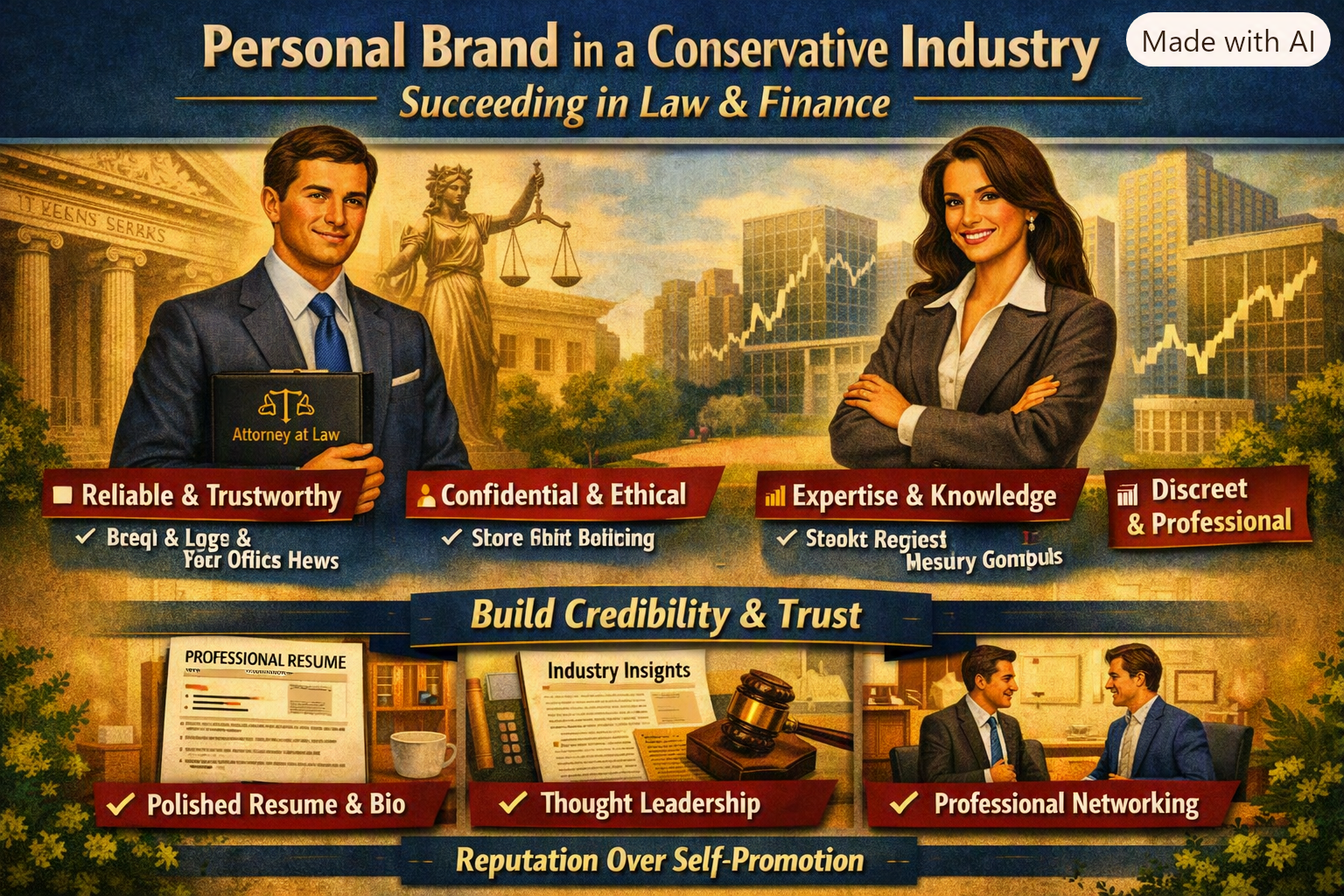
Introduction: Conservative Industry
Building a personal brand can prove to be challenging, particularly for those working in any sort of conservative industries. Law and finance exemplify sectors that build their culture around reliability, expertise, confidentiality, and other elements that often conflict with social media-driven self-promotion.
Luckily, personal branding does not necessarily mean becoming an influencer – it is more about building a certain image and promoting one’s expertise, knowledge and skills in order to position oneself as a professional in a certain field.
How to Build a Personal Brand in a Conservative Industry Like Law or Finance?
1. Understand What Personal Branding Is
Personal branding refers to individuals’ perceptions of one’s profession, talents, competencies, character, personality, accomplishments, digital presentation, and overall experience. For example, a lawyer’s personal brand can be represented by their specialization: corporate law, litigation, and so forth. In turn, the personal brand of a financial expert can be the area they advise their clients on: investment, tax, and business matters.
However, it is essential to note that personal branding does not equal extreme populism. One must not seek to become famous among everybody. Instead, the individual has to identify their target audience and then determine what they want to be known for. Moreover, the person should think about what they bring to the table to shape the correct perception of them.
Therefore, to determine the personal brand, one must answer three questions: what one wants to be known for, their target audience, and what they can bring to the table.
2. Establish Authority Before Becoming Popular
It is especially important for representatives of conservative spheres, such as lawyers and financial experts, to build authority among their future clients. For them, social media “likes” and followers are not important. In fact, these two last mentions should not be the goal of a personal brand building process but instead the outcome.
Hence, when creating content, it is better to specialize rather than try to comment on everything. Although lawyers and financial experts are general terms that cover a wide range of sub-industries, it is wiser to pick a narrower specialization and build experience there. For example, a lawyer can specialize in tech deals and comment exclusively on matters that fall under this bracket. In turn, the financial expert can specialize in corporate finance and analyze matters related to this field.
Overall, in building a personal brand, a lawyer or a financial expert must act as an expert resource that provides their audience with information they would otherwise not get.
3. Use LinkedIn as Your Professional Medium
For a finance or legal expert, Linked In is an excellent platform to build a personal brand due to its professional environment.
Ensure that your profile picture is up to standard, the headline is compelling, and the About section describes services that solve particular problems for the client.
For instance, instead of writing “Experienced professional dedicated to excellence,” it would be better to describe specific skills and the target audience or clients.
A competent assistant would probably say, “I am ready to assist a growing business in attaining stability,” instead of, “I am a finance expert with XX years of experience.”
Specificity is critical to establishing a strong personal brand.
4. Produce Educational Content
The next compelling idea for your personal brand building is to educate.
Think about what you are good at and can explain simply and clearly.
Many successful LinkedIn publishers do it by regularly posting articles about their field of expertise and describing some of their professional achievements.
They do not post research-heavy think pieces; they share vital information, explain nuances related to their field, answer frequently asked questions, and much more.
A finance expert might, for instance, write an article about the typical mistakes entrepreneurs make when studying financial statements. A lawyer could give practical advice on negotiating contracts and other common business challenges. All that is needed is to post at least one article on LinkedIn weekly or every two weeks. And it would be more beneficial to post consistently but not frequently than to publish ten articles one week and then go on a six-month hiatus.
5. Maintain Professionalism and Ethical Standards
Working in law and finance challenges personal branding because professionals must handle confidential information and comply with regulatory restrictions.
Avoid disclosing any confidential information of your clients just to tell an interesting story. In addition, be cautious while talking about cases, various transactions, investments, and professional relationships. Avoid exaggerating your achievements and competencies.
Build your online brand in such a way that reflects the key qualities clients are looking for in you. Keep in mind that all the information published under your name may affect your personal reputation as a professional. Every element of your online presence should represent you as a qualified, discreet, honest, and competent expert on the subjects of finance and law.
6. Network Authentically
While the online presence is essential in the personal branding process, it should not be the sole aspect of your activities. Meet other professionals in person by attending conferences, industry events, seminars, and workshops.
Engage in conversations with like-minded people and those who can offer beneficial connections, job opportunities, invitations to speak at the events, and media interviews. Focus on maintaining relationships rather than think about how you can benefit from the meeting right away. Network genuinely in order to build long-term partnerships and bases for referrals.
Conclusion: Conservative Industry
The conclusion that can be drawn from the research is that it is essential to know how to build a personal brand in a conservative industry such as law or finance. The brand is not created by being edgy, outrageous, opinionated, or by trying too hard to promote oneself.
You achieve success by exercising expertise, speaking articulately, providing education and information, building relationships, and maintaining a high standard of work.
A personal brand plays a critical role since it often serves as an answer to the frequently asked question, ‘Why should I trust this person?’ Therefore, a personal brand, if done correctly, can be a significant asset to clients, colleagues, and employers, providing long-term career benefits in the most competitive industries like finance or law.





Leave a Reply