Introduction
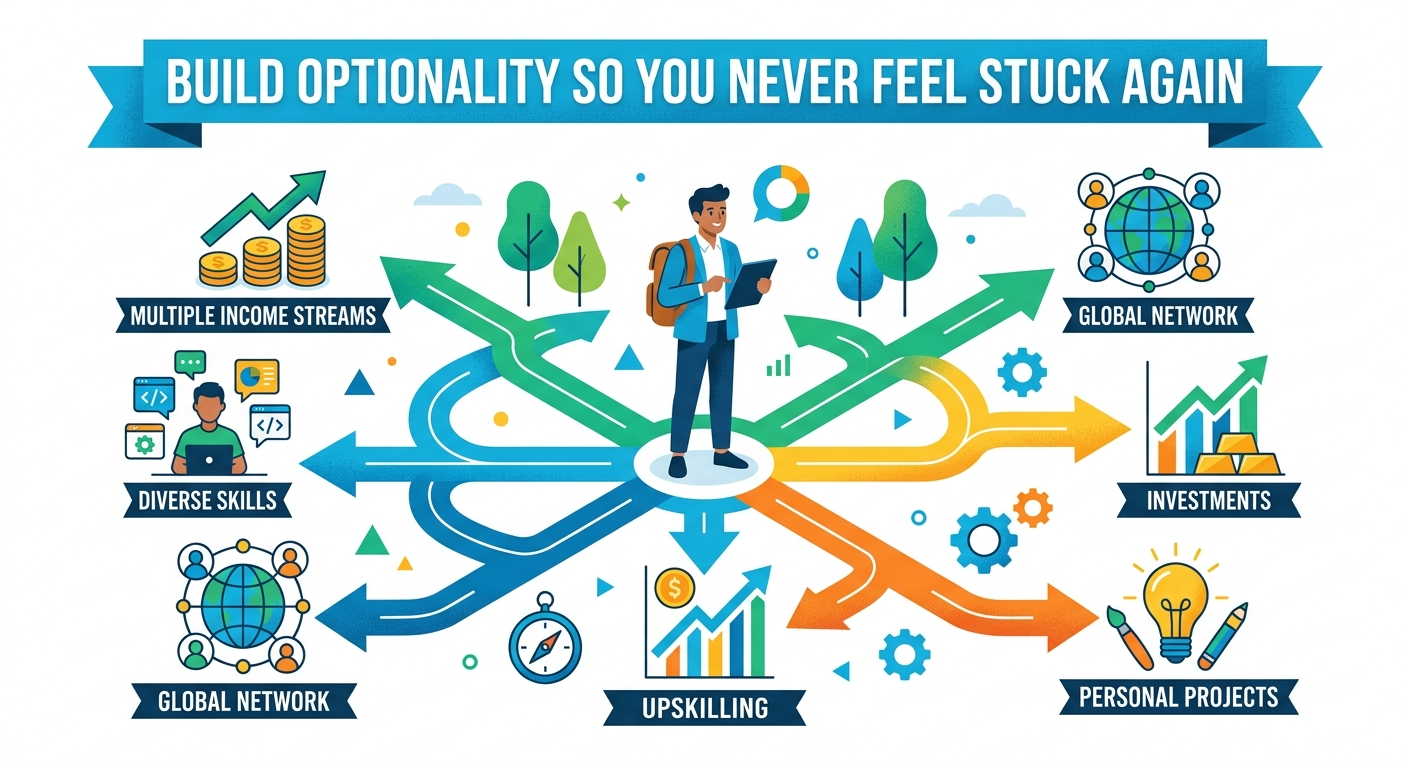
Many professionals feel trapped in careers, industries, or roles that no longer align with their goals. Often, this happens because they depend on a single path, one skill set, or limited opportunities. This is exactly why understanding how to build optionality so you never feel stuck again is essential in today’s evolving professional world.
Optionality means creating multiple possible paths for your future. It gives you the flexibility to adapt, pivot, or grow without feeling restricted by circumstances. Instead of relying on one opportunity, you create a system where choices remain available.
In a rapidly changing job market, optionality has become one of the strongest forms of career security.
Understanding what optionality really means
Optionality is the ability to make choices without being forced into one direction. In career terms, it means having enough skills, opportunities, and flexibility to adapt when needed.
Professionals with optionality are not dependent on a single employer, industry, or income source. They can shift roles, industries, or work styles more easily.
Additionally, optionality reduces fear around uncertainty. It creates confidence because alternatives exist.
Therefore, optionality is not about avoiding commitment. It is about creating flexibility within your career.
Why many professionals feel stuck
Feeling stuck often comes from overdependence. Many individuals spend years building only one type of experience.
As industries evolve, this narrow focus can become limiting. Professionals may struggle to transition because their skills are too specialized or outdated.
Additionally, financial dependency on one income source increases pressure. This makes career changes feel risky.
Moreover, lack of exposure to new opportunities reduces confidence.
Therefore, building optionality helps break this cycle.
How to build optionality so you never feel stuck again
The first step is developing adaptable skills. Focus on abilities that apply across industries, such as communication, problem-solving, leadership, and strategic thinking.
Next, diversify your experiences. Explore projects, industries, or roles outside your current environment.
Additionally, continuously build your professional network. Opportunities often come through relationships.
Moreover, stay informed about market trends and emerging industries. Awareness creates preparedness.
Thus, optionality grows through continuous expansion rather than staying static.
Building transferable and future-ready skills
Transferable skills create flexibility because they remain valuable in different environments. These skills allow professionals to move across roles and industries more easily.
Critical thinking, adaptability, collaboration, and emotional intelligence are especially important.
Additionally, digital literacy and technology awareness are becoming essential in nearly every field.
Professionals should also focus on learning how to learn. The ability to adapt quickly becomes more valuable than memorized expertise.
Therefore, future-ready skills are the foundation of optionality.
Diversifying income and professional opportunities
Relying entirely on one income source can create vulnerability. Optionality increases when professionals build multiple streams of opportunity.
This may include consulting, freelancing, side businesses, or investment-based income.
Additionally, cross-functional projects within an organization can expand exposure and experience.
Moreover, diversified opportunities reduce pressure during uncertain periods.
Thus, professional and financial diversification strengthen career flexibility.
The role of networking in creating optionality
Strong networks create access to opportunities that may not be publicly visible. Relationships often become pathways to career transitions.
Professionals should actively maintain and expand their networks through communities, events, and professional platforms.
Additionally, networking exposes individuals to new ideas and industries.
Moreover, helping others within your network strengthens long-term professional relationships.
Therefore, networking becomes a strategic investment in future optionality.
Staying adaptable during industry changes
Industries evolve constantly due to technology, market shifts, and economic conditions. Professionals who resist change often feel stuck when disruption occurs.
Adaptability allows individuals to respond quickly to new realities. Instead of fearing change, they learn how to work within it.
Additionally, adaptable professionals are more willing to experiment and explore new directions.
Moreover, resilience improves when professionals know they can pivot successfully.
Thus, adaptability supports long-term career freedom.
Building confidence through continuous learning
Confidence grows when professionals know they can evolve. Continuous learning creates this confidence.
Learning new skills, understanding market trends, and exploring different fields reduce dependency on a single path.
Additionally, practical experience strengthens adaptability and self-belief.
Moreover, continuous learning improves visibility and competitiveness in the market.
Therefore, learning becomes a long-term strategy for maintaining optionality.
Financial flexibility and career freedom
Financial pressure often prevents people from making career changes. Building financial flexibility creates more freedom to choose.
Savings, diversified income, and controlled expenses reduce dependency on one role or employer.
Additionally, financial preparation allows professionals to take calculated risks.
Moreover, it provides security during transitions or disruptions.
Thus, financial optionality supports career optionality.
Why optionality creates long-term career resilience
Careers today are unpredictable. Professionals who rely on one narrow path often struggle during disruption.
Optionality creates resilience because it provides alternatives. Individuals can shift direction without starting from zero.
Additionally, optionality encourages growth rather than stagnation.
Moreover, it reduces fear and increases long-term confidence.
Therefore, optionality becomes one of the most valuable career assets in the modern workforce.
Conclusion
Understanding how to build optionality so you never feel stuck again is essential in a rapidly changing professional world. Optionality creates flexibility, resilience, and long-term career security.
By developing transferable skills, diversifying opportunities, and continuously learning, professionals can create multiple paths for growth.
In today’s uncertain environment, career strength no longer comes from stability alone. It comes from having choices and the ability to adapt when needed.
To explore future-ready opportunities that support your growth and flexibility, use the best job tool and discover roles aligned with your evolving career goals.
Find Your Dream Job Today – Explore Endless Career Opportunities and Secure Your Next Role with Best Job Tool.


Leave a Reply