Introduction
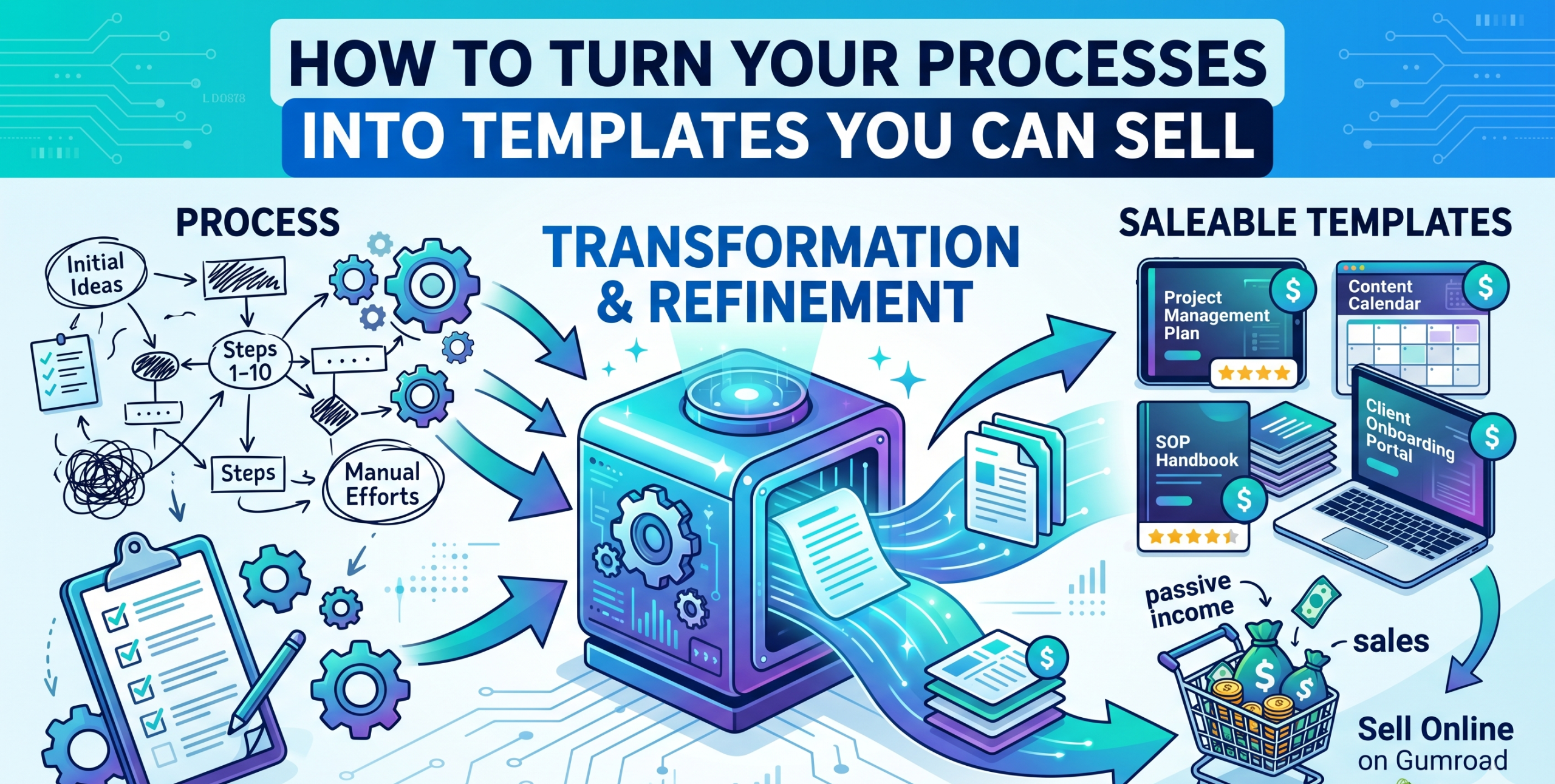
Most professionals and businesses already use repeatable processes—whether in marketing, recruitment, operations, or client management. The challenge is that these systems often remain internal and undocumented, limiting their value.
Turning your processes into sellable templates allows you to scale your expertise beyond time-based work. Instead of trading hours for income, you package knowledge into reusable assets that others can implement immediately.
This approach is increasingly popular among freelancers, consultants, creators, and remote professionals looking to build scalable income streams.
Identify Processes That Have Repeatable Value
Not every task is worth turning into a template. The first step is identifying processes that are structured, repeatable, and useful to others.
Strong candidates include client onboarding workflows, content creation systems, email outreach sequences, hiring and recruitment processes, project management frameworks, and social media planning systems.
A good rule is simple: if you’ve done it more than five times with similar steps, it likely has template potential. Focus on processes that solve clear problems rather than highly customized or one-off work.
Break Down Your Workflow Into Clear Steps
Once you identify a process, the next step is deconstruction. You need to convert experience-based work into structured, step-by-step instructions.
Start by documenting inputs required such as tools, data, and resources, followed by the sequential steps involved in execution. Include decision points, alternatives, and expected outputs or results.
For example, a content strategy process can be broken into research topics, defining audience segments, building a content calendar, writing and optimizing content, and publishing with performance tracking.
The goal is clarity. If someone unfamiliar with your work can follow it, the process is ready for templating.
Standardize and Remove Personal Dependency
One of the biggest mistakes in process design is over-reliance on personal judgment. To make a process sellable, it must be standardized.
This means removing subjective decision-making where possible, creating rules or criteria for choices, defining clear checklists instead of open-ended tasks, and using consistent formats and structures.
Instead of “write engaging emails,” define subject line formulas, email length range, tone guidelines, and CTA placement rules.
Standardization transforms expertise into a system that others can replicate without your presence.
Convert Processes Into Usable Templates
Once structured, your process must be converted into a user-friendly format. This is where monetization potential begins.
You can turn processes into Notion templates, Google Docs frameworks, Excel systems, workflow checklists, SOP documents, or automation workflows.
Each template should include a title and purpose, step-by-step instructions, examples or sample outputs, tools required, and common mistakes to avoid.
Clarity and usability matter more than complexity. A simple, actionable template often sells better than a sophisticated but confusing system.
Add Context, Not Just Instructions
A sellable template is not just a checklist—it is a guided system. Buyers need context to understand why each step matters.
Enhance your templates by adding brief explanations for each stage, real-world examples from your experience, expected outcomes, time estimates, and variations for different use cases.
Instead of only stating “send follow-up email,” explain when to send it, why timing matters, and what response patterns to expect.
This transforms your template into a learning tool rather than just a document.
Package and Position Your Templates for Sale
Even the best template will not sell without proper packaging. Positioning determines perceived value.
Define your target audience such as freelancers, agencies, or startups, the problem your template solves, the outcome it delivers, and the time or cost it saves.
Then package your product with a clean title, a short outcome-focused description, visual previews, and a clear usage guide.
You can sell templates through digital marketplaces, personal websites, or professional platforms. The key is to position your template as a solution, not a document.
Test, Refine, and Improve Based on Feedback
Your first version of a template is rarely perfect. Treat it as a product that evolves.
Share it with a small audience, collect feedback on clarity and usability, track where users struggle, refine instructions, and add missing steps or examples.
You can also create beginner, advanced, and industry-specific versions to expand reach.
Many professionals use the Best Job Tool to track feedback cycles, monitor user interaction, and refine template systems for better performance and usability.
Iteration is what transforms a basic document into a high-value digital product.
Conclusion
Turning your processes into sellable templates is one of the most efficient ways to scale expertise into income. Instead of repeatedly delivering the same work, you create systems that others can apply independently.
The process is simple but requires discipline: identify repeatable workflows, structure them clearly, remove ambiguity, and package them into usable formats. Once refined, these templates become scalable digital assets that generate long-term value.
With consistent improvement and strategic positioning, even simple internal processes can evolve into profitable products that extend your professional impact far beyond direct client work.




Leave a Reply