Introduction
Most professionals react to changes in the job market only after they become public headlines. By that point, industries may already be slowing down, hiring priorities may have shifted, and competition may have increased. This is exactly why understanding how to read job market signals before they hit the news is such a valuable career skill.
Early signals often appear long before major announcements. Companies adjust hiring patterns, industries change investment priorities, and new skills quietly become more valuable. Professionals who notice these shifts early gain a major advantage.
In a fast-changing economy, the ability to identify trends before they become obvious can significantly improve career decisions.
Understanding what job market signals really are
Job market signals are indicators that reveal changes in hiring demand, industry direction, and workforce priorities before those changes become widely discussed.
These signals can appear in hiring trends, company behavior, technology adoption, or skill demand. They often provide insight into where opportunities are increasing or declining.
Additionally, market signals are rarely dramatic at first. Small shifts usually happen gradually before becoming visible at scale.
Therefore, professionals who pay attention early can prepare before competition increases.
Why most people notice changes too late
Many professionals rely only on mainstream news or public discussions for career information. However, by the time major trends appear in the news, companies have often already adjusted internally.
Additionally, people tend to focus only on their immediate roles rather than broader industry movement.
Moreover, short-term thinking causes professionals to ignore early indicators that seem minor initially.
As a result, many react to disruption instead of preparing for it proactively.
How to read job market signals before they hit the news
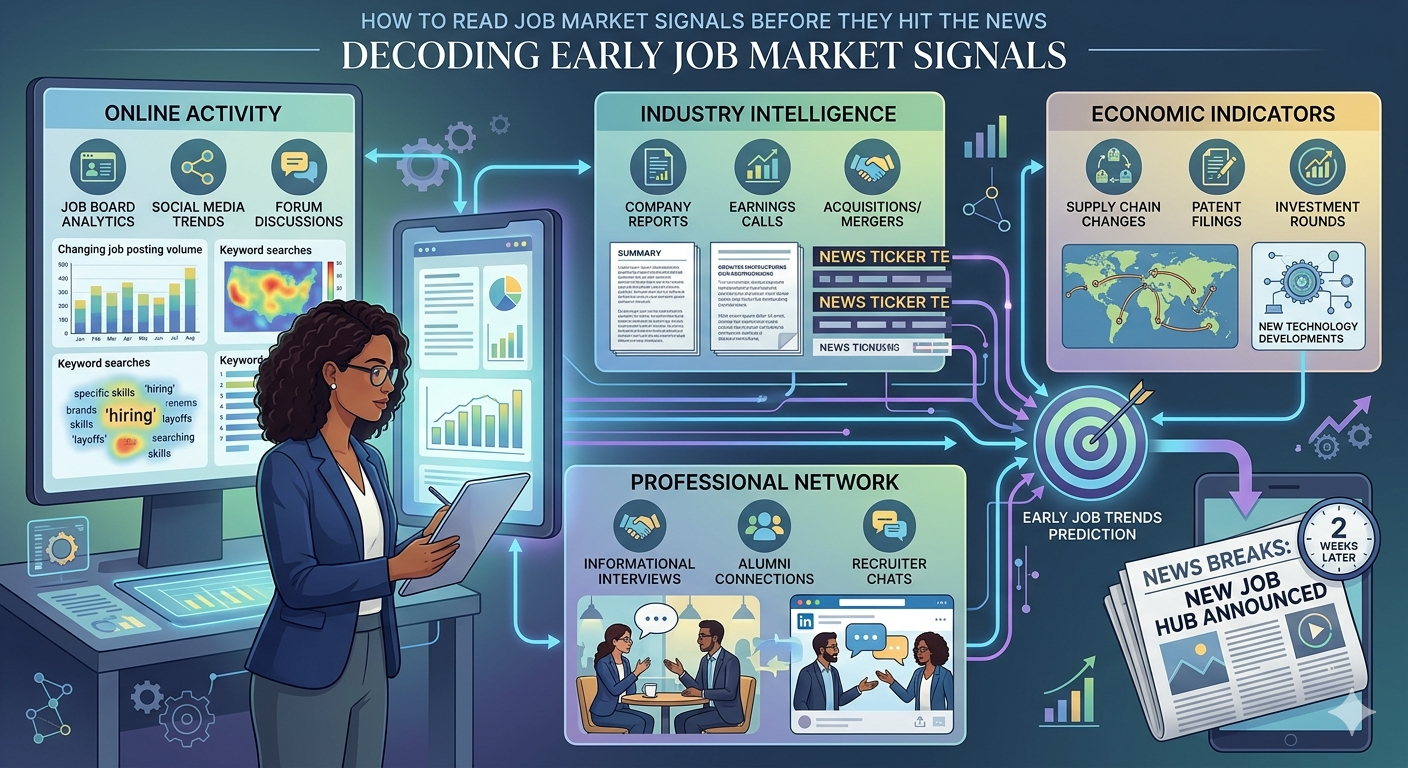
The first step is paying attention to hiring patterns. Changes in job postings often reveal where industries are moving.
If companies suddenly prioritize specific skills or roles, it usually signals future demand shifts.
Additionally, observe which departments companies are expanding or reducing. This often reflects strategic priorities before official announcements happen.
Moreover, track conversations within professional communities and industry networks. Experts often discuss changes long before they become public news.
Thus, awareness and observation create an early advantage.
Watching hiring trends and job descriptions carefully
Job descriptions provide valuable insight into market direction. They reveal what companies are investing in and what skills are becoming more important.
For example, increasing demand for AI-related roles, automation skills, or remote collaboration expertise often signals broader industry shifts.
Additionally, noticing declining demand in certain categories may indicate slowing sectors.
Moreover, repeated patterns across multiple companies are stronger indicators than isolated examples.
Therefore, hiring trends act as real-time market intelligence.
Following investment and business expansion patterns
Companies usually invest in growth areas before industries fully shift. Tracking investments, acquisitions, and expansion plans can reveal future hiring trends.
Organizations hiring aggressively in specific sectors often indicate long-term confidence in those areas.
Additionally, industries attracting funding and innovation usually create future job opportunities.
Moreover, expansion into new markets often increases demand for specialized talent.
Thus, business activity often predicts workforce demand before public headlines appear.
Paying attention to skill demand changes
Skill demand changes faster than job titles. Professionals who track emerging skills early often position themselves ahead of the market.
For example, increased demand for data literacy, cybersecurity, automation, or digital collaboration tools may indicate future growth sectors.
Additionally, transferable skills such as adaptability, communication, and strategic thinking remain consistently valuable across changing markets.
Moreover, observing which certifications or capabilities employers repeatedly request can reveal long-term trends.
Therefore, skills are often stronger indicators than titles alone.
Using professional networks as intelligence sources
Professional communities often detect changes earlier than public media. Industry insiders discuss hiring freezes, growth areas, and operational changes before formal announcements happen.
Engaging with professionals across industries improves awareness of emerging trends.
Additionally, networking conversations often reveal hidden opportunities and shifts in demand.
Moreover, staying active in online communities, LinkedIn discussions, and industry groups increases visibility into market movement.
Thus, relationships provide access to valuable early insights.
Tracking company behavior beyond public messaging
Companies do not always announce strategic changes immediately. However, their actions often reveal priorities.
Hiring freezes, restructuring, leadership changes, or shifts in product focus may indicate deeper changes within the business.
Additionally, changes in company culture or operational models can signal industry-wide transformation.
Moreover, observing patterns across multiple organizations creates stronger market understanding.
Therefore, company behavior often reveals more than official statements.
Staying adaptable when signals change
Market signals are not always permanent. Industries evolve continuously, and trends can shift unexpectedly.
Professionals should avoid overreacting to temporary changes while remaining flexible enough to adapt when necessary.
Additionally, diversification of skills and experience reduces dependence on one market direction.
Moreover, adaptability allows professionals to respond strategically rather than emotionally.
Thus, flexibility improves long-term career resilience.
Turning market awareness into career strategy
Awareness alone is not enough. Professionals must convert insights into action.
This may involve learning new skills, exploring adjacent industries, or building stronger professional visibility.
Additionally, preparing early creates more options before competition increases.
Moreover, strategic career planning becomes easier when professionals understand where markets are moving.
Therefore, market awareness supports smarter long-term decisions.
Conclusion
Understanding how to read job market signals before they hit the news gives professionals a significant advantage in an unpredictable economy. The strongest career decisions are often made before trends become obvious to everyone else.
By tracking hiring patterns, emerging skills, company behavior, and industry conversations, professionals can identify opportunities earlier and prepare more effectively.
In today’s rapidly changing market, career success depends not only on hard work but also on awareness and timing.
To stay ahead of changing hiring trends and discover future-ready opportunities, use the best job tool and position yourself before the market shifts.
Find Your Dream Job Today – Explore Endless Career Opportunities and Secure Your Next Role with Best Job Tool.




Leave a Reply