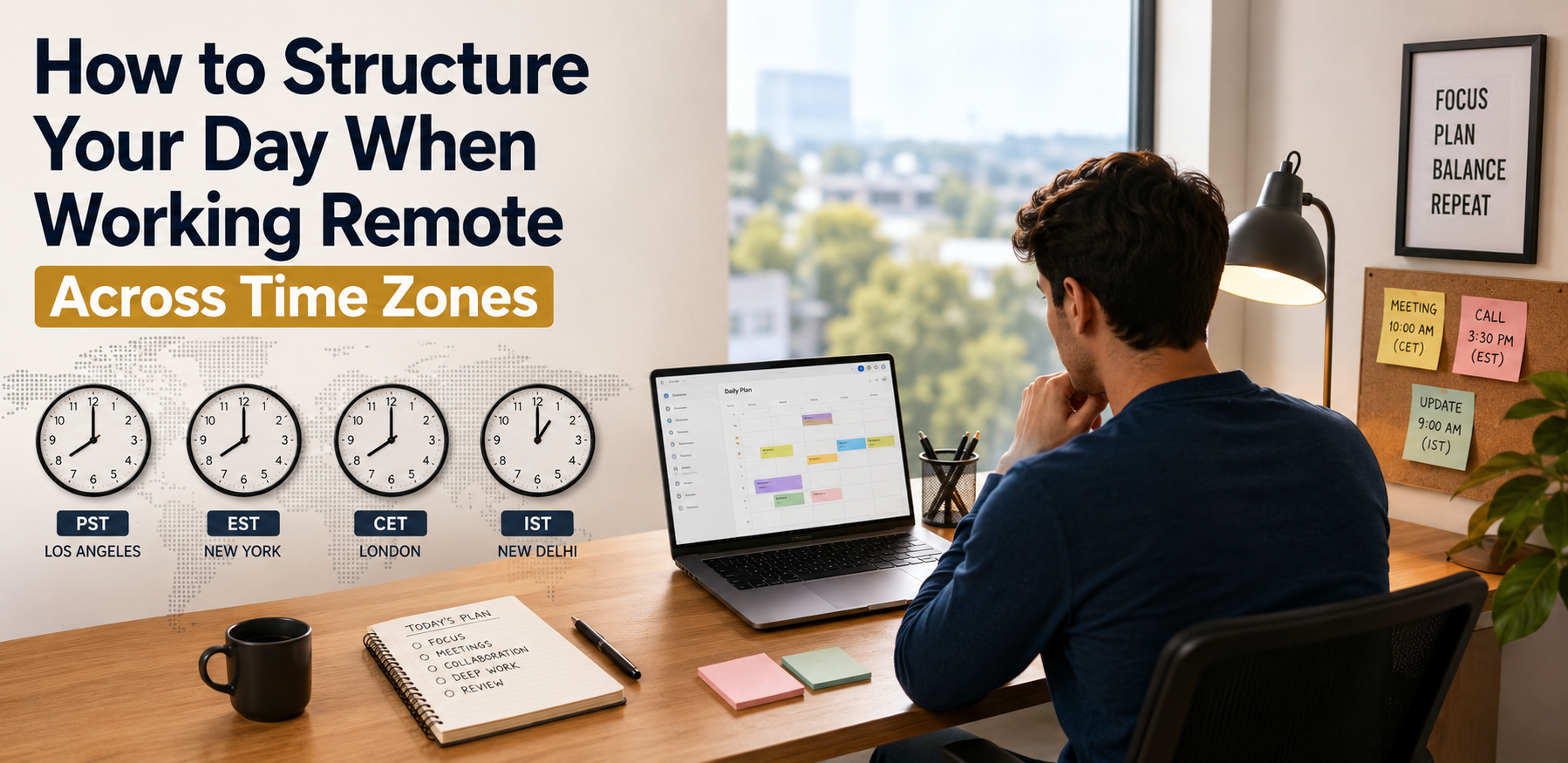
Introduction: Remote Across Time Zones
A remote job gives you flexibility and the freedom to work in your own way. However, because of this, many people do not pay attention to their time. They spend more than half of their day on random activities, and their work is not completed on time.
In remote jobs, team members, clients, and managers are often in different time zones. If you do not structure your day properly, your communication, productivity, and work-life balance can be affected.
That is why it is important to plan your day well. In this article, we will discuss how you can structure your day when work remote across different time zones.
How to Structure Your Day When Working Remote Across Time Zones?
1. Understand the Time Zones You Work With
First, you need to understand your own time zone. You should know where the company headquarters is located, where your manager is based, where your clients are located, and where your team members work from. This will help you manage your time more effectively.
To make this easier, you can use a world clock or a scheduling tool. These tools help you track different time zones and plan your day properly.
2. Identify Your Core Working Hours
Identify your company’s core working hours. This is the time when most employees, clients, and team members are online and available to work.
For example, if you are working from India and your colleagues are working from Europe, there will usually be a few hours during the day when everyone is available at the same time. You can use this time for team meetings, client calls, and collaboration with your team.
3. Plan Deep Work Around Meetings
Prioritize your deep work first. Deep work means the main tasks you are responsible for, such as writing, designing, research, or coding. Focus on these important tasks first and try to complete them before anything else.
Meetings and group discussions should be scheduled during the time when all team members are available. This helps everyone communicate better and work together more effectively.

4. Create a Daily Priority List
Before starting your work, it is important to create a priority list in the morning.
A priority list means writing down the tasks that are most important for the day at the top, less important tasks below them, and avoiding unnecessary tasks whenever possible.
When you create a priority list and work according to it, you complete your most important tasks first. This helps you stay organized and finish your work on time.
5. Use Time Blocking
Using time blocking is very important when working remotely. In a remote job, no one gives you constant instructions, and your schedule is often flexible. You have to work independently. Because of this, many people end up wasting a lot of time scrolling through social media.
That is why you should use time blocking. Time blocking means deciding in advance how much time you will spend on each activity during the day.
For example, you can set 8:00 AM to 10:00 AM for deep work, 10:00 AM to 11:00 AM for checking emails and messages, and schedule the rest of your tasks in specific time blocks throughout the day. This helps you stay focused, organized, and productive.
Conclusion: Remote Across Time Zones
Working remotely across different time zones can be challenging, but with proper planning, it becomes much easier. By understanding different time zones, identifying core working hours, prioritizing deep work, creating a daily priority list, and using time blocking, you can stay productive and organized throughout the day.
“Working across time zones requires more than hard work—it requires smart planning. Build a schedule that keeps you productive and balanced with Best Job Tool.”




Leave a Reply