Introduction: BPO Roles to Business Analysis Jobs
Many people start their careers in the BPO (Business Process Outsourcing) industry because it offers good job opportunities, communication skill development, and exposure to different business processes. However, after working in a BPO for a few years, many professionals look for career growth opportunities beyond customer support, technical support, or operations.
One career path that has become increasingly popular is Business Analysis. Business Analysts play an important role in organizations by identifying business needs, analyzing problems, and helping companies improve their processes and systems.
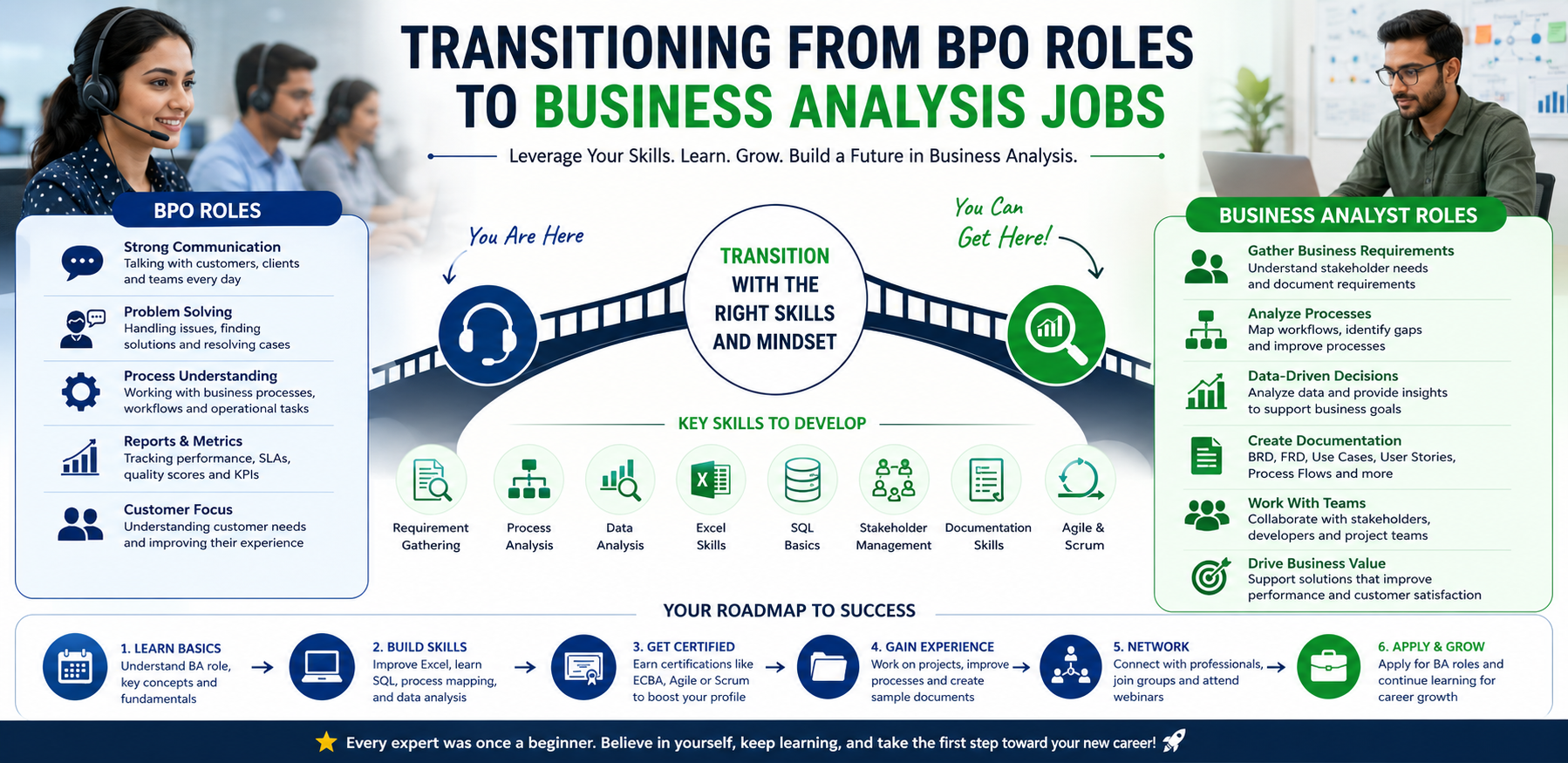
The good news is that BPO professionals already possess many skills that are useful in Business Analysis. Communication, problem-solving, stakeholder management, reporting, and process understanding are all valuable skills for a Business Analyst.
In this article, we will discuss the transition from BPO roles to business analysis jobs.
Transitioning From BPO Roles to Business Analysis Jobs
1. Creating a Business Analyst Resume
Your resume plays a critical role in your career transition.
Instead of focusing only on customer support tasks, highlight transferable skills.
For example:
Instead of writing:
“Handled customer calls and resolved complaints.”
Write:
“Analyzed customer issues, identified root causes, and collaborated with multiple teams to improve service quality.”
Instead of writing:
“Prepared daily reports.”
Write:
“Generated operational reports and analyzed performance metrics to support management decision-making.”
This approach helps recruiters see your business analysis potential.
2. Building Relevant Experience
One of the biggest challenges is getting experience.
Fortunately, you can gain relevant experience even while working in a BPO role.
Volunteer for Process Improvement Projects
Many organizations run improvement initiatives.
Volunteer to participate in projects involving:
- Workflow improvements
- Quality enhancement
- Customer experience improvements
- Automation initiatives
These projects provide valuable business analysis exposure.
Work With Reporting Teams
If your company has a reporting or MIS team, try collaborating with them.
You may gain experience in:
- Data analysis
- Dashboard creation
- Reporting
- Performance tracking
Document Existing Processes
Practice creating process documentation.
You can:
- Map workflows
- Create flowcharts
- Identify bottlenecks
- Suggest improvements
These activities closely resemble Business Analyst responsibilities.
Shadow Business Analysts
If Business Analysts work in your organization, ask whether you can observe their work or assist with projects.
This can provide valuable real-world learning.
3. Learning Agile and Scrum
Many Business Analysts work in Agile environments.
Understanding Agile concepts can improve your employability.
Learn about:
- Sprint Planning
- Product Backlog
- User Stories
- Sprint Reviews
- Daily Standups
Understanding Agile methodologies will help you work effectively with development teams.
4. Networking for Career Transition
Networking can accelerate your career change.
Use LinkedIn
LinkedIn is one of the best platforms for professional networking.
You can:
- Connect with Business Analysts
- Follow industry experts
- Join Business Analysis groups
- Share learning updates
- Publish business-related content
Networking often leads to job referrals and career opportunities.
Attend Webinars
Many organizations conduct free webinars on:
- Business Analysis
- Agile
- Data Analytics
- Project Management
These events help you learn industry trends and connect with professionals.
Join Professional Communities
Participate in online communities where Business Analysts share knowledge and experiences.
You can learn practical insights that are not always available in textbooks.
A Step-by-Step Transition Plan for BPO Roles to Business Analysis Jobs
Here is a practical roadmap for moving from BPO to Business Analysis:
Month 1–2
- Learn Business Analysis fundamentals
- Understand the BA role
- Improve Excel skills
Months 3–4
- Learn SQL basics
- Practice process mapping
- Study requirement gathering techniques
Month 5–6
- Learn Agile and Scrum concepts
- Create sample BA documents
- Update your resume
Months 7–8
- Complete a Business Analysis certification
- Build a project portfolio
- Start networking on LinkedIn
Month 9–12
- Apply for Business Analyst positions
- Attend interviews
- Continue improving technical and analytical skills
Following a structured plan can make the transition smoother and more successful.
Conclusion: BPO Roles to Business Analysis Jobs
Transitioning from a BPO role to a Business Analysis job is completely achievable. In fact, many of the skills developed in customer support, operations, and process management directly align with the responsibilities of a Business Analyst. Strong communication, problem-solving abilities, process understanding, and reporting experience provide a solid foundation for this career change.
By learning Business Analysis concepts, developing data analysis skills, gaining practical experience, earning relevant certifications, and building a strong professional network, BPO professionals can successfully move into Business Analysis roles. With dedication and continuous learning, this transition can open the door to better career growth, higher salaries, and exciting opportunities across various industries.




Leave a Reply