Introduction
Forensic accounting and fraud detection have become increasingly important as organizations manage complex financial systems, digital transactions, remote operations, and growing regulatory requirements. Companies need professionals who can examine financial information, identify irregularities, investigate suspected misconduct, and clearly explain financial evidence.
A career in forensic accounting combines accounting knowledge with investigation, data analysis, risk management, and communication skills. Unlike traditional accounting roles that primarily focus on recording and reporting financial information, forensic accounting involves understanding what happened, identifying unusual financial activity, and determining whether evidence supports potential fraud or financial misconduct.
The field also offers opportunities across banking, consulting, insurance, government, corporate finance, and professional services. Professionals can work in office-based, hybrid, or increasingly remote environments, depending on the employer and nature of investigations.
For individuals interested in accounting, analytics, compliance, or investigation, forensic accounting can provide a specialized career path with strong long-term relevance. Building this career requires the right qualifications, practical experience, analytical capabilities, and an understanding of how modern organizations manage financial risk.
1. Understand What Forensic Accounting and Fraud Detection Involve
The first step is understanding the difference between conventional accounting and forensic accounting.
Traditional accountants typically focus on financial reporting, budgeting, taxation, auditing, and maintaining accurate financial records. Forensic accountants apply accounting principles in situations where financial information must be investigated, interpreted, or presented as evidence.
Typical responsibilities may include:
- Investigating suspicious transactions and financial discrepancies
- Reviewing accounting records and supporting documentation
- Identifying unusual patterns in financial data
- Investigating potential asset misappropriation
- Supporting fraud investigations
- Conducting financial analysis during disputes
- Preparing investigation reports
- Assisting legal teams with financial evidence
- Supporting internal audit and compliance functions
- Providing expert explanations of complex financial information
Fraud detection professionals may also use data analytics to identify transactions that differ significantly from normal business activity.
Before pursuing this field, research different job descriptions and identify whether you prefer investigation, auditing, financial analysis, compliance, or litigation support. This will help you select the right specialization.
2. Build the Right Accounting and Financial Foundation
A strong accounting foundation is essential because forensic professionals must understand how legitimate financial transactions should appear before they can identify potentially suspicious activity.
A bachelor’s degree in accounting, finance, business, economics, or a related field can provide a useful starting point. Professionals from other backgrounds can also transition into forensic accounting by developing accounting knowledge through certifications, courses, and practical experience.
Focus on learning:
- Financial accounting
- Management accounting
- Auditing
- Corporate finance
- Taxation fundamentals
- Financial statement analysis
- Internal controls
- Risk management
- Business law
- Corporate governance
Understanding financial statements is particularly important. A forensic accountant may need to determine whether revenue, expenses, assets, liabilities, or cash flows appear inconsistent with underlying business activity.
Practical knowledge matters as much as academic knowledge. Work on sample financial statements, analyze transaction records, and practice identifying inconsistencies. Case studies involving fictitious companies can help develop investigative thinking without requiring access to confidential information.
3. Develop Fraud Investigation and Data Analytics Skills
Modern fraud detection increasingly depends on technology. Large organizations can generate millions of transactions, making manual review impractical. Professionals therefore need to understand how data can be analyzed to identify unusual behavior.
Learn tools commonly used for financial analysis and investigation, including:
- Advanced Microsoft Excel
- SQL for querying financial databases
- Power BI or similar visualization platforms
- Statistical analysis techniques
- Data-cleaning methods
- Spreadsheet auditing techniques
- Basic automation concepts
You do not need to become a software engineer. However, you should be comfortable working with structured financial data and explaining what the results mean.
For example, an investigator might analyze transactions to identify:
- Duplicate payments
- Unusual payment timing
- Transactions just below approval limits
- Unexpected vendor relationships
- Unusual changes in expense patterns
- Multiple payments to similar accounts
- Transactions outside normal business hours
The important skill is not simply finding an unusual transaction. It is determining whether the anomaly has a legitimate explanation.
Build small portfolio projects around these scenarios. Create a fictional dataset, analyze it, identify anomalies, document your methodology, and explain your conclusions. This provides evidence of practical ability when applying for entry-level positions.
4. Choose Certifications and Specializations Strategically
Professional certifications can strengthen credibility, particularly when competing for specialized accounting, investigation, and compliance roles.
Depending on your career direction, consider certifications related to accounting, auditing, fraud examination, financial crime, or risk management. Research eligibility requirements carefully before selecting one.
Certifications can help demonstrate knowledge of:
- Fraud prevention and detection
- Financial reporting
- Auditing
- Internal controls
- Investigation methodologies
- Compliance
- Risk assessment
However, certification should complement practical experience rather than replace it.
A useful strategy is to select one primary professional qualification and then add specialized training that matches your target role. For example, someone interested in fraud investigations may prioritize fraud examination and investigative techniques, while someone targeting forensic consulting may focus more heavily on accounting, financial analysis, and litigation support.
Review job advertisements before committing to expensive qualifications. If several employers repeatedly request a particular credential or technical capability, that is valuable evidence when planning your development.
5. Gain Experience Through Auditing, Compliance, and Remote Projects
Direct forensic accounting positions may not always be available to beginners. A practical way to enter the field is to build transferable experience through accounting, internal audit, external audit, compliance, risk, or financial analysis roles.
These positions can help you develop skills in:
- Reviewing financial records
- Testing internal controls
- Investigating discrepancies
- Documenting evidence
- Communicating findings
- Assessing financial risks
- Working with confidential information
Remote work has also expanded opportunities for professionals who can analyze financial data digitally. Depending on company policies and regulatory requirements, some research, documentation, data analysis, and reporting activities can be completed remotely.
If you want to test whether this career fits your interests before making a major commitment, take a practical approach. Complete an online case study, analyze a public financial dataset, participate in a relevant project, or shadow professionals where possible.
This type of career testing is more useful than simply reading about forensic accounting because it shows whether you enjoy detailed investigation and evidence-based problem solving.
When searching for opportunities, a best job tool can help you identify accounting, audit, compliance, and fraud-related positions across different markets and work arrangements.
6. Strengthen Communication, Documentation, and Professional Judgment
Technical accounting knowledge alone is not enough. Forensic professionals frequently need to explain complicated financial findings to managers, lawyers, auditors, regulators, or other stakeholders who may not have accounting expertise.
Strong communication involves:
- Writing clear investigation reports
- Separating facts from assumptions
- Explaining financial evidence logically
- Maintaining accurate documentation
- Presenting findings objectively
- Asking precise investigative questions
- Communicating uncertainty when evidence is incomplete
Professional judgment is equally important. An unusual transaction does not automatically mean fraud. A responsible investigator evaluates alternative explanations and avoids making conclusions that the evidence cannot support.
Develop a habit of documenting your reasoning. For every major finding, ask:
- What happened?
- What evidence supports the finding?
- What alternative explanations exist?
- What additional information is needed?
- What financial or operational impact could result?
This approach improves analytical quality and prepares you for the expectations of professional investigations.
7. Create a Long-Term Career and Financial Plan
Forensic accounting can lead to several career directions. After gaining experience, professionals may move into senior forensic accounting, fraud investigation, internal audit, financial crime compliance, risk management, litigation support, or consulting.
Build your career deliberately by reviewing your progress every six to twelve months.
Track:
- Accounting and investigative skills developed
- Certifications completed
- Relevant projects
- Technical tools learned
- Industry knowledge
- Professional network growth
- Interview performance
- Salary progression
- Target roles for the next career stage
Financial planning is particularly important when changing careers or investing in professional education. Calculate certification costs, training expenses, software subscriptions, and potential income changes before making major commitments.
If remote work is part of your long-term plan, also consider the financial implications of working from different locations. Before testing a remote or travel-based lifestyle, evaluate internet reliability, working hours, taxation requirements, insurance, accommodation costs, and emergency savings.
A best job tool can support this process by helping professionals compare relevant opportunities and identify positions that align with their preferred career direction and work model.
Conclusion
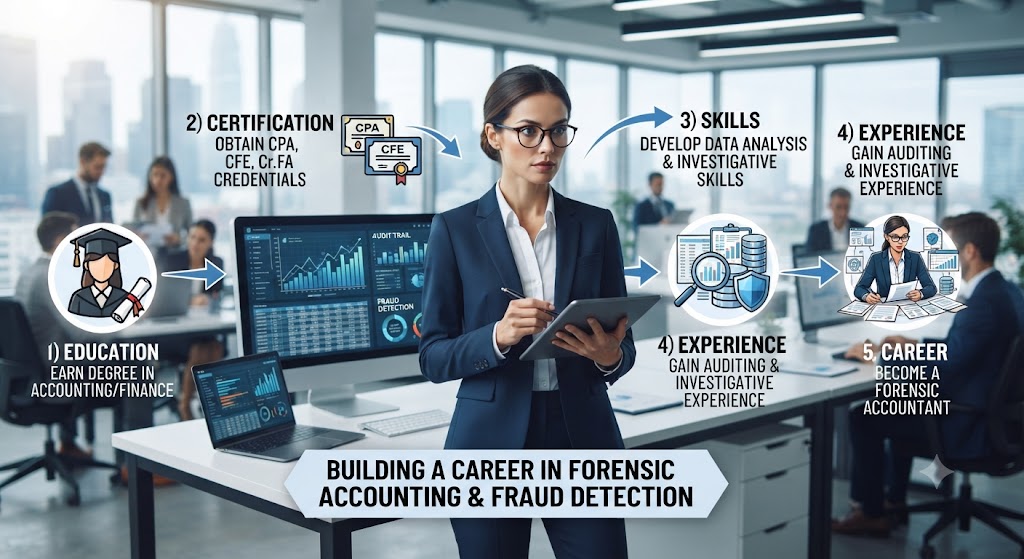
Building a career in forensic accounting and fraud detection requires more than becoming proficient with numbers. The field combines accounting, investigation, data analysis, technology, communication, and professional judgment.
The most effective path is to build a strong accounting foundation, develop fraud and data-analysis capabilities, gain experience through related roles, pursue relevant certifications, and create practical evidence of your skills.
Remote work can provide additional flexibility for suitable analytical and reporting responsibilities, while carefully planned career testing can help you determine whether forensic investigation matches your interests before making a major career change. Financial planning should remain part of the process, particularly when investing in certifications, changing industries, or exploring location-independent work.
With a structured development plan and consistent practical experience, professionals can build a sustainable career in a field that plays an important role in protecting organizations, improving financial controls, and identifying financial misconduct. A best job tool also make the job-search process more targeted by helping candidates discover opportunities that match their skills, experience, and preferred work arrangements.






Leave a Reply