Introduction
Fund administration and asset servicing are essential functions within the global financial services industry. As investment funds, asset managers, private equity firms, hedge funds, pension funds, and institutional investors expand across international markets, the need for professionals who can manage financial operations, reporting, compliance, and investment data continues to grow.
These careers are particularly suitable for professionals interested in finance but who may not want to work directly in investment banking or front-office investment roles. Fund administration and asset servicing offer opportunities across accounting, operations, reporting, technology, compliance, data management, and client servicing.
The sector also provides a range of career models. Some roles are office-based because they involve sensitive financial processes, while many analytical, reporting, technology, and operational functions can support hybrid or remote working arrangements. Professionals can also use short-term career testing, structured learning, and targeted job searches to determine which specialization suits their strengths.
Understanding the different career paths is the first step toward building a sustainable career in this field.
1. Understand Fund Administration and Asset Servicing
Fund administration refers to the operational and financial activities required to support an investment fund. Administrators help ensure that transactions, accounting records, valuations, reporting, and investor information are accurately maintained.
Asset servicing is broader and can include services that support the lifecycle of financial assets and investment portfolios.
Typical activities include:
- Fund accounting
- Net asset value calculation
- Transaction processing
- Investor reporting
- Reconciliation
- Corporate actions processing
- Custody support
- Regulatory reporting
- Performance reporting
- Data management
- Client servicing
These functions are critical because investment managers depend on accurate operational information to make decisions and meet regulatory and investor requirements.
For someone entering the industry, understanding the complete investment operations lifecycle is valuable. Instead of focusing only on one task, learn how transactions move from execution through settlement, reconciliation, accounting, valuation, and reporting.
This broader understanding can help you identify the career area that best matches your interests.
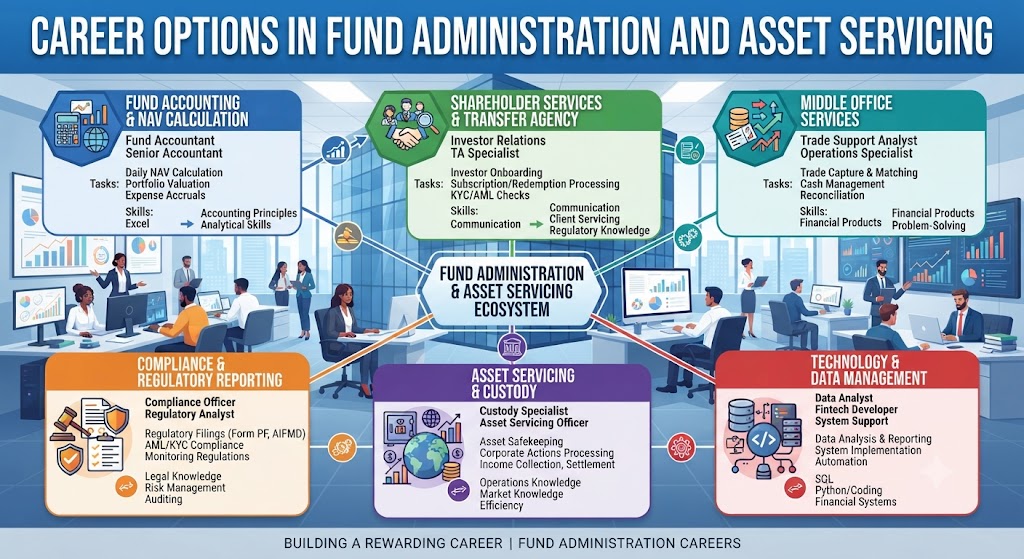
2. Explore Careers in Fund Accounting and NAV Operations
Fund accounting is one of the most established career paths within fund administration. Fund accountants are responsible for maintaining accounting records and supporting the calculation of a fund’s net asset value, commonly referred to as NAV.
Entry-level responsibilities may include:
- Recording investment transactions
- Performing cash and position reconciliations
- Reviewing pricing information
- Preparing accounting schedules
- Investigating breaks
- Supporting NAV calculations
- Maintaining documentation
- Assisting with financial reporting
With experience, professionals can progress into senior fund accounting, NAV oversight, team leadership, or fund-control positions.
This career path is particularly suitable for people who enjoy structured financial processes, accuracy, and analytical problem solving.
To prepare for these roles, strengthen your knowledge of:
- Financial accounting
- Investment products
- Journal entries
- Reconciliation
- Excel
- Financial reporting
- NAV calculations
- Operational controls
Professionals who consistently identify errors and explain discrepancies can eventually move toward supervisory and control-oriented roles.
3. Build a Career in Custody and Securities Operations
Custody and securities operations represent another major career area. These teams support the processing and safekeeping of financial assets on behalf of institutional investors and investment organizations.
Professionals may work with equities, bonds, derivatives, foreign exchange transactions, and other financial instruments.
Common responsibilities include:
- Trade settlement
- Cash management
- Securities reconciliation
- Corporate actions
- Income processing
- Position monitoring
- Exception management
- Settlement investigation
- Client reporting
This field can be attractive to professionals who enjoy fast-moving operational environments.
Corporate actions, for example, require careful attention because events such as dividends, stock splits, mergers, acquisitions, and rights issues can affect investor positions and cash balances.
Technology has also changed securities operations. Automated workflows and exception-management systems increasingly handle routine activities, while employees focus more heavily on investigation and decision-making.
Developing Excel, data-analysis, and financial systems knowledge can therefore improve your long-term career prospects.
4. Consider Client Servicing and Investor Reporting Roles
Not every career in asset servicing is highly technical. Client servicing and investor reporting offer opportunities for professionals who combine financial knowledge with communication skills.
Client-service professionals act as a connection between financial institutions and their clients. They may coordinate reporting requirements, resolve operational issues, monitor service levels, and communicate important information.
Investor reporting roles can involve preparing and reviewing:
- Fund performance information
- Portfolio reports
- Investor statements
- Financial reports
- Regulatory documents
- Management information
- Operational dashboards
These careers are useful for people who enjoy working with both data and stakeholders.
Strong communication is particularly important when working with international clients. Professionals may need to explain financial or operational issues clearly while coordinating across different time zones.
Remote work can also be possible in suitable client-service and reporting positions. However, candidates should verify the employer’s working-location requirements, especially when handling confidential financial information.
If you are considering this career path, practice writing concise business emails, presenting financial information, and explaining technical concepts to non-specialists.
5. Develop Skills in Data, Technology, and Automation
Technology skills are becoming increasingly valuable across fund administration and asset servicing.
Financial institutions generate large volumes of transaction, portfolio, pricing, and investor data. Professionals who can organize and analyze this information can provide greater value than those who rely exclusively on manual processes.
Focus on developing:
- Advanced Excel
- SQL fundamentals
- Power BI or similar visualization tools
- Data-quality management
- Financial systems knowledge
- Basic automation concepts
- Process mapping
- Reporting automation
You do not need to become a software developer to benefit from technology skills.
For example, an operations professional who can identify repetitive reconciliation tasks and create a more efficient reporting workflow can contribute directly to operational improvement.
Build practical projects around financial datasets. You could create a fictional portfolio-reconciliation dashboard, automate an Excel-based reporting process, or design a simple exception-tracking system.
These projects can demonstrate problem-solving ability during interviews.
When searching for opportunities, a best job tool can help you identify positions across fund accounting, financial operations, asset servicing, reporting, and investment operations.
6. Use Remote Work and Career Testing Strategically
Remote and hybrid work have changed how professionals evaluate financial-services careers. However, not every fund administration function is equally suitable for fully remote work.
Roles involving data analysis, reporting, technology, documentation, and certain client-service activities may have greater flexibility. Positions involving physical documentation, highly restricted systems, or specific operational controls may require office attendance.
Before accepting a remote financial-services role, evaluate:
- Required working hours
- Time-zone expectations
- Security requirements
- Equipment policies
- Internet reliability
- Data-access restrictions
- Availability of remote training
- Frequency of office visits
Career testing is also useful before committing to a specialization.
For example, if you are unsure whether fund accounting suits you, complete an accounting case study and practice reconciliation. If asset servicing interests you, study trade settlement and corporate actions. If reporting attracts you, build a financial dashboard.
This approach lets you test the actual work rather than relying on assumptions about the profession.
Travel should also be planned carefully if you intend to work remotely while moving between locations. Consider employer policies, reliable connectivity, time-zone differences, accommodation expenses, and local compliance requirements before working from another country.
7. Plan Your Career Progression and Finances
Fund administration and asset servicing provide several potential progression routes.
A professional might begin as:
Fund Operations Analyst → Senior Analyst → Team Lead → Manager → Senior Manager
Alternatively, a technology-focused professional could progress toward:
Operations Analyst → Data/Reporting Analyst → Automation Specialist → Financial Operations Technology Manager
Other possible directions include:
- Fund accounting
- Investment operations
- Custody operations
- Client servicing
- Regulatory reporting
- Risk and controls
- Financial data analysis
- Operations technology
- Product management
- Project management
Career planning should be accompanied by financial planning.
Before investing in professional certifications or changing roles, calculate:
- Course and certification costs
- Expected salary progression
- Learning time
- Potential relocation expenses
- Remote-work equipment costs
- Emergency savings
- Travel expenses if working internationally
Do not select a certification simply because it appears frequently on social media. Compare actual job descriptions and identify qualifications employers in your target market consistently request.
A best job tool can make this process more efficient by helping candidates compare opportunities and identify roles that match their preferred specialization, location, and work arrangement.
Conclusion
Fund administration and asset servicing offer diverse career opportunities for professionals who want to build a career in financial services without necessarily pursuing front-office investment roles.
Fund accounting, NAV operations, custody, securities processing, client servicing, investor reporting, data analytics, and financial technology each provide different career experiences. The best choice depends on whether you prefer accounting, operational problem solving, technology, communication, or analytical work.
The most effective strategy is to build strong financial fundamentals while developing modern technical skills. Excel, data analysis, reporting, automation, and financial systems knowledge can increase your value as routine processes become increasingly technology-driven.
Remote work can provide additional flexibility in suitable roles, but professionals should evaluate security requirements, time zones, employer policies, and connectivity before adopting a location-independent work model. Similarly, career testing through practical projects can reduce the risk of choosing a specialization based only on assumptions.
With deliberate skill development, realistic financial planning, and targeted job searching, professionals can build a sustainable career in fund administration and asset servicing while creating opportunities for long-term progression.







Leave a Reply