Introduction
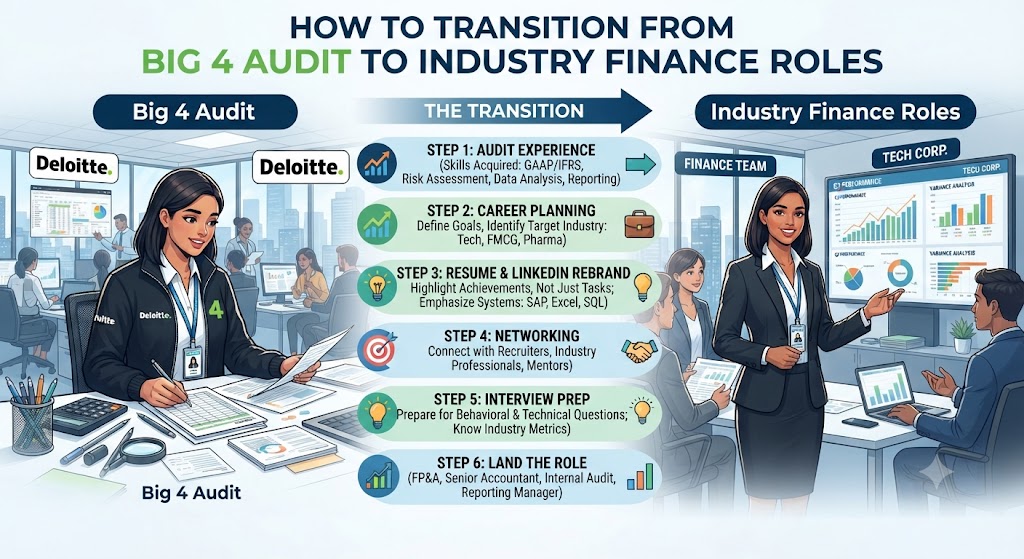
Moving from Big 4 audit to an industry finance role is a common career transition for accounting and finance professionals who want greater exposure to business decision-making, financial planning, and internal operations. Experience at a major professional-services firm provides a strong foundation in financial reporting, controls, risk assessment, stakeholder management, and analytical thinking. However, moving into industry requires professionals to reposition these skills for a different business environment.Finance Roles
In audit, the primary objective is often to independently evaluate financial information and controls. In industry finance, professionals are generally expected to use financial information to support business decisions, forecast performance, manage budgets, analyze costs, and improve profitability.
The transition therefore requires more than changing employers. It requires understanding how your existing experience translates into commercial finance responsibilities and identifying the skills you need to develop.
With careful planning, targeted applications, practical experience, and realistic financial preparation, Big 4 professionals can move successfully into roles such as FP&A analyst, financial analyst, management accountant, finance business partner, controllership, internal audit, and commercial finance.
1. Identify the Industry Finance Role You Want
The first step is deciding what type of finance role you want to pursue. “Industry finance” covers a wide range of positions, and each requires a slightly different skill set.
Common options include:
- FP&A Analyst
- Financial Analyst
- Management Accountant
- Commercial Finance Analyst
- Finance Business Partner
- Financial Controller
- Internal Audit Manager
- Finance Transformation Analyst
- Treasury Analyst
- Revenue or Cost Analyst
For professionals leaving audit, FP&A and controllership can be natural transitions because they build on existing knowledge of financial statements, accounting standards, controls, and reporting.
Commercial finance may require a stronger understanding of revenue, pricing, margins, customer behavior, and business strategy.
Before applying, review 20–30 job descriptions for your preferred role. Identify the most frequently requested skills and compare them with your current capabilities.
Create three categories:
Already have: Skills demonstrated through Big 4 experience.
Need to strengthen: Skills you understand but have limited practical exposure to.
Need to learn: Skills that rarely appeared in your audit work.
This exercise gives you a practical roadmap instead of applying randomly across finance positions.
2. Translate Big 4 Audit Experience Into Business Value
One of the biggest challenges during the transition is Finance Roles presenting audit experience in language that industry hiring managers understand.
Simply describing audit procedures may not demonstrate how you can contribute to an internal finance team.
Instead of focusing exclusively on tasks, explain the business impact of your work.
For example:
- Audit testing → financial analysis and risk assessment
- Internal control evaluation → process improvement and financial controls
- Financial statement review → financial reporting expertise
- Client discussions → stakeholder management
- Data testing → analytical problem solving
- Identifying discrepancies → financial investigation
- Managing multiple audits → project and deadline management
Your resume should show outcomes wherever possible.
Instead of saying that you “performed audit testing,” explain the type of financial information analyzed, the complexity of the engagement, the stakeholders involved, and how your work contributed to accurate reporting or risk management.
This makes your experience easier for industry recruiters to connect with their requirements.
3. Develop FP&A and Commercial Finance Skills
Audit professionals often have strong accounting knowledge but less direct experience with forecasting, budgeting, and business planning.
These are important areas to strengthen before making the transition.
Focus on:
- Budgeting
- Forecasting
- Variance analysis
- Management reporting
- Financial modeling
- Scenario analysis
- Cash-flow forecasting
- Cost analysis
- Revenue analysis
- Business performance metrics
Learn how finance teams use historical information to make forward-looking decisions.
For example, an FP&A professional might analyze actual versus budget performance and determine why revenue declined. The next step is not simply reporting the variance. The finance team may need to determine whether the issue is related to pricing, sales volume, customer churn, product mix, or market conditions.
Practice building simple financial models using fictional or publicly available data.
Create a three-statement model, a departmental budget, or a revenue forecast. Then develop multiple scenarios and explain how the assumptions affect the results.
This demonstrates that you can move beyond checking historical information and contribute to forward-looking financial decisions.
4. Strengthen Technology and Data Skills
Technology proficiency can significantly improve your competitiveness when moving from audit into industry finance.
Advanced Excel remains important, particularly for financial modeling, forecasting, reconciliation, and reporting. However, finance teams increasingly use business intelligence platforms, enterprise resource planning systems, and data-analysis tools.
Prioritize skills such as:
- Advanced Excel
- Power BI
- SQL fundamentals
- Financial modeling
- ERP systems
- Dashboard development
- Data visualization
- Automation concepts
You do not need to master every technology platform before applying.
Instead, focus on tools repeatedly requested in your target job descriptions.
For example, if FP&A positions in your target industry frequently request Excel and Power BI, prioritize those skills over learning unrelated technologies.
Build a small portfolio of finance projects. A dashboard showing revenue, expenses, margins, and monthly variance can demonstrate practical ability more effectively than simply listing “Power BI” on a resume.
When searching for opportunities, a best job tool can help you compare industry finance roles and identify positions where your existing audit experience overlaps with employer requirements.
5. Build Industry Knowledge Before You Move
One advantage of Big 4 audit experience is exposure to multiple Finance Roles companies and industries. Use that experience strategically.
If you have audited clients in technology, manufacturing, financial services, healthcare, retail, or another sector, consider targeting that industry first.
You already understand some of its:
- Financial reporting challenges
- Business models
- Internal controls
- Revenue structures
- Cost drivers
- Regulatory environment
- Operational risks
This can make your transition easier than entering an entirely unfamiliar industry.
Research your target sector before interviews. Understand how companies generate revenue, what drives costs, which financial metrics management tracks, and what risks could affect profitability.
For example, a finance candidate targeting a subscription-based technology company should understand recurring revenue, customer acquisition costs, retention, churn, and gross margins.
Industry knowledge helps demonstrate that you are interested in becoming a business finance professional rather than simply leaving audit.
6. Use Networking, Remote Work, and Career Testing Strategically
Networking can be especially useful when transitioning from professional services to industry. Speak with former Big 4 professionals who have already moved into finance roles.
Ask practical questions about:
- Their transition timeline
- Skills they had to develop
- Interview expectations
- Differences between audit and industry
- Typical responsibilities
- Career progression
- Work-life balance
- Remote or hybrid arrangements
LinkedIn can also be used to identify professionals with similar career paths. Look for people who moved from audit into FP&A, controllership, commercial finance, or finance business partnering.
Remote and hybrid opportunities can broaden your search, but do not make flexibility your only selection criterion. Evaluate the role’s learning opportunities, manager quality, responsibilities, and career progression.
If you are uncertain about which finance specialization suits you, test the work before making the transition. Build a financial forecast, analyze a company’s performance, or complete a budgeting project.
This form of career testing gives you practical insight into whether you enjoy forward-looking finance work.
If you plan to combine remote work with travel, test the arrangement gradually rather than immediately committing to a location-independent lifestyle. Consider internet reliability, working hours, employer policies, time zones, accommodation costs, and tax implications.
7. Plan Your Career Transition and Finances
Changing from Big 4 audit to industry can affect compensation, responsibilities, location, and long-term career progression. Financial planning should therefore be part of the transition strategy.
Before resigning, calculate:
- Current monthly expenses
- Emergency savings
- Expected compensation range
- Certification or training costs
- Potential relocation expenses
- Travel costs
- Health and insurance expenses
- Short-term income gaps
Avoid making a career move based solely on salary.
Compare the total opportunity, including:
Role quality + learning opportunities + manager + industry exposure + compensation + flexibility + long-term progression
You should also determine what success looks like after the transition.
For example:
Year 1: Build industry knowledge and become proficient in budgeting, forecasting, and management reporting.
Years 2–3: Move into senior analyst or finance business partner responsibilities.
Years 4–5: Progress toward finance manager, controller, or strategic finance roles.
A best job tool can support your search by helping you identify opportunities that match your experience, desired finance specialization, location, and preferred work arrangement.
Conclusion
Transitioning from Big 4 audit to industry finance is not about abandoning your existing experience. It is about repositioning it.
Audit provides valuable foundations in accounting, financial reporting, controls, risk assessment, data analysis, stakeholder communication, and professional discipline. The next step is learning how to apply those capabilities to forecasting, budgeting, commercial analysis, financial planning, and business decision-making.
Start by choosing a specific target role rather than applying broadly. Translate your audit achievements into business-focused language, strengthen FP&A and commercial finance skills, improve your technology capabilities, and develop knowledge of your target industry.
Networking and practical career testing can further reduce uncertainty, while careful financial planning can make the transition more sustainable. Remote and hybrid opportunities may provide additional flexibility, but the quality of the role and its long-term career potential should remain the primary considerations.
With a structured approach, Big 4 audit experience can become a strong foundation for a long-term industry finance career. The goal is not simply to move out of audit, but to move toward a finance role where your accounting expertise can contribute directly to business performance and strategic decision-making.






Leave a Reply