Introduction
The salary component of a job offer from a company is relatively easily understood, while equity options can seem much more exciting. However, despite the buzz around stock options and startup equity, the actual value they represent depends heavily on the stage of the company, its prospects, and a number of other factors.
This is why What Equity Means in Practice at Different Startup Stages makes up an important question in the minds of many would-be-hires. Equity options can come with significant risk and should not always be viewed as a guaranteed cash payout.
What Does Startup Equity Actually Mean?
Startup equity refers to the portion of the company an employee is entitled to own. Companies usually grant this equity as stock options, with the number of options, strike price, and vesting schedule determining their value.
For instance, if a company offers you 0.1% of the business in the form of stock options, the value of this amount depends on the total shares of the company, number of options given to you, the company’s valuation, the vesting schedule, etc.
In most cases, employees are not entitled to instant and full equity ownership upon hiring. For instance, most people working in startups sign a 4-year vesting schedule, with 1 year being the common cliff.
The practical value of your equity entitlement changes depending on the stage of the company.
What Equity Means in Practice at Different Startup Stages?
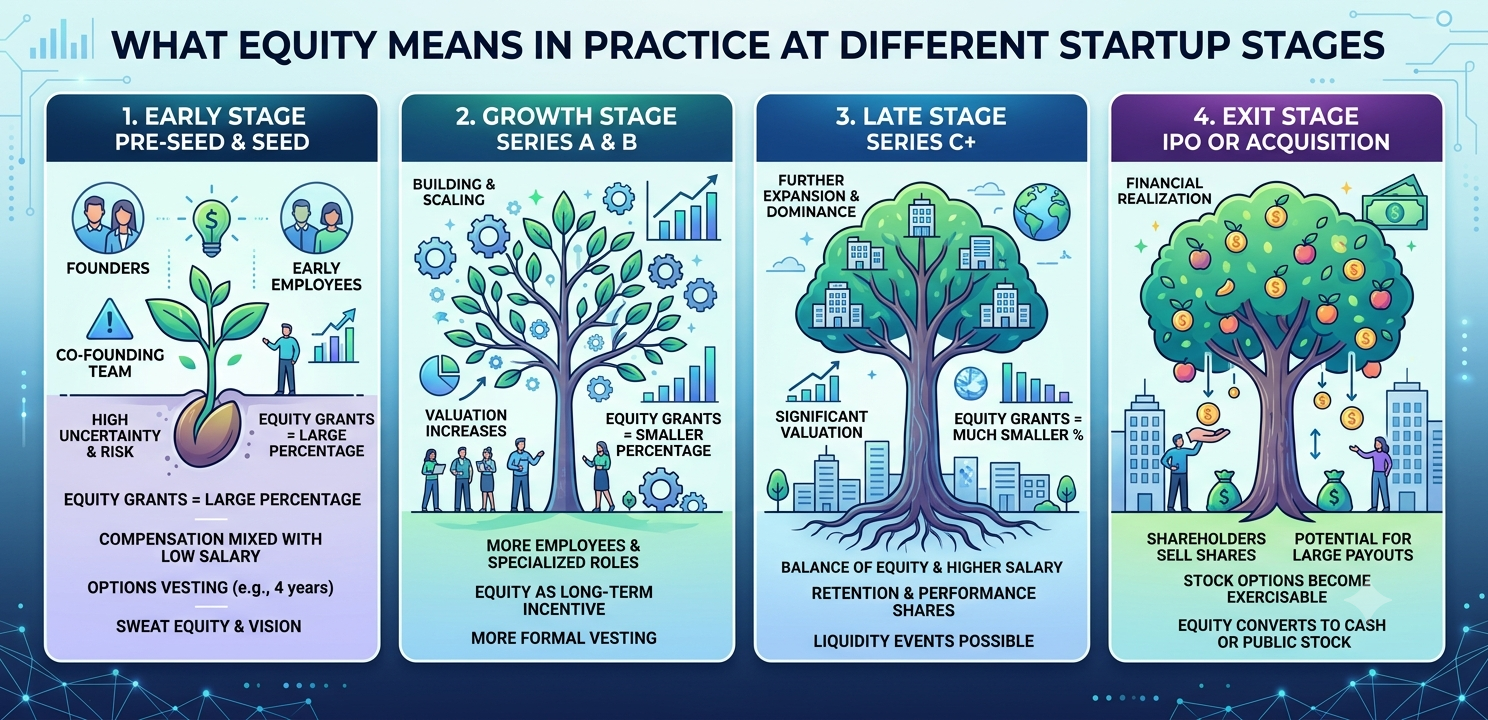
1. Equity at the Pre-Seed Stage
At the pre-seed stage, the startup company is just getting off the ground. Typically, only a few people join such companies. This could either be the founding team or the first employees to sign up with the company.
At such early stages, equity grants often constitute a higher percentage of the total company ownership.
However, at the same time, many early-stage companies fail to reach greater height and provide substantial returns to equity owners. At the pre-seed stage, employees and early hires must understand that the 0.5% equity stake they receive could become worthless if the company fails.
Therefore, pre-seed equity owners should evaluate the likelihood of the success of the company, the amount of money the business will be able to raise, its product-market fit, the ownership of the founding team, and other relevant factors.
2. Equity at the Seed Stage
Compared to pre-seed, companies at the seed stage typically have already proven their product-market fit hypothesis. They also tend to have more employees, as well as customers and revenue.
While at the seed stage, employees’ stock option grants can still be regarded as substantial, since the total company valuation at this point is not that high. At the same time, employees should remain mindful of dilution because new funding rounds issue additional shares and reduce everyone’s ownership percentage.
3. Equity at Series A and Series B
By the time a company reaches Series A or Series B, it has already had the proof of market fit and has grown beyond just the founding team or early employees. As a natural result, the equity grants per employee at this point are usually lower than at earlier stages.
In spite of the lower percentage, employees who join companies at the Series A or B stage can benefit from the more stable environment and already proven track record of the business.
However, the actual value of the options still depends on the total valuation, number of options, and other characteristics.
4. Equity at Later-Stage Startups
At later stages (Series C, D, etc.), startups typically have already had substantial revenues and a significant increase in valuation. Naturally, the equity options issued at such a stage typically comprise a smaller percentage of the company’s total ownership.
In spite of the seemingly lower grant size, later-stage companies offer better prospects for equity employees. The strike price of each option has likely increased substantially, employees now understand the terms of liquidity events, such as an acquisition or IPO, more clearly, and the company has a much higher probability of achieving a successful exit.
Another nuance that equity owners at later stages should be aware of is the liquidity risk. In the case of an IPO, employees may not necessarily be able to sell their shares right away.
5. Equity Before an IPO
Companies which are about to go public can demonstrate very attractive characteristics for employees who wish to own company stock. The valuation of a company at the time of an IPO can skyrocket, with the option strike price value seeing a significant increase.
At the same time, employees still should be mindful of the lock-up period after the IPO and other risks associated with stock ownership.
6. Understanding Dilution
One should always be aware that the concept of dilution is one of the most important aspects when it comes to startup equity.
When a company issues new shares, everybody’s existing ownership gets diluted. Naturally, if a company was worth $100 and you owned 1%, it means that you owned $1 of value. If the company now issues new shares and is now worth $150, your ownership is still 1%, which means that it is now worth $1.5.
The key concept to understand about dilution is that the company can change your initial ownership stake. Always take into account what your percentage of ownership will be after any dilution events.
In particular, always ask the question: is the percentage I’m being offered fully diluted or not? This will give you a much more accurate idea of what your initial percentage of ownership will be.
Conclusion
Startup equity can be a great addition to a compensation package. However, people often forget that the value of the options depends on the stage of the company and its prospects.
At the early stages (pre-seed and seed), the value of options is much higher, but the risk of failure is also higher. At the later stages, the company’s prospects are more stable, but the value of each option tends to decrease. Always be mindful of the strike price of your options, the likelihood of liquidity events, company valuation, dilution prospects, and the vesting schedule.
Ready to understand what startup equity could mean for your career? Before accepting an offer, evaluate the equity terms, startup stage, and potential risks carefully. Then explore relevant startup opportunities and career options on Best Job Tool, a platform connecting job seekers with employers across industries.



Leave a Reply