Introduction: Generational Differences
The modern workforce is extremely diverse. It includes employees from different generations who may have substantially different attitudes, approaches to work, and levels of experience. For instance, a team may comprise aging workers, those close to retirement, specialists with decades of experience, and young people who just graduated from college and have no work experience. These differences do not necessarily hinder collaboration, but they do require a different approach from managers and team leaders.
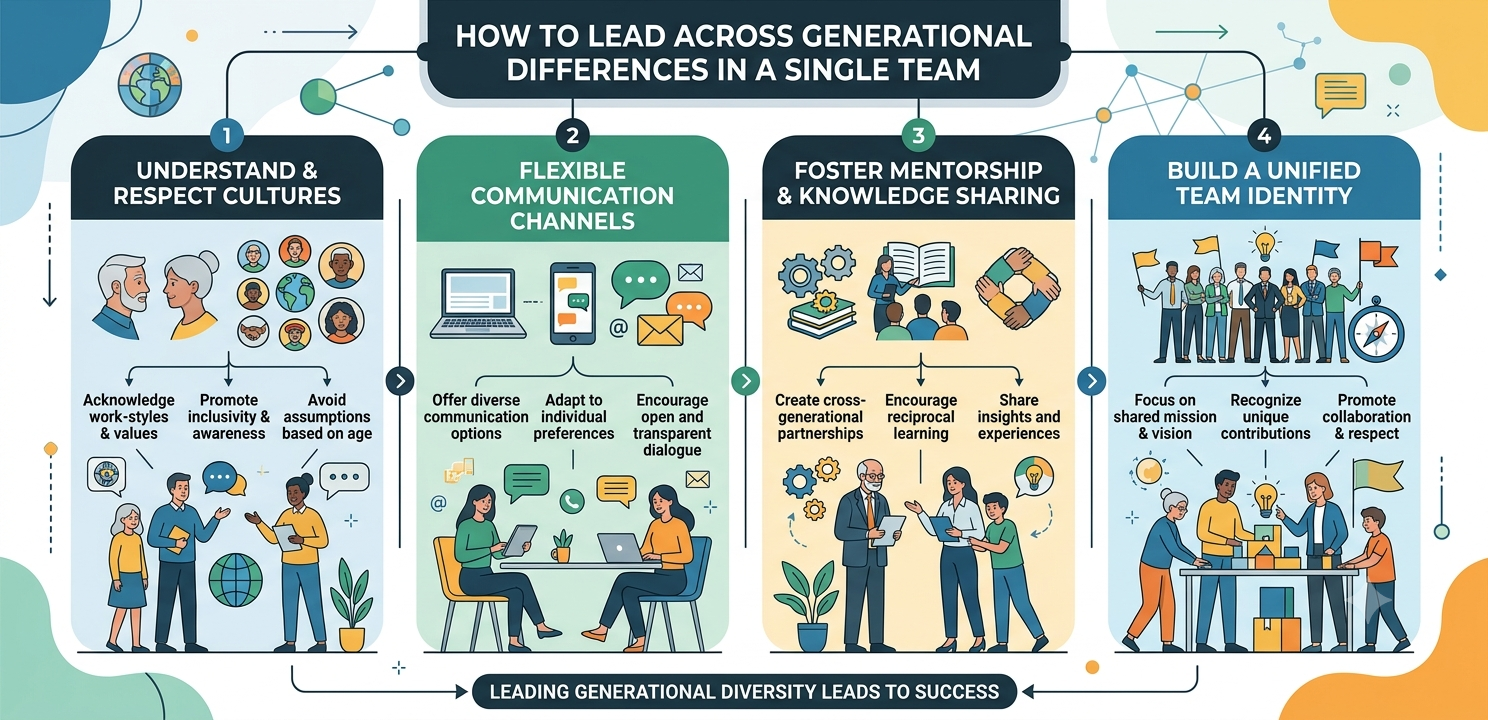
How to lead across generational differences in a single team is an essential guide for managers who wish to maximize the efficiency of their team by minimizing generational differences.
How to Lead Across Generational Differences in a Single Team Essay?
1. Understand That Differences Are Not Always Negative
Age may be used as a rough estimate of experience. Thus, many people assume that older workers are set in their ways and resistant to change, while younger people are sloppy and irresponsible. At the same time, individual factors such as education, work environment, cultural background, and personal characteristics may affect one’s approach to work.
Managers must understand that employees are individuals, and there is no guarantee that their age will dictate their behavior or attitudes towards work. Instead of grouping employees into categories, the manager should attempt to identify and consider everyone’s needs and work styles.
2. Establish Effective Communication
Workers from different generations may have substantially different communication preferences and tendencies. Thus, some team members may prefer calls and face-to-face meetings, while others are more comfortable with email or digital collaboration tools. It is essential for the manager to establish uniform communication rules and standards for the team.
Urgent matters can be discussed via phone calls or video conferencing, while formal communication can take place via email or be documented using project management software. All communication should be transparent, which means that all team members should be provided with the same information.
3. Focus on Strong Points
Although employees from different generations may have substantially different work styles and approaches, these differences should be viewed as advantages. Thus, aging workers and those close to retirement may have extensive experience, which allows them to navigate complex situations and better understand the industry nuances.
The younger generation may be more tech-savvy and more open to new ideas, while the middle-aged ones may act as bridges between different approaches, being both knowledgeable and flexible enough to adapt their work styles. The manager should strive to form working groups that combine people with different approaches, so the team can benefit from the experience of all members.
4. Avoid Favoritism
Employees should never suspect favoritism on the part of the manager, as it can make the workplace environment uncomfortable and even toxic for some employees. Thus, workers from different generations should receive the same considerations regarding scheduling, assignments, performance outcomes, rewards, and promotions.
Equal treatment does not necessarily mean identical conditions. For instance, some workers may be more productive when they can choose their working hours, while others are less responsible about their tasks when given this opportunity. If the company allows for such flexibility, everyone should have the opportunity, but each worker should be responsible for their results.
5. Encourage Reverse Mentoring
Not all mentoring practices are cut the same way. The reverse mentoring allows young employees to share their knowledge and skills with older colleagues. Thus, the two parties can learn from each other and build stronger working relationships based on mutual respect. This arrangement helps both generations realize that they have useful knowledge and experiences that can be transferred to someone else.
6. Give Multiple Channels for Input
Some people are more comfortable with expressing their opinion verbally, while others may need more time to formulate their ideas. During meetings, the manager can give more attention to outspoken employees, neglecting quieter ones who may have useful suggestions. To avoid such biases, the manager can ask employees for their input in writing or offer to schedule additional meetings.
This approach is especially necessary when combining workers from different generations, as their communication styles may vary substantially.
Conclusion: Generational Differences
Leading a team across generational differences requires understanding, flexibility, and mutual respect. Different generations may have different communication styles, work preferences, and expectations, but these differences can become strengths when leaders create an inclusive environment. By focusing on shared goals, encouraging open communication, adapting leadership approaches, and valuing each employee’s experience and perspective, leaders can build stronger collaboration.
Ready to build a stronger, more collaborative multigenerational team? Apply these strategies to improve communication, encourage mutual respect, and make the most of every generation’s strengths. For more career and workplace guidance, explore the Best Job Tool platform and discover resources to help you grow professionally.
Leave a Reply