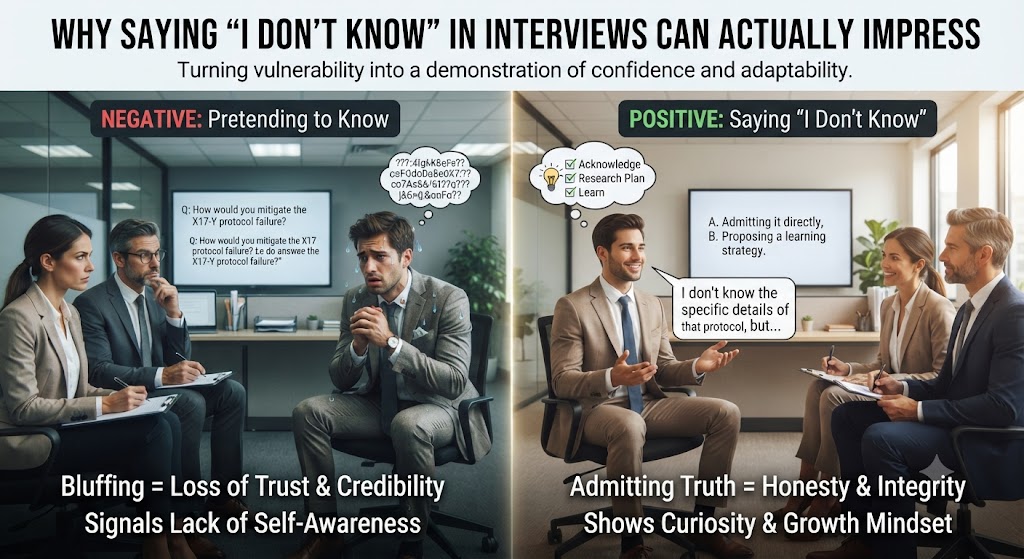
Job interviews are often treated as tests of knowledge. Candidates prepare answers, research companies, memorize common interview questions, and try to present themselves as confident professionals. However, attempting to answer every question with certainty can sometimes create a problem. When do not know something, pretending otherwise can be more damaging than simply acknowledging the knowledge gap.
Saying “I do not know” does not automatically make a candidate look unqualified. When communicated professionally, it can demonstrate honesty, self-awareness, and a willingness to learn. The important part is what comes after the statement. A strong candidate can acknowledge what they do not know and then explain how they would find the answer or approach the problem.
This approach is particularly relevant in modern workplaces where professionals frequently encounter new software, changing processes, unfamiliar markets, and unexpected business problems. Employers cannot expect every candidate to know everything. Instead, interviews can reveal how candidates respond when their existing knowledge is not enough.
1. Understand What Interviewers Are Actually Testing
Not every interview question is designed to determine whether you know a particular fact.
Some questions are intended to evaluate your reasoning process.
For example, an interviewer may ask about a technology you have never used. The Interviews real question may be whether you can explain how you would learn it, identify reliable resources, and apply the knowledge to your work.
When you encounter something unfamiliar, consider responding with a structured approach:
- Clearly acknowledge the knowledge gap.
- Explain what you already understand about the broader topic.
- Describe how you would find the correct information.
- Connect the situation to a similar experience you already have.
- Explain how you would apply the new knowledge.
This provides more information about your working style than an invented answer would.
2. Replace “I Don’t Know” With a Professional Response
There is an important difference between saying “I don’t know” and ending the conversation there.Interviews
A stronger response might be:
“I haven’t worked directly with that technology, so I don’t want to give you an inaccurate answer. However, I have worked with a similar system, and I would approach learning this by…”
This response communicates honesty while demonstrating initiative.
Another useful structure is:
Acknowledge → Connect → Explain → Learn
For example:
- Acknowledge: “I have not worked with that specific platform.”
- Connect: “I have used a similar CRM system.”
- Explain: “The workflow I used involved…”
- Learn: “I would expect the transition to require learning the platform-specific features.”
This approach prevents the knowledge gap from becoming the entire focus of the answer.
3. Avoid Guessing When Accuracy Matters
Guessing can create serious problems in interviews, particularly for technical, financial, legal, medical, engineering, compliance, or data-related positions.
Suppose an interviewer asks for a specific technical calculation and you are uncertain about the answer. Giving a confident but incorrect response may raise concerns about your judgment.
Instead, explain your reasoning and identify where you would verify the information.
For example:
“I would need to verify the exact formula before giving you a definitive number. My understanding of the process is…”
This demonstrates that you understand the difference between knowledge and assumption.
That distinction is valuable in professional environments where incorrect information can affect customers, budgets, security, compliance, or business decisions.
4. Show How You Learn New Skills
Modern careers require continuous learning. Software changes, industries evolve, and job responsibilities often expand after hiring.
Therefore, candidates should prepare examples that demonstrate their ability to learn.
Think about situations where you:
- Learned unfamiliar software
- Took responsibility for a new process
- Changed departments
- Learned a technical skill
- Worked with an unfamiliar client
- Entered a new industry
- Solved a problem without previous experience
Use the STAR framework when answering these questions:
Situation: What was happening?Interviews
Task: What did you need to accomplish?
Action: What did you do to close the knowledge gap?
Result: What happened afterward?
This provides evidence that not knowing something today does not prevent you from becoming capable tomorrow.
5. Use the Interview to Demonstrate Problem-Solving
Some interview questions deliberately involve unfamiliar situations.
Instead of focusing entirely on producing the correct answer immediately, explain how you would approach the problem.
For example:
“I haven’t encountered this exact situation before. I would first identify the relevant information, clarify the constraints, review similar cases, and then test the most appropriate solution.”
You can then explain what information you would need before making a final decision.
This is particularly useful for roles involving:
- Management
- Consulting
- Data analysis
- Engineering
- Operations
- Product management
- Customer success
- Sales
- Marketing
- Project management
Professionals in these roles frequently encounter problems without predefined answers.
6. Prepare for Interviews Without Pretending to Know Everything
Good preparation does not mean memorizing answers to every possible question. Instead, candidates should understand their own experience deeply enough to discuss it clearly.
Before an interview, research:
- The company’s products or services
- The responsibilities of the role
- Relevant industry trends
- Common technical requirements
- The organization’s customers
- Recent company developments
- Skills mentioned repeatedly in the job description
Then identify areas where your experience is limited.
For each gap, prepare an honest explanation.
For example:
Gap: No direct experience with a specific software platform.
Response strategy: Explain experience with comparable tools and describe how you would learn the new platform.
Gap: Limited management experience.
Response strategy: Discuss project leadership, mentoring, coordination, or ownership responsibilities.
Gap: No experience in the company’s specific industry.
Response strategy: Connect transferable knowledge and explain your research into the sector.
This turns weaknesses into structured conversations rather than surprises.
7. Connect Interview Honesty With Long-Term Career Growth
Being honest during an interview is not only about making a good impression. It can also help create a more accurate match between the candidate and the employer.
If you exaggerate your skills to secure a position, you may later face responsibilities you are not prepared to handle. That can create unnecessary stress and affect productivity.
A better approach is to understand the difference between:
- No experience
- Basic exposure
- Working knowledge
- Independent proficiency
- Advanced expertise
Candidates should communicate their level accurately.
For example, saying “I have basic exposure to SQL and have used it for simple data Interviews queries” is more useful than claiming advanced SQL expertise without supporting experience.
This clarity can also help candidates identify roles where their current capabilities align with employer expectations.
A global job platform such as a best job tool can help professionals research job descriptions and identify recurring skills before applying. Reviewing multiple listings can reveal which qualifications are essential and which are commonly listed as preferred.
Conclusion
Saying “I do not know” during an interview does not automatically create a negative impression. The impact depends on how the statement is communicated and what follows it.
A professional response acknowledges the knowledge gap, avoids guessing, demonstrates related experience, and explains how the candidate would find or learn the missing information.
Interviewers are hiring people, not databases. No candidate can know every technology, process, industry term, or business situation. What matters is whether the candidate can recognize uncertainty, think logically, learn efficiently, and communicate honestly.
The next time you face an interview question you cannot answer confidently, avoid inventing a response. State what you know, acknowledge what you do not know, and explain how you would approach learning or solving it.
That approach can demonstrate a valuable professional quality: knowing the limits of your current knowledge while being prepared to expand them.




Leave a Reply