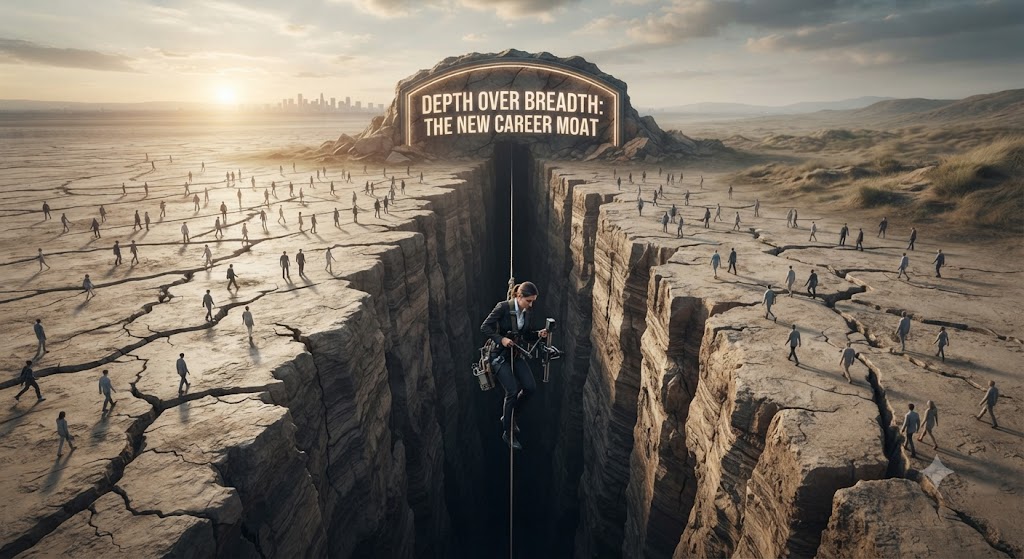
Modern careers reward adaptability. Professionals are expected to learn new technologies, understand multiple functions, work across teams, and respond quickly to changing business requirements. As a result, many Breadth try to build broad skill sets across several areas.Depth
Breadth can certainly create flexibility. However, in increasingly competitive job markets, deep expertise can provide another important advantage. Professionals who understand a specific problem, industry, technology, or business function at a high level can become difficult to replace.
This is where the idea of a career “moat” becomes useful. In business, a moat refers to an advantage that protects an organization from competitors. In a career, specialized expertise can serve a similar purpose by creating capabilities that are difficult to replicate quickly.
Choosing depth does not mean ignoring other skills. Instead, it means developing one or two areas deeply while maintaining enough broader knowledge to collaborate effectively.
For professionals planning their next career stage, this approach can influence skill development, remote work, productivity, job searches, travel flexibility, and financial planning.
1. Understand Why Career Breadth Alone May Not Be Enough
Having many skills can make a professional adaptable. However, knowing a little about many subjects does not always create strong professional differentiation.
For example, someone may have basic knowledge of marketing, sales, analytics, project management, and design. This broad knowledge can be useful, but employers may still ask:
What problem can this person solve particularly well?
Depth provides a clearer answer.
A professional with deep expertise in marketing analytics, for example, may be able to:
- Build advanced reporting systems
- Interpret customer behavior
- Identify performance problems
- Recommend data-driven strategies
- Communicate insights to senior stakeholders
The objective is not to become narrowly specialized to the point of being inflexible. Instead, develop a clear area of expertise that gives your broader career skills a strong foundation.
2. Choose a Skill That Can Compound Over Time
Not every skill deserves years of investment.
When choosing an area for deeper development, evaluate its potential to remain valuable and expand as your experience grows.
Consider whether the skill:
- Solves meaningful business problems
- Is difficult to master quickly
- Connects with your existing experience
- Appears frequently in relevant job descriptions
- Can lead to higher levels of responsibility
- Can transfer across companies or industries
- Supports remote or international opportunities
Review current job descriptions before committing to a long learning path.Breadth
A global job platform such as a best job tool can help professionals examine roles across employers and markets. Look for recurring requirements rather than relying on one job posting.
If the same specialized skill appears repeatedly in roles that interest you, it may deserve greater attention.
3. Build Expertise Through Real Projects
Courses can introduce concepts, but professional depth usually develops through application.
Choose projects that force you to solve increasingly difficult problems.
For example, instead of completing five introductory courses in data analytics, you might:
- Analyze a real business dataset
- Build a reporting dashboard
- Identify trends
- Present recommendations
- Measure the outcome
- Document your methodology
Each project should increase the complexity of the problems you can handle.
A useful progression is:
Learn → Apply → Measure → Review → Improve
This cycle is more valuable than collecting certificates without practical experience.
Keep documentation of significant projects. These records can later become portfolio examples, interview stories, performance-review evidence, or material for professional discussions.
4. Combine Depth With Enough Breadth to Collaborate
Choosing depth does not mean becoming isolated from other disciplines.
A highly specialized professional still needs to understand how their work affects other functions.
For example, a cybersecurity specialist may need to understand:
- Business operations
- Risk management
- Compliance
- Finance
- Communication
- Project management
However, they do not need to become an expert in all of those areas.
This creates a useful model:
Deep expertise in one area + working knowledge of adjacent areas
This combination can make professionals more effective because they understand both their specialty and the business environment around it.
The goal is a T-shaped skill profile: deep knowledge in one domain combined with broader awareness across related areas.
5. Use Depth to Improve Remote Work and Global Opportunities
Specialized expertise can be particularly useful for remote professionals because many companies can hire specialized talent regardless of location.
A professional with a clearly defined capability may be able to work with organizations in different cities, countries, and time zones.
However, remote specialization requires more than technical knowledge.
Develop:
- Written communication
- Documentation skills
- Presentation ability
- Time-zone management
- Independent problem-solving
- Digital collaboration
- Self-management
Remote professionals should also test whether their preferred working environment actually supports deep work.
If you plan to work while traveling, conduct a short travel test first. Evaluate internet reliability, workspace quality, meeting schedules, time-zone differences, costs, and productivity.
A location that looks attractive may not be suitable for focused professional work.
6. Protect Time for Deep Work and Learning
Depth requires concentration.
A professional cannot develop advanced expertise if every working hour is fragmented between meetings, notifications, emails, and minor administrative tasks.
Create dedicated blocks for high-value work.
For example:
Morning:
Deep work on complex projects.
Midday:
Meetings and collaboration.
Afternoon:
Administrative tasks, communication, and lower-concentration work.
Evening or selected days:
Structured learning or professional development.
The exact schedule depends on your role, but the principle remains consistent: protect uninterrupted time for activities that require serious thinking.
Remote workers should be especially careful about digital interruptions.
Turn off nonessential notifications and establish clear communication expectations with colleagues.
7. Turn Specialized Expertise Into Long-Term Career and Financial Value
Deep expertise becomes a career advantage when it produces measurable value.
Track outcomes such as:
- Revenue influenced
- Costs reduced
- Processes improved
- Projects completed
- Risks identified
- Customers retained
- Efficiency increased
- Problems solved
These results make your expertise easier to communicate to employers.
Depth can also support financial planning.
Specialized skills may create opportunities for:
- Higher-responsibility roles
- Consulting
- Freelancing
- Training
- Advisory work
- International employment
- Specialized contract work
However, professionals should avoid assuming that specialization automatically guarantees higher income. Market demand, experience, location, industry, communication skills, and business conditions also influence compensation.
Financial planning should therefore continue alongside professional specialization.
Maintain emergency savings and evaluate the costs of certifications, training, equipment, travel, or career transitions before committing significant resources.
Conclusion
Breadth can make a professional adaptable, but depth can make their expertise difficult to replace. In a competitive job market, developing a clear area of specialization can become a long-term career advantage.
The most practical approach is not to choose between breadth and depth completely. Instead, develop deep expertise in one valuable area while maintaining enough knowledge of related disciplines to collaborate effectively.
Choose a skill carefully. Study real job requirements. Apply your knowledge to increasingly complex projects. Measure your results. Protect time for deep work. Strengthen communication skills so your expertise can operate effectively in remote and international environments.
At the same time, connect career development with financial planning. Specialized expertise can create new opportunities, but sustainable career growth also requires financial flexibility and thoughtful decision-making.
A best job tool, as a global job platform, can help professionals research roles across different markets and identify which specialized capabilities employers repeatedly request.
Your career does not need to be built around knowing everything. A stronger strategy can be to become exceptionally useful at solving a specific category of problems while remaining adaptable enough to understand the wider business environment.
That combination of depth, flexibility, and measurable expertise can become a durable career advantage.





Leave a Reply