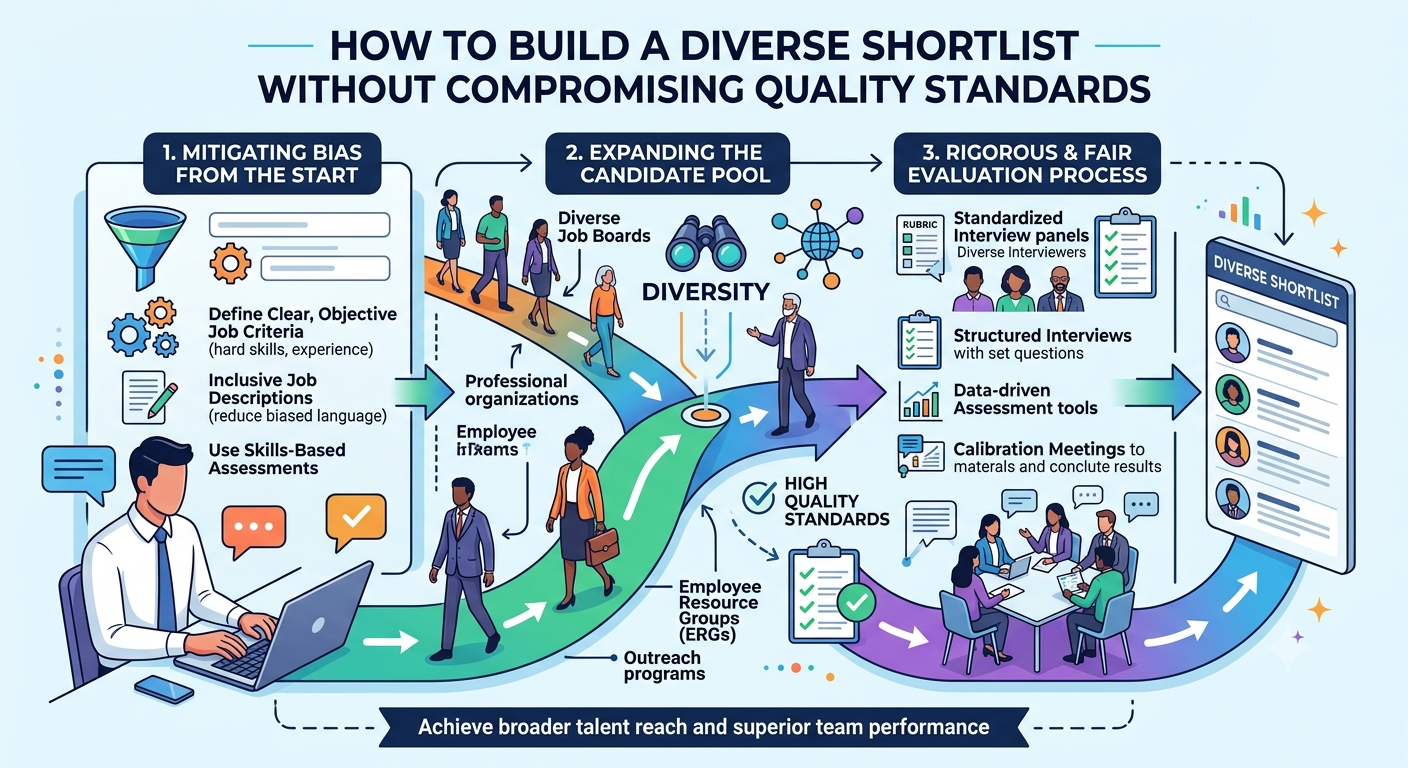
Introduction: Diverse Shortlist
Finding the right candidates plays a critical role in building a productive and high-performing workforce. At the same time, businesses face the risk of failing to attract a diverse pool of applicants while also meeting their quality control standards. Recruiters may be biased against those with different backgrounds, educational qualifications, career prospects, or personal values. A diverse shortlist aids recruiters in selecting from a wide talent pool with varying backgrounds while ensuring that the same standards are maintained.
Creating a diverse shortlist should not entail lowering the professional, academic, or personal requirements for the given position. Instead, the focus should be on finding individuals with a variety of backgrounds and considering them according to objective and relevant criteria.
Therefore, the guide below highlights key approaches to building a diverse shortlist without compromising quality standards.
How to Build a Diverse Shortlist Without Compromising Quality Standards?
1. Clarify job requirements
The first step towards building a diverse shortlist is defining the requirements a candidate must meet to fill the given position. In this case, recruiters should only include the mandatory qualifications needed to handle the responsibilities entailed by a particular role.
At the same time, adding unnecessary requirements may disqualify eligible candidates. One example is specifying the types of degrees required when experience can be a better predictor of performance.
Therefore, recruiters should differentiate between requirements that are mandatory and those that can be optional before publishing the details. In addition, this strategy broadens the scope of the search to include individuals with varying levels of education and backgrounds but with the same skill set.
2. Post inclusive job descriptions
Job descriptions often contain specific language that makes it challenging for the best candidates to apply. They also entail requirements or responsibilities irrelevant to the job, thus putting off many talented but underqualified individuals.
When developing job descriptions, recruiters should ensure that they use inclusive language and remove any unnecessary or overly specific details. At the same time, they should use more generalized descriptions, such as years of experience instead of the exact number of months.
An inclusive job description is also more likely to attract a diverse talent pool without compromising the quality of new hires. As such, they should always focus on responsibilities and avoid emphasizing any additional aspects of the role.
3. Find candidates in different places
Traditional job boards, professional networks, and personal contacts are good places to find active and qualified candidates. However, they are not enough to fulfill the demand for diverse applicants, and recruiters should consider looking further. Individuals from different professional backgrounds often require various platforms to find and engage them.
For instance, the recruiter can consider reaching out to professional networks, universities, and employee groups to find active candidates. In addition, they can look at those returning to work after a career break or from different industries with similar skill sets.
Although this method increases the chances of finding diverse candidates, recruiters must ensure that the requirements still apply when considering a candidate for a position.
4. Use skills-based screening
Most recruiters use degrees, educational backgrounds, and work experience as the primary screening criteria. While these aspects of a candidate’s profile can be valuable, they do not always guarantee professionalism.
As such, recruiters should utilize skills-based screening to ensure diversity without sacrificing quality. In this case, the candidate’s abilities, achievements, and experience are more important than their personal and professional background.
For instance, a content writing application can be determined by the submission samples, research abilities, and expertise in the field. This approach helps the recruiters to meet their requirements, including experience and skill set, while also considering diverse backgrounds.
Before screening potential candidates, the recruiters should establish standardized criteria useful for comparing the best candidates. This strategy will help them to shortlist the appropriate individuals based on objective evidence rather than subjective judgment.
5. Set standardized screening criteria
The main consideration should include the skills and qualifications required for the role, the general experience level needed, and the competencies necessary for the opportunity. In addition, the recruiters should specify the relevant evidence and scoring ranges for each component.
By using standardized screening criteria, the recruiters ensure that they compare the most relevant aspects of a candidate’s profile. It will also reduce the influence of personal biases and ensure that every application is considered based on fair grounds.
6. Mitigate unconscious biases
Unconscious biases may affect the decisions of the recruiters, especially when considering candidates’ personal background or unrelated work experience. As such, businesses can utilize structured screening and interviewing processes to reduce the effects of these biases.
The recruiters can also take a bias training course to identify triggers and respond appropriately when they arise. However, bias training alone is rarely sufficient, and the business must also consider other steps that help reduce the effects of unconscious biases.
When making hiring decisions, recruiters must take a holistic view of the candidate rather than focusing on their irrelevant but interesting background. This strategy will ensure that they shortlist individuals based on relevant factors and make better evidence-based decisions.
7. Apply additional layers of evaluators
A single recruiter or a hiring manager can be biased in their approach to considering candidates for a position. However, multiple evaluators can highlight the most important factors and contribute to the decision-making process to shortlist the best candidates.
For instance, a hiring manager can assess the technical knowledge of a candidate, while a recruiter can evaluate their professional experience and a technical person can measure specific skills. All evaluators must consider the same selection criteria and base their recommendations on objective evidence before coming together to discuss their findings.
This strategy reduces the likelihood of recruiters falling for the biases of others or making decisions based on subjective considerations. In addition, it provides an opportunity to evaluate the candidate from different angles and focus on what is important.
8. Evaluate diversity and quality
The recruiters should continually monitor the success of various diversity initiatives, such as increasing the representation of women or people from different ethnicities in different roles. However, when implementing such policies, it is important to balance diversity and quality throughout the selection process.
As such, the recruiters should keep track of recruitment statistics, such as the number of diverse candidates reaching the offer stage. At the same time, they should also review data, such as relevant knowledge, abilities, and skills, and ensure that they are not being overlooked in favor of irrelevant factors.
If some individuals from the same minority group fail to make it to the next round, the hiring team should consider the causes and eliminate some requirements for all other candidates.
Conclusion: Diverse Shortlist
A diverse shortlist is a reflection of the efforts recruiters invest in ensuring that there are no unnecessary barriers to talent acquisition. Businesses must take the time to identify the requirements for a particular role, increase the chances of finding talented candidates, and consider each application objectively.
As such, they should set the requirements to ensure that they focus on the most critical evidence, such as personal qualifications for knowledge-intensive roles. Moreover, the recruiters should use a combination of the above strategies when short-listing candidates to ensure that they meet their requirements and avoid biases.
Build a diverse, high-quality workforce with the Best Job Tool to streamline recruitment, reduce hiring bias, and identify top talent.



Leave a Reply