Introduction: Recruiter Productivity
Measuring recruiter productivity beyond the number of offers made makes it possible for companies to hire competent candidates. It is not sufficient to rely only on the quantity of offers as a performance metric. For instance, a recruiter may make numerous offers but fail to acquire desirable candidates or retain their employees.
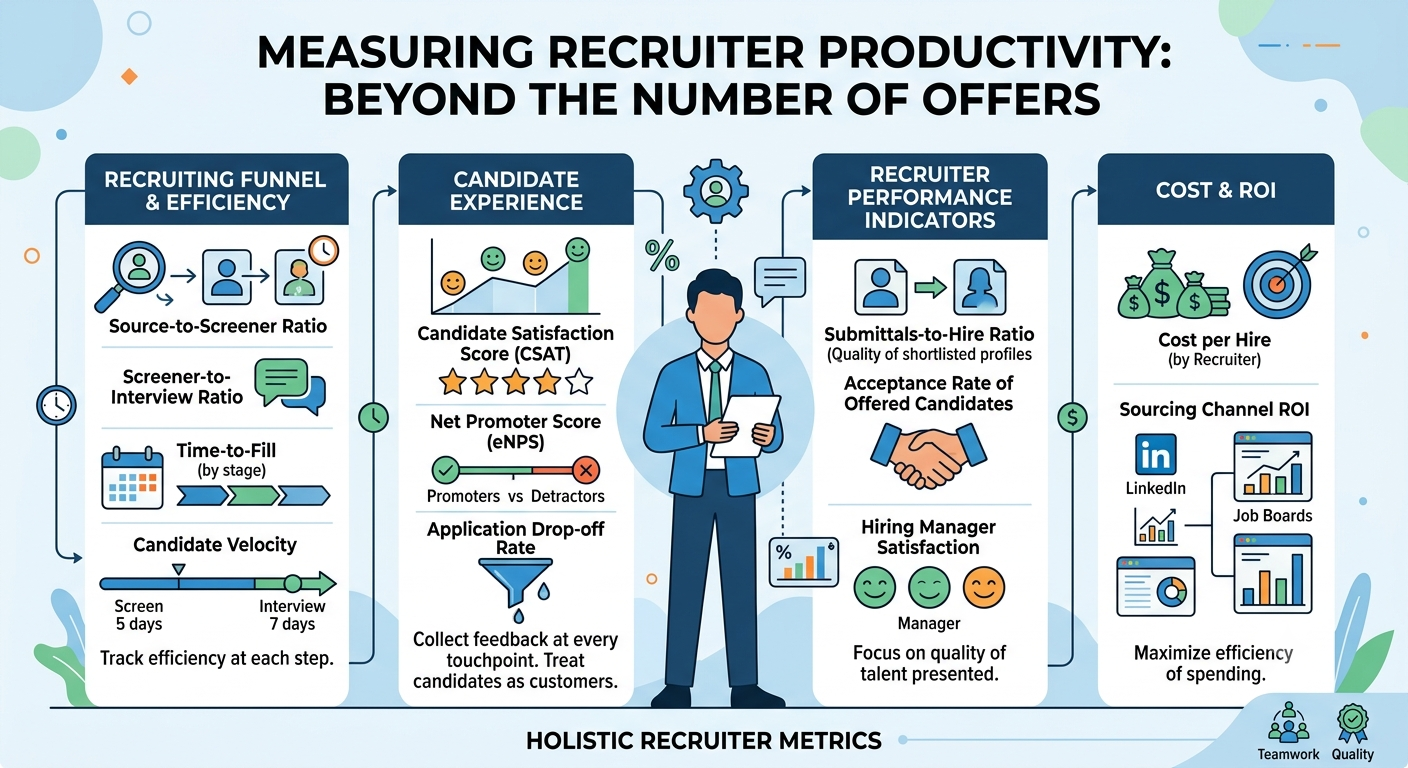
Businesses have to assess the productivity of the recruiters based on the offers made. Businesses should evaluate hiring quality, time-to-hire, and candidate retention to attract and recruit top talent. The article below contains key metrics that businesses can use to assess the performance of their recruiters. Recruiter productivity depends on more than the number of job offers made, as hiring quality and candidate satisfaction also influence recruitment success.
How to Measure Recruiter Productivity Beyond Offers Made?
1. Evaluate the Quality of Hires
The quality of hires made by a recruiter can significantly impact a business’s overall performance. Focusing only on the number of hires may lead businesses to make poor recruitment decisions. Recruiter productivity can improve when hiring professionals focus on selecting candidates who meet job requirements and contribute to business growth.
Do you like this personality? For example, a recruiter may make five successful hires compared to another recruiter who makes ten hires. In such a scenario, it is evident that the former recruiter has a better performance than the latter.
Businesses can assess hiring quality by tracking employee performance scores and probation pass rates. By basing their assessment and subsequent actions on these figures, companies can guarantee that they have quality manpower.
2. Measure Time-to-Hire
Time-to-hire measures the average days from the start of recruitment to offer acceptance. Tracking this KPI helps businesses identify delays and improve hiring efficiency. Tracking time-to-hire helps businesses measure recruiter productivity and identify delays that affect the efficiency of the hiring process.
On the other hand, a short time-to-hire should not compromise the quality of the new hires. Recruiters can ensure that they keep their candidates engaged throughout the recruitment process and provide them with timely feedback. In addition, they can shorten the time required for making appointments with hiring managers. Businesses should compare time-to-hire only for similar roles, as specialized positions may require longer hiring periods.
3. Track Candidate Experience
Candidate experience refers to the general impression of the recruitment process that candidates obtain during their interaction with the firm. This metric helps recruiters attract qualified candidates and prevent them from choosing competitors. Poor organization and unclear application updates may discourage candidates from continuing the hiring process. As such, businesses need to measure candidate experience when evaluating the performance of their recruiters.
A company can use candidate satisfaction surveys to analyze candidate experience by comparing the candidate’s expectations against the actual recruitment process. In addition, firms can review complaints, drop-off rates, and delays in the recruitment process to identify where they can enhance their recruitment process.
4. Use recruitment data to improve performance
With the use of recruitment analytics, it will be possible for businesses to consolidate various productivity figures into a single dashboard and focus on more than one metric. It is essential that the management does not rely on a particular score when measuring an employer’s performance but pays attention to a combination of indicators.
For example, the dashboard should comprise time-to-hire, offer acceptance rate, candidate satisfaction, quality of hire, cost per hire, and new-hire retention. It will enable recruiters and managers to track the trends and set performance benchmarks in terms of unique issues. Moreover, companies should configure tolerances for roles depending on the complexity of the position, the number of applicants, and available resources. As a result, recruiters will receive more practical guidance on improving their performance rather than aiming at irrelevant goals.
5. Assess Hiring Manager Satisfaction
Hiring managers collaborate closely with recruiters to ensure that the firm’s workforce needs are met. They can offer recruiters valuable insight into how successfully the organization is meeting its personnel needs. As such, by analyzing the satisfaction level of hiring managers, recruiters can identify the strengths and weaknesses of their performance. Companies can use survey tools to determine the extent to which hiring managers are satisfied with the performance of the recruiters. The questions should be designed to analyze the hiring managers’ impression of the recruiters, their understanding of the requirements of the vacant positions, the level of communication displayed by the recruiters, and their overall satisfaction with the recruiters’ performance.
Hiring managers’ feedback is crucial, as it highlights the areas where a recruiter can improve their performance. However, businesses should cross-examine these results with objective-based statistics to ensure that the hiring managers’ feedback is not influenced by their personal opinions.
6. Measure Employee Retention
Employee retention enables businesses to track the long-term success of their recruiters by recording the rate at which the employees the recruiters hire continue to work for the company after being hired. The most common timeframe used for measuring employee retention is 90 days, 6 months, and 1 year. As such, if the recruiters’ newly hired employees leave their jobs due to miscommunication about the role, businesses can reconsider how they present the job requirements and qualifications. In addition, this information can also help companies determine if the recruiters’ offer reasonable compensation, attractive benefits, and work environment.
However, the level of employee retention that a business records should not be solely attributed to the performance of their recruiters. There are instances where the actions of the company’s management can increase the likelihood that an employee that the recruiters have hired will stay in their job.
7. Determine Recruitment Pipeline Conversion Rates
Conversion rates indicate how successfully recruiters support the business in transitioning candidates from one stage of the recruitment process to another. Firms can track conversion rates at the following stages;
a. The percentage of applicants that the recruiters receive and successfully move from submitting their resume to the recruitment decision-makers at the company for screening.
b. The number of applicants that get past the resume screening and successfully go to the interview stages.
c. The percentage of candidates that successfully move from the interview to the final selection stages.
d. The number of candidates that successfully receive job offers from the companies.
By analyzing the performance of their recruiters at various stages in the recruitment process, businesses can pinpoint areas where they can enhance the performance of their recruiters. In addition, this information can also help firms discover the steps that their recruiters consistently perform poorly. As such, it can play a crucial role in helping businesses enhance their recruitment process.
8. Measure Sourcing Channel Effectiveness
There is a list of various recruiting channels through which recruiters search for potential candidates. Some of them include job boards, LinkedIn, employee referrals, professional networks, etc. Measuring these channels’ effectiveness is one of the main recruitment Key Performance Indicators (KPI). This metric allows organizations to determine which of the recruiting channels provide the best candidates and those that can be closed.
The most valuable candidates, their performance, and retention rate can be measured to see the impact of different sources on the organization. For instance, if the best performers are referred by employees, the company should consider emphasizing the referral program. Understanding the value of each recruiting channel will also help the organization optimize the budget spent on recruiting and save time by eliminating underperforming sources.
Conclusion: Recruiter Productivity
In order to evaluate the productivity of recruiters correctly, it is important to consider many factors in addition to the number of offers. The company should concentrate on such aspects as the quality of workers hired, speed of recruitment, candidate experience, acceptance rate, workforce retention, and expenses per recruit. By analyzing these points, a company can understand its productivity in terms of recruiters and the quality of new employees.
Moreover, the company will be able to identify particular issues and solve them to increase the recruitment quality and improve workers’ experience. This will allow the company not only to attract new specialists but also to maintain the existing ones. Thus, a company has to take a closer look at all aspects of the recruitment process in order to ensure that they are operating at the highest level and in the most beneficial way for the company.
Improve your hiring strategy and measure recruiter productivity beyond offers made with the Best Job Tool to make data-driven recruitment decisions.



Leave a Reply