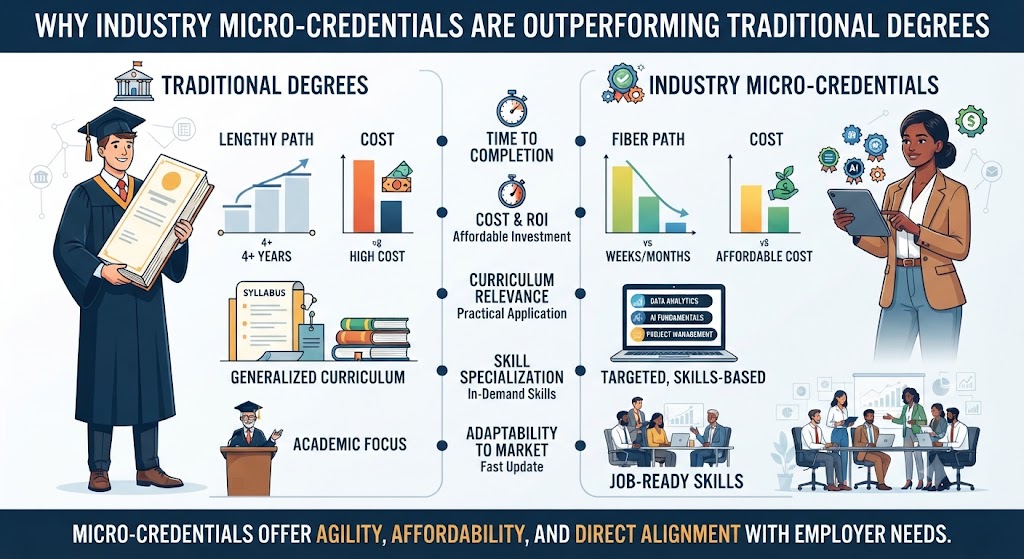
The professional world is changing rapidly as employers seek candidates with practical skills, industry knowledge, and the ability to adapt to new technologies. Although traditional degrees remain valuable, many companies are increasingly recognizing industry micro-credentials as an effective way to evaluate job readiness. These short, focused certifications help professionals demonstrate specific abilities without committing to several years of formal education.
From digital marketing and data analytics to cybersecurity and project management, micro-credentials are becoming an important part of modern career development. They allow job seekers to learn relevant skills, improve their resumes, and respond quickly to changing hiring requirements. Moreover, they can be particularly useful for professionals pursuing remote opportunities, planning international careers, or transitioning into new industries.
However, micro-credentials do not automatically replace traditional degrees. Their value depends on the industry, the quality of the certification, and the skills employers actually need. Understanding these differences can help professionals make better decisions about education, career growth, and long-term financial planning.
The Growing Demand for Skills-Based Hiring
Employers increasingly need candidates who can perform specific tasks from the beginning of employment. A degree may demonstrate academic knowledge, but it does not always show whether someone can use industry tools, manage practical projects, or solve workplace problems.
Consequently, many organizations are adopting skills-based hiring practices. Instead of relying exclusively on educational qualifications, recruiters may evaluate portfolios, technical assessments, professional certifications, and relevant work experience.
Micro-credentials support this approach because they focus on defined competencies. For example, a candidate applying for a data analyst position might demonstrate knowledge of Excel, SQL, data visualization, and reporting through targeted certifications.
This approach benefits both employers and applicants. Companies can identify relevant capabilities more efficiently, while candidates can demonstrate their readiness through evidence of practical learning.
Professionals can respond to this trend by:
- Reviewing job descriptions to identify frequently requested skills.
- Comparing their existing abilities with employer requirements.
- Choosing credentials that address specific skill gaps.
- Building projects that demonstrate how those skills work in practice.
- Updating their resumes and professional profiles with verified achievements.
Ultimately, employers are interested not only in what candidates have studied but also in what they can contribute to the organization.
Why Micro-Credentials Offer Greater Learning Flexibility
Traditional degrees generally follow structured academic schedules and require a significant time commitment. In contrast, many micro-credentials offer flexible learning formats, including self-paced courses, online assessments, and short practical programs.
This flexibility makes them attractive to working professionals, recent graduates, freelancers, and people changing careers. Instead of leaving a job to pursue another qualification, learners can develop new capabilities alongside their existing responsibilities.
For example, a marketing professional interested in analytics could complete a short course in web analytics while continuing to manage daily campaigns. Similarly, an administrative professional could learn project management software before applying for operations roles.
Micro-credentials can also support professionals working remotely across different time zones. Online learning allows them to organize study sessions around meetings, deadlines, and personal commitments.
To make flexible learning productive:
- Establish weekly study hours and realistic completion dates.
- Divide large learning goals into smaller modules.
- Practice each new skill through a real or simulated project.
- Review progress every two weeks.
- Apply newly learned techniques to current work whenever possible.
Although flexibility is valuable, learners should avoid collecting certificates without a clear objective. A focused learning plan connected to specific career goals generally provides more value than completing unrelated courses.
Lower Education Costs and Better Financial Planning
The cost of education is an important consideration for professionals deciding how to improve their qualifications. Traditional degrees can involve tuition fees, accommodation, transportation, learning materials, and income lost while studying.
Micro-credentials may offer a more affordable alternative for acquiring selected skills. However, prices vary considerably, and some advanced certifications, examination fees, and specialized training programs can be expensive.
The financial advantage depends on whether the qualification improves employability, supports career progression, or helps the learner move into a better-paying role.
Before purchasing a certification, professionals should evaluate its potential return on investment.
Consider these factors:
- Total cost: Include course fees, examination charges, software subscriptions, and study materials.
- Time investment: Estimate the hours required to complete the program and prepare for assessments.
- Employer recognition: Check whether companies in the target industry request or value the credential.
- Practical relevance: Determine whether the course teaches skills used in actual job responsibilities.
- Career potential: Identify whether the qualification supports a realistic promotion, career change, or job application strategy.
For example, someone interested in project coordination might compare the cost of a specialized project management course with the expected benefits of applying for relevant positions. The objective should be to make an informed investment rather than assume that every certificate leads to higher earnings.
Financial planning also means protecting essential savings. Avoid taking on unnecessary debt for credentials that lack clear industry recognition or measurable career relevance.
How Micro-Credentials Support Remote and Global Careers
Remote work has expanded opportunities for professionals to apply for positions beyond their immediate geographic location. However, international employers may receive applications from candidates with different educational backgrounds, qualifications, and professional experiences.
In this environment, clearly defined credentials can help demonstrate specialized knowledge. A recognized certification in cloud computing, cybersecurity, digital advertising, or business analytics may give recruiters additional evidence of a candidate’s technical capabilities.
Micro-credentials can also help professionals prepare for jobs that require familiarity with digital tools and independent working practices.
For example, remote project coordinators may benefit from training in collaboration platforms, workflow management, and project documentation. Digital marketers may strengthen their profiles through certifications in analytics, search advertising, or campaign measurement.
Professionals seeking international opportunities should take the following steps:
- Research job requirements in their target countries and industries.
- Identify certifications mentioned repeatedly in relevant vacancies.
- Verify whether the issuing organization is recognized by employers.
- Develop a portfolio demonstrating practical application.
- Highlight communication, time management, and cross-cultural collaboration skills.
- Check visa, licensing, and work authorization requirements before accepting an international position.
A global job platform such as best job tool can help job seekers explore opportunities across different markets and compare the qualifications employers request.
Nevertheless, a micro-credential does not guarantee international employment or replace mandatory licensing requirements. Candidates should evaluate each opportunity individually and ensure their qualifications match the employer’s expectations.
Practical Skills Make Micro-Credentials More Valuable
A certificate alone does not prove that a candidate can perform a task effectively. Its real value increases when the learner can demonstrate the knowledge through practical work.
Employers may ask candidates to explain a project, complete an assessment, analyze a business problem, or demonstrate proficiency with relevant software. Therefore, practical application should be part of every credential-based learning plan.
Consider a professional completing a data analytics certification. Instead of listing the certificate on a resume and stopping there, the candidate could build a dashboard using a publicly available dataset, identify meaningful trends, and explain the business implications.
Similarly, someone earning a digital marketing credential could develop a sample campaign plan, define measurable objectives, and explain how performance would be evaluated.
To turn a credential into demonstrable experience:
- Complete a project that reflects a real workplace challenge.
- Document the problem, process, tools, and results.
- Publish appropriate work samples in a professional portfolio.
- Explain the business value of the skills demonstrated.
- Prepare to discuss decisions, limitations, and lessons learned during interviews.
Where possible, seek feedback from experienced professionals or mentors. Their input can help identify weaknesses that course assessments may not reveal.
This combination of structured learning and practical evidence makes a candidate’s profile more credible. It also helps professionals develop confidence when applying for roles that require new technical or operational capabilities.
Why Traditional Degrees Still Matter in Many Industries
Despite the growing popularity of micro-credentials, traditional degrees remain essential or strongly preferred in many professions. Healthcare, law, architecture, and several engineering disciplines may require formal education, professional accreditation, examinations, or licensing before someone can practice.
Degrees can also provide a broad academic foundation, opportunities for research, and access to professional networks. These benefits may be difficult to replicate through short courses alone.
In other fields, employers continue to use degree requirements when screening candidates for entry-level or leadership positions. The importance of formal education varies according to the role, employer, country, and level of responsibility.
Therefore, professionals should avoid treating degrees and micro-credentials as competing options in every situation.
A more effective strategy is to determine which qualification best supports the desired career path.
- Choose a traditional degree when the profession requires formal academic qualifications or a comprehensive educational foundation.
- Choose a micro-credential when a specific skill gap is preventing progress or an employer values a recognized technical certification.
- Combine both approaches when a degree provides the foundation and additional credentials demonstrate current industry knowledge.
- Prioritize experience and a portfolio when employers emphasize practical performance and demonstrable results.
For graduates, micro-credentials can strengthen an existing qualification. For experienced professionals, they can provide targeted learning without requiring another full academic program.
The best decision depends on professional goals rather than the assumption that one educational format is universally superior.
How to Build a Career Strategy Around Micro-Credentials
The strongest approach to professional development begins with a clear career objective. Rather than pursuing every popular certification, job seekers should identify the roles they want and work backward from the skills those positions require.
First, review several job descriptions for the same target role. Record the technical skills, software knowledge, qualifications, and experience requested by employers. Next, compare these requirements with your existing capabilities.
This process helps identify the gaps that matter most.
Create a simple development plan with three priorities:
- Learn: Select one credible credential that addresses a high-priority skill gap.
- Demonstrate: Build a project or complete a practical assessment that proves your ability.
- Apply: Update your resume, portfolio, and professional profiles before applying for suitable positions.
Set a realistic budget and timeline. For instance, you might dedicate six to eight weeks to developing one skill, completing a project, and preparing applications. The exact schedule should reflect the complexity of the subject and your existing knowledge.
Track outcomes rather than certificates collected. Useful measures include the number of relevant applications submitted, interview invitations received, recruiter feedback, and opportunities to use the skill professionally.
A global job platform such as best job tool can support this process by helping candidates explore job opportunities and identify recurring employer requirements. However, job applications should be tailored to each position rather than relying on credentials alone.
Finally, reassess your plan every few months. Technologies, employer expectations, and career priorities change. Continuing education is most effective when it responds to real market needs and supports a clearly defined professional direction.
Conclusion
Industry micro-credentials are gaining recognition because they provide focused, flexible, and often cost-effective ways to develop job-relevant skills. They can help professionals respond to changing employer expectations, strengthen remote-work applications, prepare for career transitions, and demonstrate practical knowledge.
However, their effectiveness depends on quality, industry recognition, and the ability to apply what has been learned. Traditional degrees remain important in professions requiring formal qualifications and in roles where broad academic preparation is essential.
For most professionals, the goal should not be to choose between degrees and micro-credentials without considering context. Instead, they should build a balanced career strategy that combines appropriate education, practical experience, continuous learning, and informed financial decisions.
By identifying relevant skill gaps, selecting credible credentials, and demonstrating measurable capabilities, job seekers can make their qualifications more meaningful to employers. Explore opportunities, understand hiring requirements, and use best job tool to support your search for the next step in your professional journey.



Leave a Reply