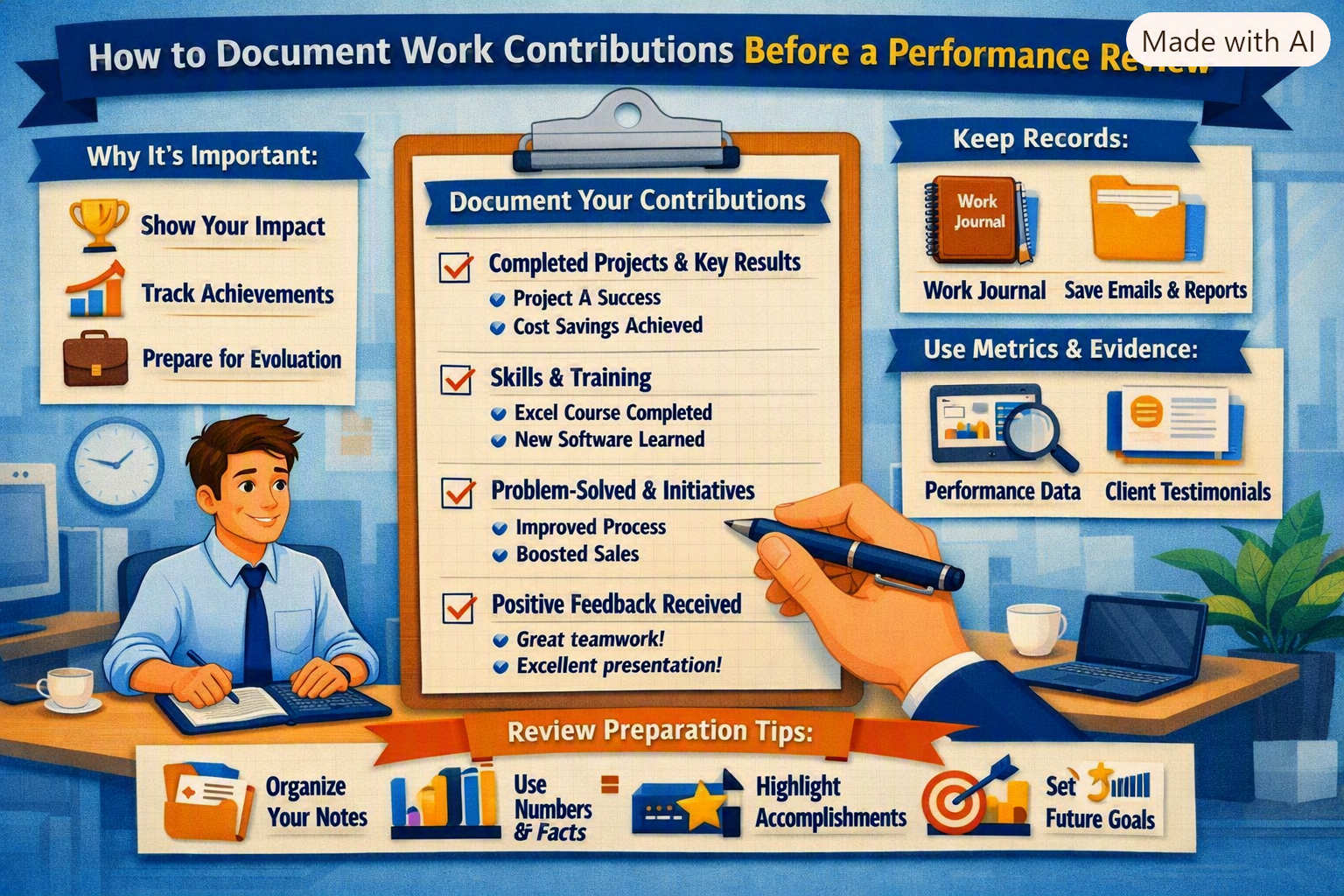
Introduction: Document Work Contributions
A performance review is an important opportunity to discuss your accomplishments, goals, and areas for improvement. But the problem is that many people fail at the first step — finding and formulating what exactly they want to say. The information is there, but it is scattered across dozens of meetings, reports, and emails — and your memory can only hold so much.
How to document your contributions at work before a performance review is a common question, and the answer is a simple yet time-consuming task: note everything relevant that you did this year. Yes, it does take effort, but it will make your life much easier in the long run. Even more importantly, you need to understand that documentation does not equal a boring list of tasks. To help you compile a complete and compelling list, here are a few pointers.
How to Document your Contributions at Work Before a Performance Review Essay?
1. Start Keeping Notes
The easiest way to prepare for a performance review is to start documenting your work year-round. Do not leave it to the last moment, so you do not have to rummage through your emails and reports in a panic two weeks before the meeting.
All you need is a single document, spreadsheet, or note field where you can store and organize important achievements. For each notable event, try to briefly write down what it was, what your role in it was, and what the result was. The latter is even more important than the first two. For example, do not write ‘worked on customer complaints,’ but ‘processed customer complaints and reduced pending issues.’
Even if this is a tiny thing, after a few months, these notes will become your ticket to a great review.
2. Measure Outcomes, Not Input
What exactly did you do this year? Well, you did everything your job description said you would do. However, your performance review is not about fulfilling your duties — it is about exceeding them. That is why, when compiling your list of achievements, you should not focus on the inputs (efforts) you made but rather on the outputs (results).
For example, instead of ‘prepared weekly reports,’ write down ‘prepared weekly reports that allowed the department to keep track of pending work and meet deadlines.’ The key here is to measure the outcomes: how did your efforts affect the workflow, customer satisfaction, and overall performance?
Whenever possible, quantify these results. Words like ‘improved’ or ‘reduced’ are great, but a specific number will give you more credibility. If you cannot think of a particular figure, you can always write down a short explanation of the outcome.
3. Save Evidence of Your Success
Documentation is only as good as the evidence you can provide. That is why it is a good idea to store any relevant messages, reports, customer testimonials, or other documents that can serve as proof of your achievements. Again, you do not want to turn your entire year of work into a single folder, so be picky about what you choose to keep.
For example, if you accomplished something big and notable, make sure to keep the final report or message acknowledging your success. Similarly, if you received any praise from a client, coworker, or manager, make sure to keep that somewhere accessible. However, you must follow your company’s security and privacy regulations when saving any sensitive information.
4. Note Any Increases in Performance
If you think about it, almost any achievement can be measured in numbers. You were faster, more accurate, or more efficient this year than last. Perhaps you handled more responsibilities or dealt with more difficult clients. All of these can be considered increases in performance, and you should note them in your performance review notes.
Make a list of everything that comes to your mind. For example, the following achievements can typically be quantified:
- The number of projects completed or cases handled
- The reduction in time spent on routine procedures
- The number of employees you trained or mentored
- The number of weeks ahead of schedule you finished a project
- The increase in accuracy when completing reports
- The amount of extra work you took on for a short-term project
If there are no concrete numbers, briefly describe the improvements and their outcomes.
5. Record What Issues You Helped Solve
You may think that the only achievements worth noting are major projects completed and goals met. However, a true professional knows that every day brings its own challenges. Did you solve an urgent problem for a client today? Did you streamline a complicated procedure for your coworker? These are all examples of issues you helped solve, and they should be recorded as achievements in your performance review.
This category is perfect for showcasing your creativity, initiative, and leadership skills. You do not necessarily have to describe an entire project here — a few sentences about how you managed to quickly overcome a serious obstacle will do.
6. Remember to Mention Teamwork
When thinking about their contributions, people often forget that not all achievements are directly related to one person’s actions. Sometimes, a team of people has to combine their efforts to achieve a common goal. If you are a team player, make sure to mention any achievements that required collaboration with coworkers.
Do not forget to add a brief description of what exactly you did to contribute to this outcome. For example, instead of ‘collaborated with the sales department,’ write ‘developed a new system for tracking client requirements in collaboration with the sales department.’
Conclusion: Document Work Contributions
Documenting your contributions before a performance review helps you clearly demonstrate the value of your work. Keep track of your achievements, completed projects, measurable results, feedback, and challenges you have overcome throughout the review period.
A well-organized record can make performance discussions more focused and help your manager understand your growth. Instead of relying on memory, build a consistent habit of recording your progress so you can confidently communicate your impact and prepare for future career opportunities.
Ready for your next performance review? Start documenting your achievements, track your progress, and showcase your value with the Best Job Tool platform to take the next step in your career.





Leave a Reply