Introduction: Navigate Reporting
To report directly to a founder means that a junior employee can learn faster and get more opportunities. However, being in constant communication with the person who has a tremendous amount of responsibilities may be overwhelming at times.
Despite the challenges of understanding the expectations, asking for advice, and taking ownership, reporting directly to the founder is a great opportunity for a junior employee. To succeed in it, one should know how to communicate with a busy person, be accountable for their responsibilities, and understand the founder’s expectations.
Moreover, being available for questions and seeking help when needed will demonstrate a junior employee’s initiative and interest in work. How to Communicate with a Busy Person Effectively?
Since every founder has specific preferences and ways of communication, a junior employee should invest time and effort in learning them.
For instance, some founders may prefer getting updates via email, while others may want precise information and prefer task management software. Paying attention to what communication style the founder prefers will allow avoiding misunderstandings and miscommunications.
In addition, a junior employee should always define the scope of responsibility and clarify the goals and deadlines for the given task.
In case of uncertainty about the task, a junior employee should ask clarifying questions. A junior employee needs to remember that the primary mission is to achieve the goal set by the founder.
When asking for advice or submitting the results of work, a junior employee should be clear and concise to avoid misunderstanding and save the founder’s time.
Although asking questions may seem shameful for some junior employees, asking the right questions demonstrates the junior employee’s initiative and engagement in the work.
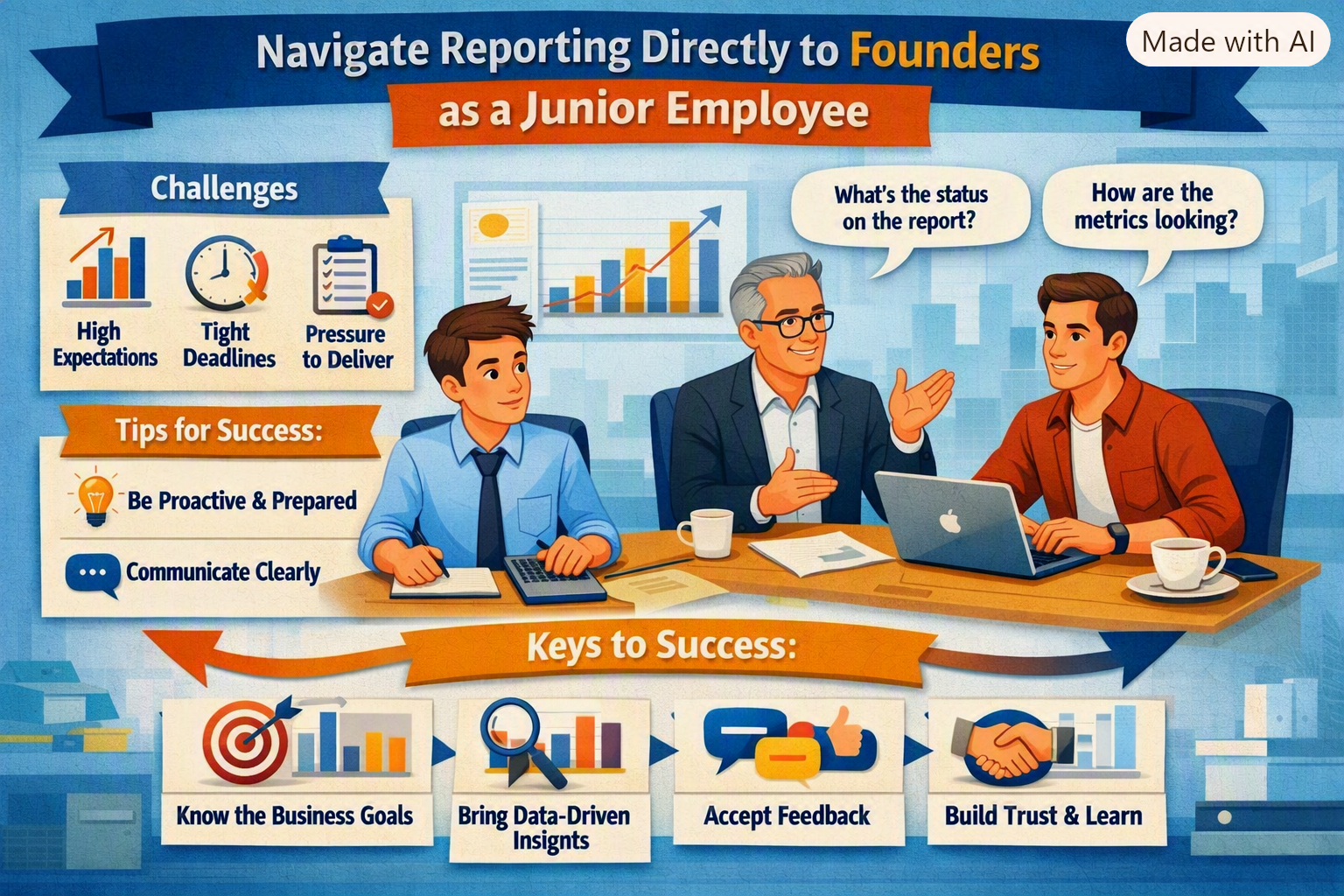
Navigate Reporting Directly to Founders as a Junior Employee
1. How to Respond to Feedback?
Feedback from the founder may be more challenging than feedback from the line of leadership. A junior employee should keep in mind that the founder is human, and taking his or her advice personally should not affect the junior employee’s work. Moreover, a junior employee should listen closely to the feedback provided by the founder and look for actionable takeaways.
If the founder’s feedback is confusing, a junior employee should ask for an example or seek clarification.
It can be helpful to keep a log of feedback received from the founder. If the founder often comments on the same topic, like written communication or meeting efficiency, it will be easier to see the patterns. Keeping track of repetitive topics will also be helpful for providing better results for the founder and demonstrating that the junior employee is receptive to feedback.
2. How to Get Comfortable With Shifting Goals and Priorities?
Working in a startup environment means that priorities and goals may shift rapidly. A task that was considered “urgent” can become unimportant if a new opportunity emerges. Such situations may be overwhelming for a junior employee, especially when they have already invested a lot of effort in the task.
When the goals and priorities change, a junior employee should prioritize their work and let the founder know about it.
To do that, one can inform the founder that the new task is urgent, and ask if it should be prioritized over the existing tasks. For example, one can say “I currently have these three tasks. Since the new task is urgent, I will put it on the first priority.” It will prevent the junior employee from doing useless work and wasting the founder’s time.
3. How to Build a Trustworthy and Respectful Relationship?
Since a junior employee is in the direct contact with the founder, the relationship between them plays a significant role. To succeed at work and get noticed by the founder, a junior employee should aim to build a trustworthy and respectful relationship with him or her.
A junior employee should remember that no one expects them to perform at the level of the founder right away. However, a junior employee should fulfill the basic obligations, meet the deadlines, and be honest and transparent when communicating with the founder. Moreover, a junior employee should not promise what they cannot deliver. Small but constant efforts will show the founder that a junior employee can be trusted and will enable them to get more responsibilities.
4. How to Stay Organized?
Since a junior employee communicates directly with the founder, they may forget critical details or miss important tasks. A junior employee should maintain a reliable record of communication with the founder, tasks, and results. Keeping track of what has been done, what is in progress, and what needs to be done will prevent mistakes and save time and effort.
It can be a simple spreadsheet or a list of tasks and priorities. In addition, maintaining a reliable record of tasks will be helpful when discussing work with the founder. Having specific information about the tasks will allow demonstrating more achievements and getting more results.
5. How to Grow as a Professional by Reporting Directly to the Founder?
Reporting directly to the founder provides a junior employee with the opportunity to learn from the top. However, being under the wing of the founder does not mean behaving like the founder. A junior employee should remember that the position and experience determine the level of responsibility.
A junior employee should seek to learn and grow while maintaining humility and transparency in communication with the founder. It will be easier to achieve work-life balance and avoid the feeling of constant pressure.
Moreover, a junior employee should observe how the founder approaches various situations and applies the gained experience in their work. Reporting directly to the founder can provide a junior employee with a steep learning curve. The more a junior employee tries to be receptive to the founder’s advice and experience, the faster they will grow as a professional.
Moreover, the direct interaction with the founder will allow a junior employee to gain precious experience in decision-making, leadership, and management, which no textbook can provide. However, a junior employee should not expect to receive too much information at once.
Conclusion: Navigate Reporting to Founders
How to navigate reporting to founders directly as a junior employee depends on effective communication, responsibility, and learning. Although a junior employee may feel insecure about their abilities at the begging, such interactions allow them to demonstrate their skills and get more work opportunities.
Reporting directly to the founder is a great chance to gain the attention of the top management. The above-mentioned strategies will help a junior employee to succeed at work and increase their chances of promotion.
Ready to navigate reporting directly to founders as a junior employee? Use the Best Job Tool platform to explore the right opportunities, build your career strategically, and take your next professional step with confidence.



Leave a Reply