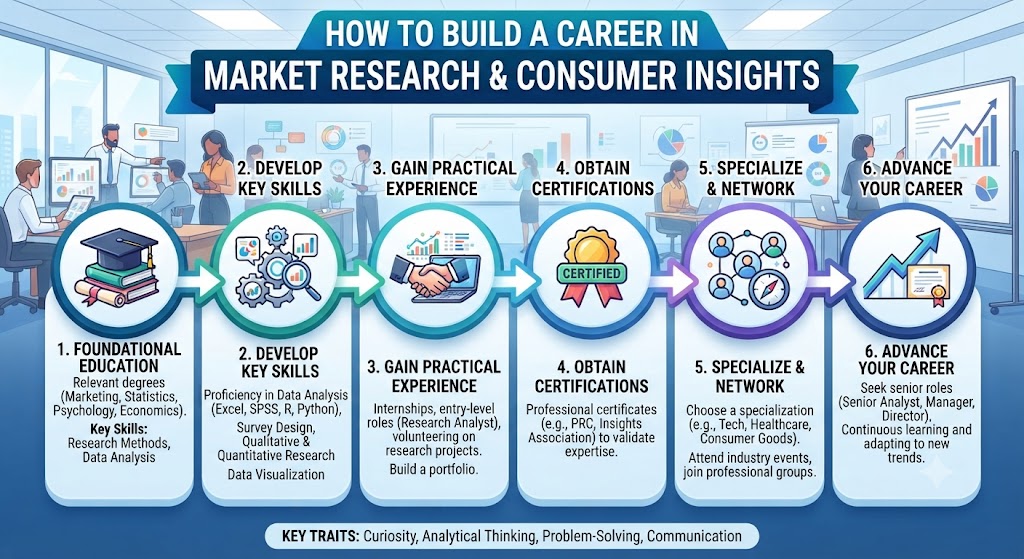
Market research and consumer insights play a critical role in helping businesses understand what people want, why they make purchasing decisions, and how markets are changing. From product development and pricing to branding and customer experience, organizations rely on research professionals to turn consumer information into practical business decisions.
A career in this field can suit graduates from marketing, business, psychology, economics, communications, statistics, and related disciplines. It can also offer opportunities across industries such as technology, retail, healthcare, financial services, media, travel, and consumer goods.
The growth of digital research, social listening, customer analytics, online surveys, and behavioral data has also expanded the skills expected from market research professionals. Building a successful career therefore requires more than knowing how to conduct surveys. Professionals need research expertise, analytical ability, business understanding, communication skills, and the ability to explain findings clearly.
Understand What Market Research and Consumer Insights Professionals Do
Market research focuses on collecting and analyzing information about customers, competitors, products, and markets. Consumer insights goes a step further by interpreting research findings to explain customer behavior and support business decisions.
Although the terms are often used together, the work can vary considerably between organizations. Some roles are highly analytical, while others focus more on research design, qualitative interviews, strategy, or client communication.
Typical responsibilities may include:
- Designing customer surveys and research studies
- Conducting interviews and focus groups
- Analyzing customer and market data
- Monitoring competitors and industry trends
- Studying purchasing behavior
- Measuring brand awareness and perception
- Creating customer segments and personas
- Evaluating product concepts
- Preparing research reports and presentations
- Translating findings into business recommendations
Before applying for jobs, identify which part of the field interests you most. A person who enjoys statistics may prefer quantitative research, while someone interested in psychology and communication may prefer qualitative research or consumer behavior.
Understanding these differences helps you target relevant positions rather than applying broadly to every research-related vacancy.
Build the Core Skills Employers Look For
A strong market research professional combines research methodology with analytical and communication skills. You do not necessarily need to master every tool immediately, but you should develop a practical foundation.
Research skills are essential. Learn how to formulate research questions, identify target audiences, create survey questions, select appropriate research methods, and recognize potential sources of bias.
Data skills are equally important. Become comfortable working with spreadsheets and basic statistical concepts. Depending on the role, you may also benefit from learning data visualization and analytics platforms.
Important skills include:
- Survey design
- Qualitative interviewing
- Quantitative analysis
- Excel or spreadsheet analysis
- Data visualization
- Statistical fundamentals
- Consumer segmentation
- Competitor research
- Presentation development
- Report writing
- Critical thinking
- Business communication
Do not focus only on collecting certifications. Employers need evidence that you can use your knowledge to solve practical problems.
For example, instead of simply listing “survey research” on your resume, create a small research project that investigates why customers prefer one product category over another. Explain your methodology, sample assumptions, findings, and recommendations.
That project gives recruiters something concrete to evaluate.
Gain Practical Experience Through Research Projects
Entry-level candidates often face the challenge of needing experience before getting their first research job. Personal and academic projects can help bridge that gap.
Choose a realistic business question and complete a research project from beginning to end.
For example, you could study:
- Why customers abandon online shopping carts
- How consumers choose travel platforms
- Factors influencing subscription renewals
- Consumer preferences for sustainable products
- How students select online learning platforms
- Brand preferences within a specific product category
A simple project can include a research objective, questionnaire, respondent group, analysis, and final recommendation.
Your portfolio should demonstrate how you move from a question to an actionable conclusion.
For each project, explain:
- What business problem were you investigating?
- Who was the target consumer?
- Which research method did you use?
- How did you analyze the information?
- What patterns did you identify?
- What should a business do based on the findings?
This approach demonstrates commercial thinking rather than simply technical knowledge.
Internships are another practical route into the industry. Look for positions involving customer research, marketing analytics, competitive intelligence, brand strategy, customer experience, or business research. These roles can provide transferable experience even when the job title does not specifically say “market researcher.”
Learn to Combine Consumer Psychology With Data
Consumer insights professionals need to understand both numbers and human behavior.
A dataset may show that a particular customer segment has a high purchase frequency. However, the business still needs to understand why that behavior occurs and whether it is sustainable.
This is where consumer psychology becomes valuable.
Study concepts such as:
- Customer motivations
- Decision-making behavior
- Perception and positioning
- Brand loyalty
- Social influence
- Price sensitivity
- Customer satisfaction
- Behavioral patterns
- Customer needs and pain points
At the same time, learn how to question data rather than accepting every result at face value.
A survey result can be influenced by the wording of a question, the sample selected, the timing of the research, or the way respondents interpret the question.
When reviewing research, ask:
- Is the sample appropriate?
- Are there enough respondents?
- Could the question create bias?
- Does the result represent actual behavior or stated preference?
- Are there alternative explanations?
- Does the finding match other available evidence?
This combination of behavioral thinking and analytical discipline can make research recommendations more useful to decision-makers.
Develop Remote Research and Digital Research Skills
Market research increasingly involves digital tools and distributed teams. This creates opportunities for professionals who can conduct research effectively while working remotely.
Remote research may involve online surveys, video interviews, digital focus groups, social listening, online communities, and remote collaboration with research teams.
To work effectively in remote environments, develop a structured workflow.
Use a clear process:
- Define the research objective before collecting information.
- Create a documented research plan.
- Keep research files organized in shared folders.
- Maintain consistent naming conventions for datasets.
- Record assumptions and methodology.
- Schedule regular team check-ins.
- Present findings through concise digital reports.
- Protect confidential consumer information.
Remote work also makes international research more accessible. A researcher can potentially collaborate with teams in multiple markets without relocating.
However, international research requires cultural awareness. A question that works well in one market may not produce equivalent results elsewhere. Language, purchasing habits, social norms, and economic conditions can affect consumer responses.
For professionals interested in travel-related industries, this skill can be especially valuable. Travel testing and consumer research can involve comparing customer expectations across destinations, testing booking experiences, studying traveler preferences, or evaluating tourism products.
The key is to treat travel testing as structured research rather than casual observation. Define the hypothesis, collect comparable information, document findings, and connect observations to customer or business outcomes.
Use Career Platforms and Build a Targeted Job Search
Once your skills and portfolio are ready, focus your job search on roles that match your capabilities.
Potential job titles include:
- Market Research Analyst
- Consumer Insights Analyst
- Research Analyst
- Consumer Research Associate
- Insights Executive
- Brand Research Analyst
- Customer Insights Analyst
- Marketing Research Coordinator
- Competitive Intelligence Analyst
- Customer Experience Analyst
Use job descriptions to identify recurring requirements. If multiple employers request survey design, Excel, qualitative research, and presentation skills, prioritize those areas in your portfolio and resume.
A global job platform such as best job tool can also help candidates explore opportunities across different locations and job categories. Rather than applying randomly, create a targeted search strategy based on your preferred industry, location, work arrangement, and career level.
Your application process should include:
- A resume tailored to research-related roles
- A concise LinkedIn profile
- A research portfolio
- Relevant project examples
- Industry-specific keywords used naturally
- Customized applications for priority positions
Track your applications in a spreadsheet. Record the company, role, application date, location, work arrangement, required skills, interview stage, and follow-up date.
This makes the search measurable and prevents opportunities from being lost because of poor organization.
Improve Productivity, Financial Planning, and Long-Term Career Growth
A research career can involve multiple projects, deadlines, datasets, interviews, presentations, and stakeholder requests. Productivity therefore becomes an important professional skill.
Use a weekly system that separates research tasks into categories such as data collection, analysis, reporting, meetings, and professional development.
Protect focused time for analytical work. Avoid filling the entire calendar with meetings when research requires uninterrupted concentration.
Financial planning is equally important when building a long-term career. Early-career professionals should understand their expected income, living expenses, savings goals, professional-development costs, and potential relocation expenses.
If you plan to pursue international or remote opportunities, consider additional financial factors such as:
- Currency differences
- Tax obligations
- Cost of living
- Relocation expenses
- Travel costs
- Emergency savings
- Professional certifications or training
Career growth should also be intentional. After gaining foundational experience, consider specializing in an area such as healthcare research, technology, retail insights, financial services, customer experience, or brand strategy.
Over time, professionals can progress into roles such as Senior Research Analyst, Consumer Insights Manager, Research Director, Strategy Consultant, or Head of Insights, depending on their experience and specialization.
A best job tool approach to career development is not simply finding the next vacancy. It means continuously matching your skills with changing employer requirements and identifying opportunities where your research expertise can create measurable business value.
Turn Research Findings Into Business Decisions
The most valuable market research professionals do not stop at presenting data. They explain what the findings mean and what the organization should consider doing next.
Imagine a company discovers that customers are dissatisfied with its checkout process. Reporting that satisfaction is low is only the beginning.
A stronger insight might identify the specific stage where customers experience friction, which customer segments are most affected, and what changes could potentially improve the experience.
When presenting research, use a simple structure:
Finding → Meaning → Business implication → Recommended action
For example:
- Finding: A significant customer segment abandons the purchase process during payment.
- Meaning: Customers may be experiencing friction or uncertainty at checkout.
- Business implication: The company may be losing otherwise interested customers.
- Recommended action: Test a simplified checkout process and measure conversion changes.
This makes research easier for managers and executives to use.
Strong communication is therefore one of the most important career differentiators in this field. Learn to turn complex datasets into concise presentations, clear charts, and practical recommendations.
Conclusion
Building a career in market research and consumer insights requires a combination of research methodology, analytical capability, consumer psychology, business understanding, and communication. The field offers opportunities across industries, and digital research has created additional possibilities for remote and international work.
Start by learning the fundamentals, then demonstrate your skills through practical research projects. Build a portfolio that shows how you collect information, analyze evidence, identify consumer patterns, and develop business recommendations.
At the same time, approach your job search strategically. Target relevant roles, tailor your applications, track opportunities, and continue developing skills that employers consistently request. A best job tool can support a broader global job search, but your research portfolio and ability to turn consumer evidence into useful business decisions will ultimately demonstrate your professional value.



Leave a Reply