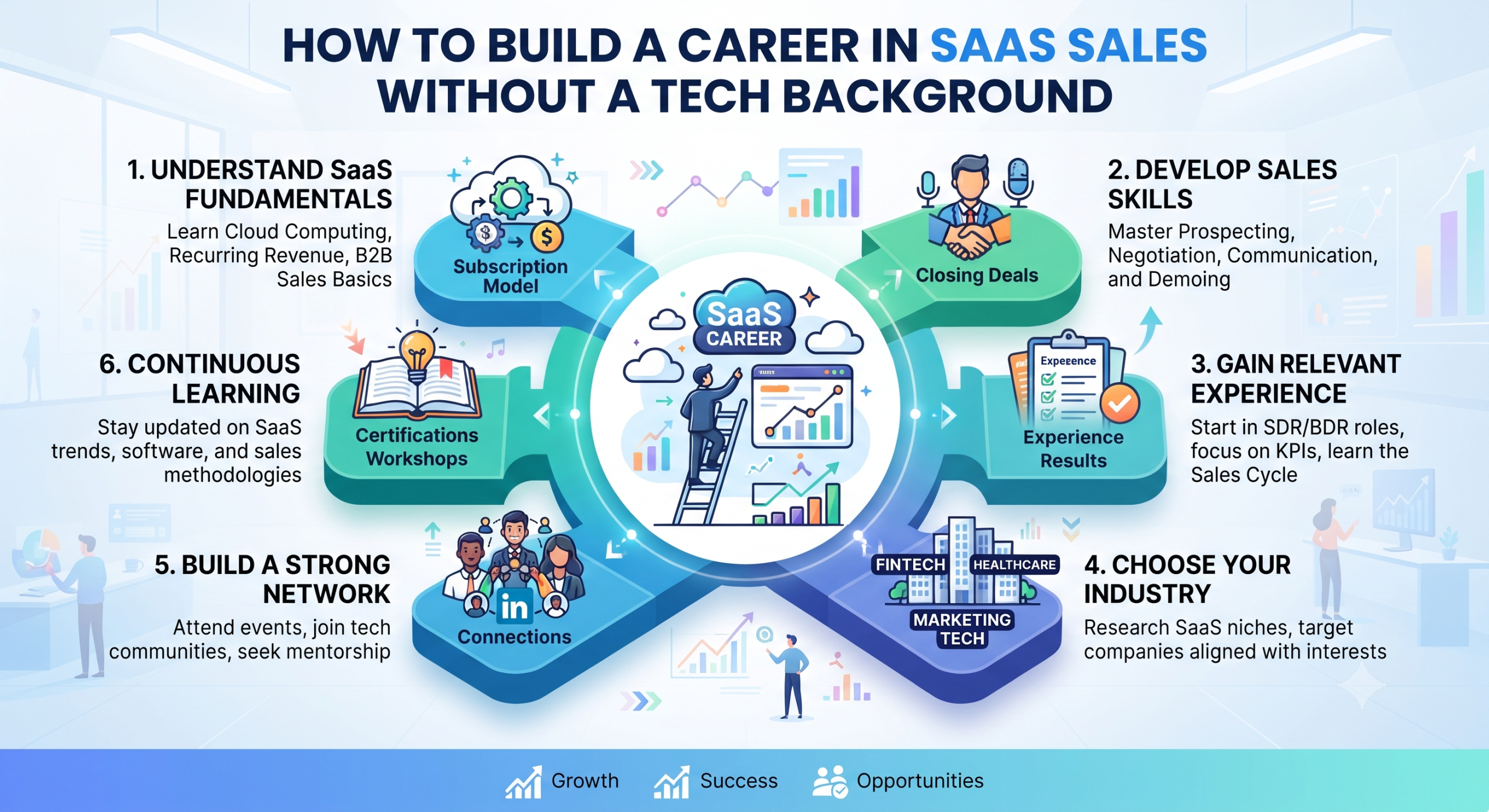
SaaS sales has become an attractive career option for professionals who enjoy communication, problem-solving, and relationship building. Software companies need sales professionals who can understand customer problems and explain how digital products can solve them. However, many people assume that a technical degree or software development experience is necessary to enter SaaS sales.
In reality, sales professionals do not usually need to build the software themselves. Instead, they need to understand the product well enough to connect its features with customer needs. Therefore, people from retail, banking, customer service, recruitment, marketing, hospitality, and other backgrounds can develop successful SaaS sales careers.
The transition does require structured learning. You need to understand SaaS business models, develop sales skills, learn basic technology concepts, and gain experience with customer relationship management tools. Fortunately, these skills can be developed without becoming a software engineer.
This guide explains how to build a career in SaaS sales without a technical background while maintaining a practical approach to remote work, productivity, travel testing, and financial planning.
Understand What SaaS Sales Actually Involves
First, understand the role before deciding whether SaaS sales is right for you. SaaS stands for Software as a Service, meaning customers typically access software through the internet and pay through subscription-based pricing models.
SaaS sales professionals help businesses or individuals understand the value of these products and decide whether they fit their needs.
Depending on the company and role, responsibilities may include:
- Finding potential customers
- Conducting prospect research
- Sending sales outreach
- Qualifying leads
- Scheduling product demonstrations
- Understanding customer requirements
- Handling objections
- Negotiating deals
- Maintaining CRM records
- Following up with prospects
For example, an Account Executive may demonstrate how a business software platform can reduce manual work or improve team collaboration.
Meanwhile, a Sales Development Representative may focus primarily on identifying prospects and creating initial conversations.
Therefore, SaaS sales contains several career paths rather than one standard job.
Common positions include:
- Sales Development Representative
- Business Development Representative
- Inside Sales Representative
- Account Executive
- Account Manager
- Customer Success Manager
- Sales Operations Specialist
Understanding these differences will help you choose an entry point that matches your existing strengths.
Learn Technology Without Becoming a Developer
A lack of technical experience should not prevent you from entering SaaS sales. However, you still need enough product knowledge to communicate confidently with customers.
You do not necessarily need to learn programming. Instead, focus on understanding how software products work from a user’s perspective.
Start by learning concepts such as:
- Cloud computing
- SaaS subscriptions
- APIs
- Integrations
- Databases
- Data security
- User permissions
- Automation
- Analytics dashboards
- Software implementation
For instance, if you are selling customer relationship management software, you should understand how the platform stores customer information, tracks interactions, manages sales pipelines, and generates reports.
Similarly, if you are selling project management software, learn how users create projects, assign tasks, track deadlines, collaborate, and analyze performance.
Therefore, focus on practical product knowledge rather than trying to master software development.
A useful exercise is to choose three SaaS products and explain each one in simple language. Describe the problem it solves, who uses it, what its main features are, and why a customer would pay for it.
This exercise will gradually improve your confidence.
Develop Core SaaS Sales Skills
Next, build the sales skills that employers expect. Strong communication is important, but SaaS sales involves much more than speaking confidently.
You need to understand customer problems and ask useful questions.
Important skills include:
- Prospecting
- Lead qualification
- Discovery calls
- Product demonstrations
- Objection handling
- Negotiation
- Follow-up
- Relationship management
- CRM management
- Sales forecasting
For example, instead of immediately explaining every product feature, start by asking the customer about their current process.
You could ask:
- What problem are you trying to solve?
- How are you currently managing this process?
- What challenges does your team face?
- How much time does the current process require?
- What would an improved process look like?
Then, connect the relevant product capabilities to the customer’s answers.
As a result, the sales conversation becomes more consultative instead of sounding like a generic product pitch.
Furthermore, practice explaining technical concepts in simple business language. This skill is particularly valuable when selling software to non-technical decision-makers.
Start With Entry-Level SaaS Sales Roles
If you have no SaaS experience, applying directly for senior Account Executive positions may not be the most practical route. Instead, consider entry-level roles that allow you to develop industry knowledge.
Sales Development Representative and Business Development Representative positions are common starting points.
In these roles, you may:
- Research potential customers
- Identify decision-makers
- Conduct outbound outreach
- Respond to inbound leads
- Qualify prospects
- Schedule meetings
- Maintain CRM information
- Support Account Executives
These responsibilities can teach you the fundamentals of SaaS sales.
Moreover, you can build measurable achievements relatively quickly. For example, you may track the number of qualified meetings generated, response rates, conversion rates, or opportunities created.
Later, strong performance can help you move toward Account Executive or other specialized roles.
However, career progression varies between companies. Therefore, examine the training structure, promotion criteria, sales cycle, product complexity, and compensation model before accepting a position.
Use Remote Work and Practical Product Testing
SaaS sales is particularly compatible with remote work because sales teams can prospect, conduct meetings, demonstrate software, and update CRM systems from different locations.
Therefore, remote SaaS roles can provide access to companies outside your local job market.
However, remote work requires strong productivity habits.
Create a structured daily routine that separates:
- Prospect research
- Outreach
- Follow-ups
- Customer meetings
- CRM updates
- Learning
- Administrative tasks
For example, you could reserve your highest-energy hours for prospecting and customer conversations. Then, use lower-focus periods for CRM updates and administrative work.
Travel testing can also be useful when evaluating SaaS products designed for travel, hospitality, logistics, or remote teams. For example, you can test how an application performs while working from different locations or under different connectivity conditions.
The objective should be structured observation. Record the user experience, identify potential problems, and consider how those insights could affect a sales conversation.
When searching for opportunities, a best job tool, which is a global job platform, can help you explore SaaS sales roles across different locations and work arrangements.
Additionally, search for multiple job titles rather than relying only on “SaaS Sales.” Roles such as SDR, BDR, Account Executive, Business Development Representative, and Inside Sales Representative may contain similar responsibilities.
Build a Strong Resume Without Technical Experience
Your previous career experience can still be valuable when applying for SaaS sales positions. The key is to present transferable skills in a business-focused way.
For example, customer service experience can demonstrate communication and problem-solving. Recruitment experience can demonstrate prospecting and relationship management. Retail sales can demonstrate objection handling and closing skills.
Instead of listing only responsibilities, highlight measurable results.
For example:
“Managed customer inquiries and resolved service issues.”
can become:
“Managed high-volume customer interactions while resolving issues efficiently and maintaining strong customer satisfaction.”
Similarly, instead of saying:
“Worked with clients.”
you could explain the type of clients, problems you solved, and measurable outcomes.
Your resume should also demonstrate your interest in SaaS. Include relevant training, product research, CRM experience, sales certifications, or portfolio exercises.
For example, create a simple mock sales project showing how you would prospect for a fictional SaaS company. Include the target customer, outreach strategy, discovery questions, and follow-up process.
As a result, employers can see evidence of your sales thinking even if you have not previously worked in software.
Plan Your Career Growth and Financial Strategy
Finally, create a realistic career roadmap. SaaS sales can offer several directions after you gain initial experience.
A possible progression could include:
Entry level:
Sales Development Representative or Business Development Representative
Early career:
Senior SDR, BDR, or Junior Account Executive
Mid-level:
Account Executive, Account Manager, or Sales Operations Specialist
Senior level:
Senior Account Executive, Sales Manager, or Revenue Operations Manager
Leadership:
Sales Director, Head of Sales, or Vice President of Sales
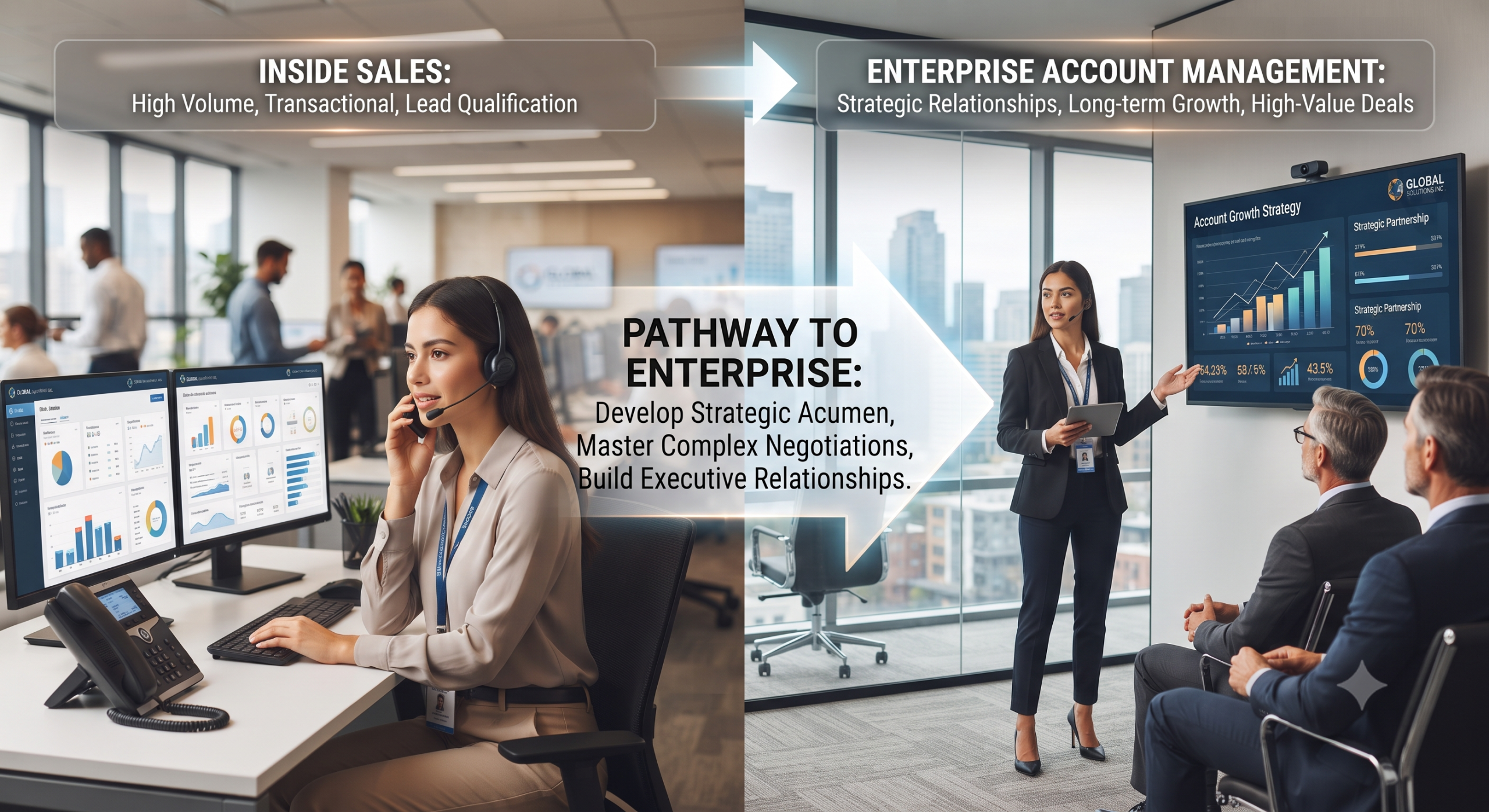
However, not every professional needs to move into management. Some people prefer to develop as individual contributors and specialize in enterprise sales, strategic accounts, or specific industries.
At the same time, maintain a financial plan during your transition. SaaS sales compensation can include fixed salary and variable commissions, so understand the difference between guaranteed and performance-based income.
Before changing careers, consider:
- Monthly living expenses
- Emergency savings
- Expected base salary
- Commission structure
- Training expenses
- Remote-work costs
- Travel expenses
- Long-term savings goals
For example, do not evaluate a sales offer only by looking at its advertised total compensation. Review the base salary, commission structure, quota expectations, ramp period, and payment terms.
A best job tool, as a global job platform, can help you research SaaS sales opportunities and compare roles based on responsibilities, locations, and required qualifications.
Conclusion
Building a career in SaaS sales without a tech background is possible when you focus on the skills that sales organizations actually need. You do not need to become a developer. Instead, learn enough about software products to understand customer problems, explain solutions, and communicate business value.
First, learn SaaS fundamentals and basic technology concepts. Next, develop prospecting, discovery, communication, objection handling, and CRM skills. Then, target entry-level SaaS sales roles where you can gain measurable experience.
Furthermore, use remote opportunities to expand your job search beyond your local market. Practical product testing can also help you understand customer experiences and improve your ability to discuss software solutions.
Most importantly, build your career around measurable performance. Track meetings generated, qualified opportunities, conversion rates, revenue contribution, and customer relationships whenever possible.
With consistent learning, practical sales experience, and careful financial planning, professionals from non-technical backgrounds can gradually move into SaaS sales and later explore careers in account management, enterprise sales, sales operations, or revenue operations.


Leave a Reply