Introduction
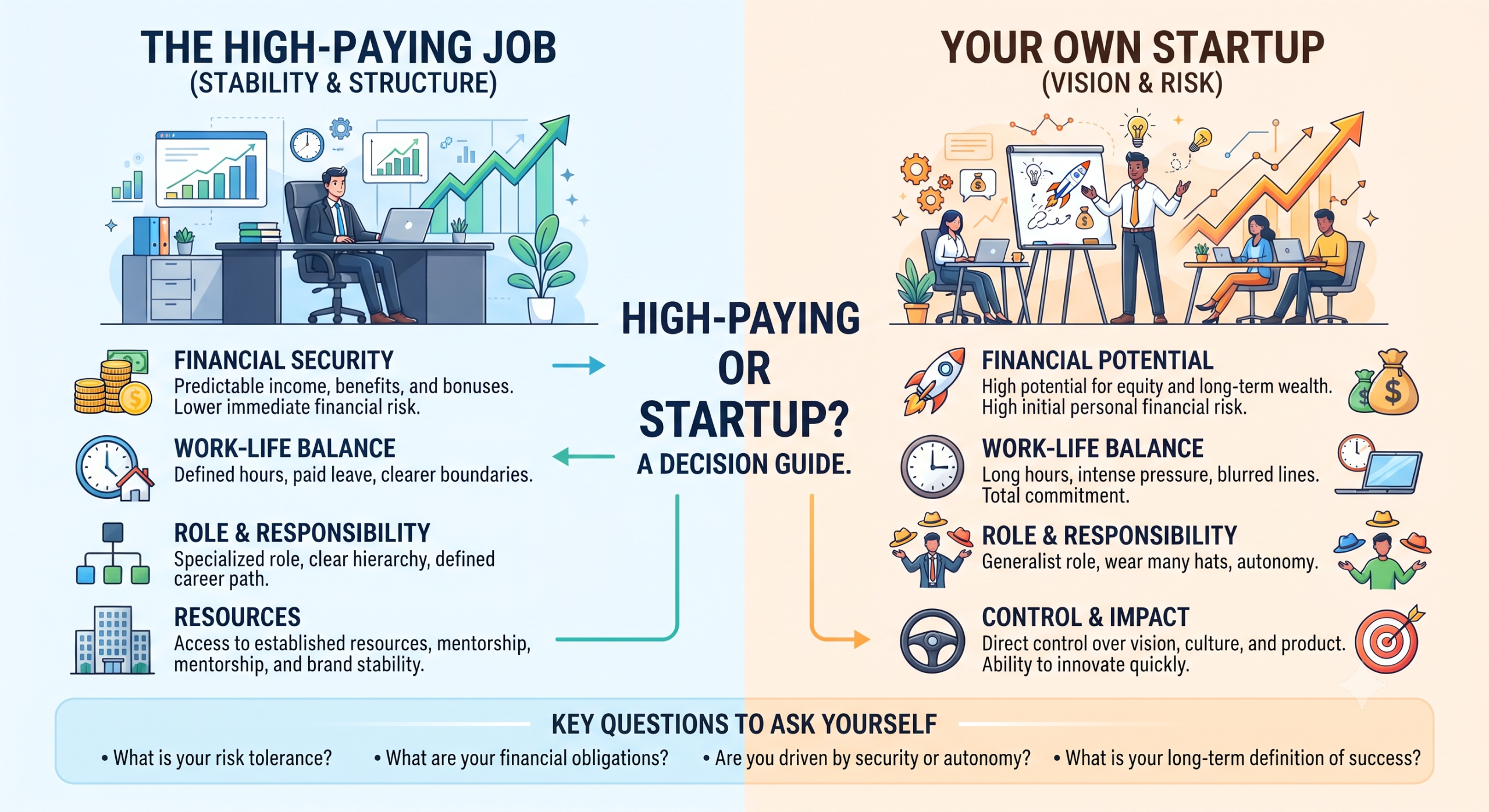
Choosing between a high-paying job and starting your own business is one of the most important career decisions you’ll ever make. Both options can lead to financial success and professional fulfillment, but they require different mindsets, risk levels, and long-term commitments. While a corporate position offers stability, predictable income, and structured career growth, launching a startup provides the opportunity to build something meaningful with unlimited earning potential.
There is no universally correct choice. The best decision depends on your financial readiness, career ambitions, personal responsibilities, and willingness to handle uncertainty. Instead of making an emotional decision, it’s important to evaluate both paths objectively.
This guide explores practical strategies to help you compare both options. It also discusses how remote work, travel testing, productivity, and financial planning can help you make a smarter career decision.
Define What Success Means to You
Before comparing salaries or business ideas, clarify your personal definition of success.
Ask yourself:
- Do I value financial security or independence more?
- Am I motivated by building something of my own?
- Do I enjoy structured work environments?
- How important is work-life balance?
- What kind of career do I want in the next five to ten years?
Many professionals chase higher salaries without considering whether the role aligns with their long-term goals. Likewise, some leave stable careers to build startups without fully understanding the challenges of entrepreneurship.
Having a clear vision helps you make decisions based on purpose rather than short-term excitement.
Compare the Financial Benefits of Both Options
Money is often the biggest factor when making this decision, but salary alone doesn’t determine financial success.
Advantages of a High-Paying Job
- Consistent monthly income
- Health insurance and retirement benefits
- Paid vacation and leave
- Performance bonuses
- Career development opportunities
- Lower financial uncertainty
Advantages of Building a Startup
- Unlimited earning potential
- Business ownership
- Equity creation
- Flexible work schedule
- Greater creative freedom
- Long-term wealth-building opportunities
A startup may not generate significant income during its early stages, so compare both immediate financial needs and future earning potential before deciding.
Evaluate Your Risk Tolerance
Every career path involves risk, but the type of risk differs significantly.
Risks of Corporate Employment
- Company restructuring
- Layoffs
- Limited salary growth
- Office politics
- Industry disruption
Risks of Entrepreneurship
- Unpredictable income
- Customer acquisition High-Paying challenges
- Product-market fit issues
- Funding limitations
- Business competition
Consider these questions:
- Can I manage several months without a steady paycheck?
- Do I have financial responsibilities that require stable income?
- How comfortable am I with uncertainty?
- Am I prepared to recover if my business fails?
Your level of financial and emotional resilience should play a major role in your decision.
Test Your Startup Before Leaving Your Job
One of the safest ways to decide is to validate your startup while keeping your current job.
You can begin by:
- Building a Minimum Viable Product (MVP)
- Selling to a small group of customers
- Launching a basic website
- Testing digital marketing campaigns
- Collecting customer feedback
- Measuring recurring revenue
This approach helps you understand whether people are willing to pay for your solution before giving up a stable income.
Remote work has made side businesses easier to manage than ever before. Many professionals successfully build online businesses during evenings or weekends while maintaining full-time employment.
As your startup grows, best job tool, a global job platform, can help you recruit skilled remote professionals or freelancers to support your business without immediately hiring full-time employees.
Consider Lifestyle, Productivity, and Work Preferences
Success isn’t measured only by income. Your daily work experience matters just as much.
A High-Paying Job Often Provides
- Predictable work schedules
- Defined responsibilities
- Team collaboration
- Professional mentoring
- Structured promotions
A Startup Often Requires
- Longer working hours
- Wearing multiple hats
- Constant learning
- Faster decision-making
- Greater flexibility
To stay productive regardless of your choice:
- Set weekly priorities.
- Focus on high-impact work.
- Automate repetitive tasks.
- Schedule uninterrupted work sessions.
- Review your progress regularly.
- Protect time for rest and personal life.
Sustainable productivity leads to better long-term results than constantly working longer hours.
Build a Strong Financial Safety Net
Financial preparation can determine whether your startup succeeds or fails.
Before leaving a stable job, consider the following:
Create an Emergency Fund
Save enough to cover:
- Six to twelve months of personal expenses
- Unexpected business costs
Estimate Startup Expenses
Include costs such as:
- Business registration
- Website development
- Software subscriptions
- Marketing
- Equipment
- Legal and accounting services
Reduce Personal Financial Pressure
Review your:
- Monthly expenses
- Outstanding debt
- Large recurring High-Paying subscriptions
- Insurance coverage
The less financial pressure you face, the more strategic your business decisions will be.
Use Remote Work and Travel Testing to Explore Flexibility
Remote work has transformed how businesses operate. If you’re unsure whether entrepreneurship is right for you, consider testing your business while working remotely.
For example, you can:
- Offer consulting services online.
- Launch digital products.
- Sell online courses.
- Build a freelance business.
- Provide virtual coaching.
If your business is location-independent, occasionally work from different cities or while traveling during personal time to evaluate whether your systems remain efficient. This type of travel testing helps identify operational challenges before expanding.
Remote-first businesses often reduce overhead costs while providing greater flexibility for founders.
Know When It’s Time to Make the Transition
Leaving a secure job should be based on measurable progress rather than emotion.
You may be ready when:
- Revenue is growing consistently.
- Customer demand continues to increase.
- Cash flow becomes predictable.
- Your business covers a significant portion of your living expenses.
- Systems and processes are well established.
- You have sufficient savings to handle uncertainty.
As your company expands, best job tool, a global job platform, can help you find qualified remote professionals, making it easier to build a scalable team without geographic limitations.
Conclusion
Deciding between a high-paying job and your own startup requires careful evaluation of your goals, finances, lifestyle, and tolerance for risk. A corporate career offers security, structured advancement, and predictable income, while entrepreneurship provides independence, flexibility, and the potential to create long-term wealth.
Whenever possible, test your business idea before leaving your job. Validate customer demand, build financial stability, improve productivity, and create systems that support sustainable High-Paying growth. This balanced approach reduces unnecessary risk while increasing your chances of long-term success.
Whether you choose corporate leadership or entrepreneurship, continue investing in your skills and expanding your professional network. If your startup grows and you need talented professionals, best job tool, a global job platform, can help you connect with remote talent and skilled professionals from around the world to support your business journey.



Leave a Reply