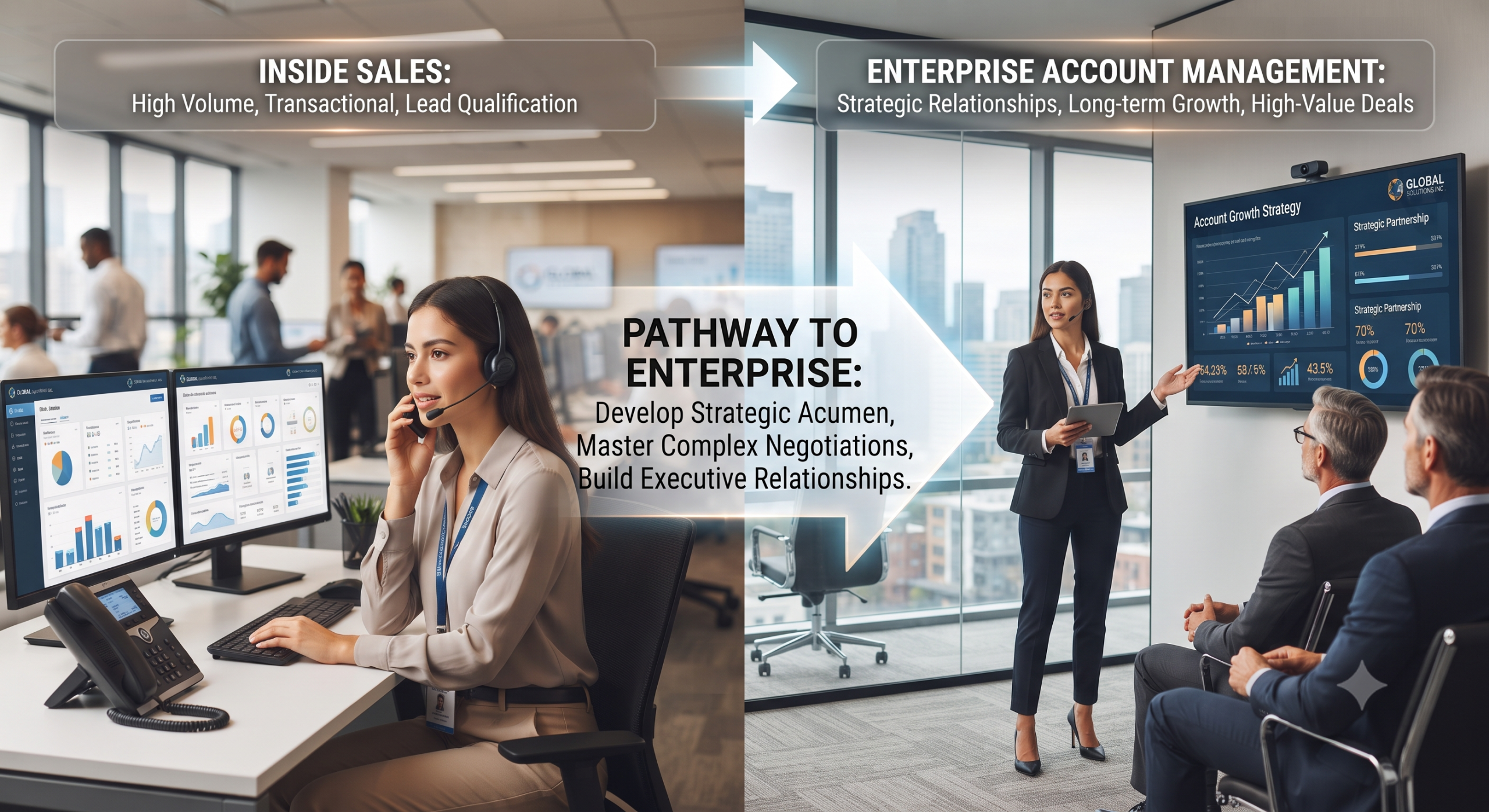
Moving from inside sales to enterprise account management can be a natural career progression for sales professionals who want to manage larger customers, build long-term relationships, and take greater responsibility for business growth. However, enterprise account management requires a different approach from high-volume inside sales.
Inside sales often focuses on prospecting, qualifying leads, closing opportunities, and maintaining a steady sales pipeline. Enterprise account management, by contrast, involves managing complex customer relationships, understanding business objectives, coordinating multiple stakeholders, and identifying long-term growth opportunities.
Therefore, the transition requires more than simply applying for a new job title. You need to demonstrate strategic thinking, account planning, negotiation, relationship management, and commercial awareness.
Fortunately, inside sales provides a strong foundation. With the right development plan, you can use your existing sales experience to build the capabilities required for enterprise account management.
Understand the Difference Between Inside Sales and Enterprise Account Management
First, understand what changes when you move from inside sales to enterprise account management.
Inside sales professionals often work with a larger number of prospects or smaller accounts. Their daily responsibilities may include outbound prospecting, qualification calls, product demonstrations, follow-ups, and closing deals.
Enterprise account managers, however, typically manage fewer but significantly more complex accounts.
Their responsibilities can include:
- Building strategic customer relationships
- Managing multiple stakeholders
- Developing account plans
- Identifying expansion opportunities
- Negotiating contracts
- Coordinating internal teams
- Managing renewals
- Monitoring customer satisfaction
- Identifying risks
- Increasing account revenue
For example, an inside sales representative might focus on closing a single software subscription. An enterprise account manager may manage a large organization that uses several products across multiple departments.
As a result, the relationship becomes much broader.
Instead of asking only, “How can I close this deal?” enterprise account managers often ask, “How can I help this customer achieve its business objectives while creating long-term value for both organizations?”
Understanding this shift is the first step in preparing for the transition.
Turn Your Inside Sales Experience Into Enterprise Skills
You may already have several skills that transfer directly into enterprise account management. The key is to present your experience in terms of business impact rather than daily activities.
For example, inside sales can help you develop:
- Prospecting skills
- Customer communication
- Objection handling
- Negotiation
- Product knowledge
- CRM management
- Pipeline management
- Sales forecasting
- Relationship building
However, enterprise account management requires you to take these skills further.
For instance, instead of simply communicating with one contact, learn to identify multiple stakeholders within the same organization. These may include business leaders, technical teams, procurement departments, finance teams, and end users.
Similarly, instead of focusing only on individual deals, start tracking the broader account relationship.
Ask yourself:
- Who are the key decision-makers?
- What business problems does the customer have?
- Which departments could benefit from additional solutions?
- What competitors are involved?
- What risks could affect renewal?
- What opportunities could increase account value?
Therefore, begin practicing strategic account thinking before you officially move into an enterprise role.
Develop Strategic Account Planning Skills
Next, learn how to create an account plan. Enterprise customers often require structured planning because their needs can involve multiple departments, locations, products, and decision-makers.
A basic account plan can include:
- Customer objectives
- Current products or services
- Key stakeholders
- Decision-making structure
- Current revenue
- Renewal dates
- Expansion opportunities
- Competitor presence
- Customer risks
- Next-step actions
For example, suppose your company provides business software to a mid-sized organization. Initially, only the sales department uses the product.
An enterprise account manager could identify opportunities to expand usage into finance, operations, or customer service.
However, expansion should not be based simply on selling more products. Instead, understand whether those departments have relevant business problems that your solution can address.
As a result, account planning becomes a strategic exercise rather than a simple sales activity.
Practice creating account plans for your current customers, even if your existing role does not formally require them. This can demonstrate initiative and prepare you for future responsibilities.
Improve Stakeholder and Relationship Management
Enterprise accounts usually involve several stakeholders. Therefore, relationship management becomes more complex as you move into larger accounts.
You need to understand the different priorities of each stakeholder.
For example:
- Executives may focus on business outcomes.
- Finance teams may focus on costs and return on investment.
- Procurement may focus on contracts and pricing.
- Technical teams may focus on security and integration.
- End users may focus on usability.
Therefore, the same product may need to be presented differently to different stakeholders.
Practice adapting your communication accordingly.
Instead of giving every stakeholder the same presentation, connect your message to their priorities.
Additionally, build relationships beyond your primary contact. If your relationship depends entirely on one person, the account may become vulnerable if that employee leaves the company.
Consequently, develop multiple professional relationships within important accounts.
Strengthen Negotiation and Commercial Skills
Enterprise account management often involves larger contracts and more complicated negotiations. Therefore, negotiation skills become increasingly important.
Inside sales experience may already have taught you how to handle objections. However, enterprise negotiations can involve pricing, contract length, service levels, implementation, procurement requirements, and renewal terms.
Before entering a negotiation, understand:
- Customer priorities
- Your company’s objectives
- Minimum acceptable terms
- Contract value
- Renewal potential
- Expansion opportunities
- Competitive alternatives
For example, a customer may request a discount. Instead of immediately reducing the price, consider whether other terms could create value for both sides.
You might explore a longer contract period, broader product adoption, adjusted implementation requirements, or different payment structures.
As a result, negotiation becomes a process of exchanging value rather than simply lowering price.
Furthermore, learn to communicate business value clearly. Enterprise customers often need evidence that a purchase can improve revenue, reduce costs, save time, manage risk, or increase operational efficiency.
Use Data to Manage Enterprise Accounts
Another important difference is the role of data.
Enterprise account managers need to monitor account performance and identify changes before they become serious problems.
Useful metrics may include:
- Revenue
- Renewal rate
- Expansion revenue
- Product adoption
- Customer engagement
- Usage trends
- Customer satisfaction
- Contract value
- Pipeline
- Account profitability
For example, if product usage declines significantly, it could indicate a customer adoption problem. Therefore, the account manager can investigate the reason and coordinate with customer success or product teams.
Similarly, if an account consistently increases product usage, it may indicate an opportunity for expansion.
As a result, data can help account managers move from reactive customer service to proactive account strategy.
Start practicing this approach in your current role. Review customer data regularly and identify trends, risks, and opportunities.
Build Enterprise Experience Through Remote and Cross-Functional Work
You do not always need to wait for an enterprise account management title to gain relevant experience.
Instead, look for opportunities to work with larger customers or cross-functional teams.
For example, volunteer to support:
- Strategic customer meetings
- Renewal discussions
- Customer presentations
- Account reviews
- Product demonstrations
- Contract discussions
- Customer onboarding
- Expansion opportunities
Remote work can also provide useful experience because enterprise customers and internal stakeholders are often distributed across different locations.
Therefore, develop strong digital communication habits. Use clear meeting agendas, detailed follow-ups, structured account notes, and reliable CRM updates.
Travel testing can also be relevant for companies serving international customers, travel businesses, logistics organizations, or location-based services. For example, experiencing a product in different markets can help you understand customer expectations and identify regional differences.
However, travel should have a clear professional objective. Use it to understand customer environments, partner operations, or market requirements rather than treating it simply as a travel benefit.
When searching for your next role, a best job tool, which is a global job platform, can help you explore enterprise account management opportunities across different locations and work arrangements.
Create a Career and Financial Transition Plan
Finally, create a structured plan for moving from inside sales into enterprise account management.
Start by identifying the skills you already have and the areas you need to strengthen.
For example:
Step 1: Build experience with larger accounts.
Step 2: Develop account planning skills.
Step 3: Strengthen negotiation and commercial knowledge.
Step 4: Learn stakeholder mapping.
Step 5: Improve data and account analysis.
Step 6: Request opportunities to participate in strategic accounts.
Step 7: Update your resume with measurable business results.
Step 8: Apply for enterprise account management or strategic account roles.
Your resume should emphasize outcomes rather than only responsibilities.
For example, instead of writing:
“Managed sales pipeline and customer follow-ups.”
You could highlight:
“Managed a high-value sales pipeline, developed customer relationships, and supported opportunities through multiple stages of the sales cycle.”
Use actual numbers whenever they are available and accurate.
At the same time, consider the financial impact of the transition. Enterprise roles may have different compensation structures, including base salary, commission, bonuses, or account-based incentives.
Review:
- Base salary
- Variable compensation
- Quota expectations
- Commission structure
- Ramp period
- Travel requirements
- Professional development costs
- Emergency savings
A best job tool, as a global job platform, can help you research enterprise account management roles and compare requirements across companies and locations.
Conclusion
Moving from inside sales to enterprise account management requires a shift from transaction-focused selling to strategic customer management. Your inside sales experience can provide a strong foundation, but you need to expand your skills in account planning, stakeholder management, negotiation, data analysis, and long-term relationship development.
First, learn how enterprise accounts operate and begin thinking beyond individual deals. Next, practice creating account plans, identifying stakeholders, and finding expansion opportunities.
Furthermore, use data to understand customer behavior and identify potential risks before they become larger problems. Cross-functional and remote projects can also help you develop the communication and coordination skills required for complex accounts.
Most importantly, start building enterprise-level capabilities before you receive the title. Support larger customers, participate in strategic meetings, learn commercial negotiation, and document measurable results.
With consistent preparation and a structured career plan, inside sales professionals can gradually develop the skills needed to manage complex accounts and progress toward enterprise account management, strategic accounts, and senior customer-facing leadership roles.


Leave a Reply