Introduction
Negotiating a salary is an important step in building a successful career in the United States. Whether you are a recent graduate, an experienced professional, or an international candidate, accepting the first offer without reviewing its terms may mean missing an opportunity to secure better compensation. However, many job seekers hesitate to negotiate because they Without fear the employer might withdraw the offer.
The key is to approach salary discussions professionally, confidently, and with realistic expectations. Employers often expect candidates to discuss compensation, particularly for experienced and specialised positions. Nevertheless, negotiation practices vary by company, industry, seniority, and the circumstances of the hiring process.
Before entering a negotiation, understand your market value, assess the complete compensation package, and decide which terms matter most to you. Clear communication and reasonable expectations can help you advocate for yourself without creating unnecessary tension.
This guide explains how to negotiate your salary in the USA, research appropriate compensation, respond to an offer, and explore alternatives when an employer cannot increase the proposed salary.
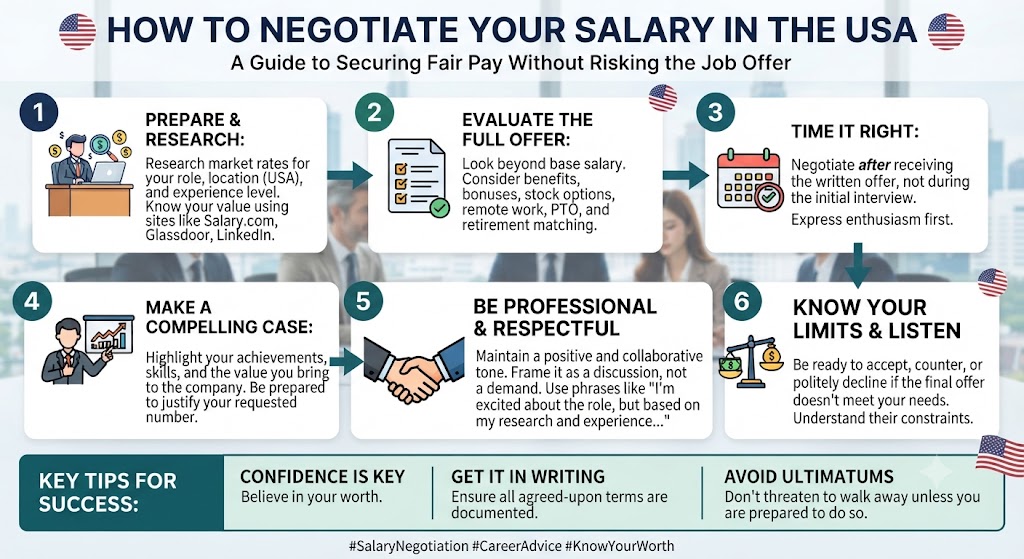
1. Research Your Market Value Before Negotiating
Preparation is the foundation of effective salary negotiation. Before discussing compensation, research what employers typically pay for comparable roles in your industry, location, and experience level.
Salary ranges can differ significantly between cities. A software engineer working in San Francisco may receive a different compensation package from someone performing a similar role in a smaller metropolitan area. Industry demand, company size, specialist skills, and local living costs can also influence pay.
Use Reliable Salary Resources
Research compensation using multiple sources rather than relying on a single online estimate. Useful resources include:
- The US Bureau of Labor Statistics for occupational wage information.
- Salary information published by reputable recruitment platforms.
- Job advertisements that disclose compensation ranges.
- Professional associations and industry salary surveys.
- Conversations with recruiters and professionals in your field.
The US Bureau of Labor Statistics provides occupational employment and wage data that can help you understand compensation trends across professions and locations.
Compare positions with similar responsibilities and experience requirements. A senior role should not be benchmarked against an entry-level position simply because both share the same job title.
Establish Your Target Salary
Once you understand the market, identify three figures:
- Target salary: The amount you would ideally like to earn.
- Acceptable salary: The amount you would realistically consider accepting.
- Walk-away point: The minimum compensation that makes the role worthwhile for you.
Consider your experience, financial commitments, expected responsibilities, Without benefits, and alternative opportunities when setting these figures.
Keep your minimum acceptable amount private during negotiations. Your target should reflect market evidence and the value you bring rather than an arbitrary increase over the initial offer.
2. Wait for the Right Moment to Discuss Compensation
Timing can influence how a salary negotiation develops. If possible, allow the employer to understand your qualifications and suitability before entering detailed compensation discussions.
During early interviews, recruiters may ask about your salary expectations. You do not always need to provide a precise number immediately, especially if you have not yet learned enough about the role.
You could respond:
“I am open to discussing compensation based on the responsibilities of the position and the overall package. I would be interested in understanding the budgeted salary range for this role.”
This answer keeps the conversation professional while encouraging the employer to share useful information.
When You Receive an Offer
An offer provides a natural opportunity to review compensation. Thank the employer, express your interest, and request reasonable time to evaluate the terms.
For example:
“Thank you for the offer. I am excited about the opportunity and appreciate the team’s confidence in me. I would like to review the compensation and benefits package carefully before confirming my decision.”
Avoid negotiating aggressively before understanding the responsibilities, benefits, work arrangements, and expectations.
If the employer asks for your expectations earlier in the process, provide a researched range that reflects your qualifications and the position’s market value. Make sure the range is realistic and that you would genuinely consider an offer near its lower end.
3. Negotiate With Evidence Rather Than Personal Needs
A strong salary negotiation explains why your skills and experience support the requested compensation. Employers are generally better positioned to evaluate a business case than a request based only on personal expenses.
For example, explaining that you have specialised technical expertise, experience leading projects, or a record of improving business results can strengthen your argument.
Connect Your Experience to Business Value
Prepare two or three examples of achievements that demonstrate Without your contribution.
These may include:
- Increasing revenue or reducing operating costs.
- Improving customer satisfaction or retention.
- Managing complex projects within deadlines.
- Developing systems that improve productivity.
- Leading teams or training colleagues.
- Bringing specialist qualifications or industry knowledge.
Use measurable results when you have reliable figures. For example, if you reduced processing time by 20%, explain how that improvement benefited the organisation.
If you are a recent graduate without extensive employment experience, highlight internships, relevant projects, technical skills, certifications, and evidence of your ability to learn quickly.
Make a Clear and Reasonable Request
Once you have presented your evidence, state your preferred salary directly.
For example:
“Based on the responsibilities of the position, my experience in project delivery, and the market range for comparable roles, I was hoping for a base salary closer to $85,000. Is there flexibility to move the offer toward that amount?”Without
The figure should be based on your research and the actual offer, not copied blindly from an example.
Avoid issuing ultimatums unless you are genuinely prepared to decline the opportunity. A collaborative question invites discussion while allowing the employer to explain any budget limitations.
4. Evaluate the Entire Compensation Package
Salary is only one part of an employment offer in the United States. Benefits, bonuses, retirement contributions, paid leave, and working arrangements can significantly affect the overall value of a position.
Before negotiating, review the complete package rather than focusing exclusively on annual base pay.
Important Components to Review
Consider the following:
- Base salary: Your regular compensation before taxes and deductions.
- Annual bonus: The eligibility rules, performance conditions, and payment schedule.
- Equity compensation: Stock options or restricted stock, where applicable, including vesting conditions and potential risks.
- Health insurance: Premiums, deductibles, coverage, and employer contributions.
- Retirement benefits: Employer contributions or matching arrangements under plans such as a 401(k).
- Paid time off: Vacation, sick leave, holidays, and other applicable leave.
- Work arrangements: Remote work, hybrid schedules, commuting requirements, and flexibility.
- Professional development: Training budgets, certifications, and education support.
A higher salary does not automatically mean a better offer if it comes with significantly higher expenses or less valuable benefits.
For example, an offer with a slightly lower salary might be more attractive if it includes strong health coverage, retirement contributions, and a shorter commute. Conversely, a higher base salary may be more valuable if other benefits are limited.
Negotiate Alternatives if the Salary Is Fixed
Some employers have strict salary bands or standardised compensation policies. If the recruiter cannot increase the base salary, ask whether other components are negotiable.
Possible alternatives include a signing bonus, additional paid leave, flexible working arrangements, professional development funding, or a formal salary review after six months.
A review should include clear expectations and a defined timeline. Do not assume a future salary increase is guaranteed unless the relevant terms are documented.
5. Use Professional Communication to Protect the Offer
The way you negotiate can matter as much as the amount you request. Employers need to understand that you remain interested in the role and are discussing compensation in good faith.
Stay Positive and Collaborative
Start by expressing appreciation for the offer. Explain your request calmly and connect it to the responsibilities, your qualifications, or market evidence.
Avoid making demands, exaggerating competing offers, or comparing yourself negatively with other employees.
If you have another genuine offer, you may mention it professionally when relevant. However, never invent competing offers or make claims you cannot support.
Handle Pushback Gracefully
If an employer says the salary is fixed, acknowledge the explanation and explore available alternatives.
You could say:
“I understand that the base salary may be limited by the company’s compensation structure. I remain very interested in the role. Could we explore whether there is flexibility in the signing bonus, additional leave, or a documented compensation review?”
If the employer cannot improve any terms, evaluate whether the original package meets your needs. You can accept, request further clarification, or decline respectfully.
There is no completely risk-free negotiation strategy. Employers differ in their policies and responses, so the objective is to make a reasonable request while preserving a positive professional relationship.
6. Avoid Common Salary Negotiation Mistakes
Even qualified candidates can weaken their negotiating position through poor preparation or unclear communication.
Avoid these common mistakes:
- Accepting immediately without reviewing the terms: Request time to understand the complete offer.
- Choosing an unrealistic salary target: Base your request on comparable roles and your qualifications.
- Giving a range that is too broad: Use a focused, researched range that reflects your expectations.
- Focusing only on personal expenses: Explain your professional value alongside your compensation requirements.
- Making threats: Avoid ultimatums unless you are prepared to walk away.
- Negotiating without understanding benefits: Review the entire package before deciding what to request.
- Relying on verbal promises: Ask for agreed compensation and material employment terms in writing.
- Ignoring deadlines: Confirm when the employer needs your decision and respond within the agreed timeframe.
Job seekers should also be cautious about accepting an offer without understanding its conditions. Review any contingencies, such as background checks, reference checks, or work authorisation requirements.
For international candidates, employment eligibility and immigration requirements can affect the hiring process. Verify the conditions applicable to your circumstances and avoid assuming that an offer automatically provides permission to work in the United States.
7. Finalise the Agreement and Make an Informed Decision
Once you and the employer reach an agreement, request an updated written offer reflecting the final terms. Review the details carefully before accepting.
Check that the document accurately states the base salary, bonus eligibility, benefits, start date, job title, work location, and any other negotiated conditions.
If the employer agrees to a future compensation review, confirm the timing, performance criteria, and decision-making process in writing where possible.
Evaluate the Offer Against Your Career Goals
Before making your final decision, ask yourself:
- Does the compensation meet my financial requirements?
- Are the responsibilities aligned with my skills and long-term goals?
- Does the position offer opportunities for learning and advancement?
- Are the working arrangements suitable for my circumstances?
- Have I understood the risks, conditions, and benefits of the offer?
Do not accept an offer solely because you fear losing it. At the same time, recognise that every negotiation involves uncertainty and that an acceptable offer may be worth accepting even if it does not meet your ideal target.
Maintain a professional tone throughout the process, regardless of the outcome. A respectful negotiation can preserve relationships with recruiters and employers, even if you ultimately decide not to proceed.
A best job tool, such as a global job platform, can also help you explore vacancies across industries, compare role requirements, and identify opportunities that align with your career goals. Having a clear view of the available market can support more informed compensation decisions.
Conclusion
Negotiating your salary in the USA without losing the offer requires preparation, realistic expectations, and professional communication. Research market compensation, identify your target and minimum acceptable salary, and wait for an appropriate opportunity to discuss the package.
When presenting your request, focus on your experience, relevant skills, and measurable contributions. Consider the full compensation package, including bonuses, benefits, retirement contributions, paid leave, and flexibility. If the base salary cannot be increased, explore alternatives that could improve the overall value of the offer.
Most importantly, remain respectful and collaborative. Avoid ultimatums, unsupported claims, and unrealistic demands. Review the final written terms carefully before making your decision.
Salary negotiation is not about winning every request. It is about reaching a fair agreement that reflects your value, meets your needs, and supports your professional development. With careful preparation and a practical approach, you can advocate for better compensation while maintaining a positive relationship with your prospective employer.
Using a best job tool—a global job platform—alongside reliable salary research can help you discover relevant opportunities and make more confident career decisions.



Leave a Reply