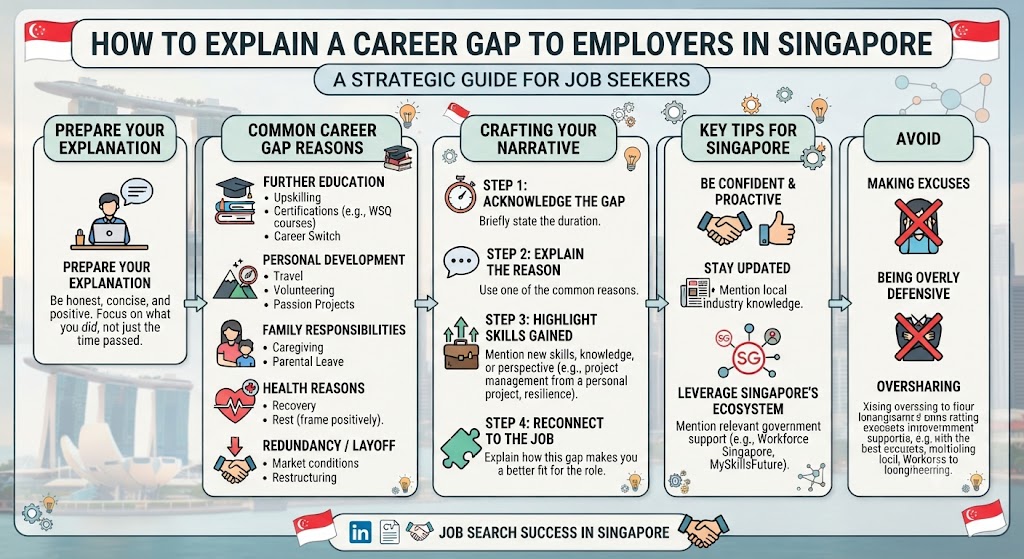
A career gap does not have to prevent you from securing a job in Singapore. Whether you took time off for family responsibilities, further education, health reasons, personal development, or an unsuccessful job search, employers Singaporestill consider you a strong candidate. What matters most is how you explain the break and demonstrate your readiness to return to work.
Singapore’s competitive job market requires candidates to present their experience, skills, and professional value clearly. Therefore, preparing an honest explanation of your career gap can help you approach interviews with greater confidence. With the right strategy, you can turn a period away from employment into an opportunity to demonstrate adaptability, self-awareness, and continued learning.
Understand Why Employers Ask About Career Gaps
Recruiters may ask about employment gaps to understand your professional journey, current skills, and readiness for a new role. However, a career gap does not automatically mean that an employer will reject your application.
Employers in Singapore may want to understand whether you have maintained relevant knowledge, whether your circumstances have changed, and how quickly you can adapt to the position.
Common reasons for career gaps include:
- Family responsibilities or caregiving.
- Health or personal circumstances.
- Pursuing higher education or professional certifications.
- Relocation to Singapore or another country.
- Redundancy, restructuring, or company closure.
- Taking time to explore a new career direction.
- Searching for a suitable role after leaving a previous position.
The important point is to provide a clear explanation without becoming defensive. Employers generally need enough information to understand your circumstances and assess your suitability for the job.
Prepare an Honest and Professional Explanation
Before attending an interview, prepare a short explanation that describes your career gap accurately. Avoid inventing employment history, exaggerating freelance work, or presenting personal activities as professional experience when they were not.
Your explanation should focus on three elements: the reason for the gap, what you did during that period if relevant, and why you are ready to return to work.
For example, if you took time off for family responsibilities, you could say:
“I took a planned career break to manage family responsibilities. During that period, I reassessed my professional goals and kept myself informed about developments in my field. I am now ready to return to work and contribute my experience to a new team.”
If you were unemployed after a redundancy, you could explain:
“My previous role ended following organisational restructuring. I used the time to strengthen my skills, research suitable opportunities, and identify positions that align with my experience. I am now focused on finding a role where I can make a meaningful contribution.”
Keep your explanation factual and positive. You do not need to share Singapore details that are unrelated to your professional suitability.
Highlight Skills and Activities During Your Career Break
A career gap can still involve valuable learning and personal development. If you completed relevant activities during your time away from work, mention them when they strengthen your application.
For example, you may have completed online courses, worked on personal projects, volunteered, learned new software, or developed language skills. These activities can demonstrate that you remain interested in your profession.
Consider highlighting:
- Professional certifications relevant to the target role.
- Online courses in digital tools, project management, finance, or communication.
- Freelance assignments or independent projects, where applicable.
- Volunteer work that developed leadership or organisational skills.
- Industry reading and professional networking.
- Practical projects that demonstrate current abilities.
For candidates returning to technology, marketing, finance, or other fast-changing fields, showing updated knowledge can be especially useful.
However, focus on genuine achievements rather than listing every activity. Explain how your learning connects to the employer’s requirements and how you can apply it in the workplace.
Address Career Gaps Clearly on Your Resume
Your resume should make your professional timeline easy to understand. You do not need to draw unnecessary attention to a career gap, but you should avoid misleading employers about employment dates.
Use consistent month-and-year formatting for previous roles when appropriate. If the gap is substantial, you may include a brief entry such as “Career Break,” “Professional Development,” or “Family Caregiving,” provided the description accurately reflects your circumstances.
For example:
Career Break | January 2024 – December 2024
- Took time away from full-time employment for personal responsibilities.
- Completed relevant online training in digital marketing.
- Prepared to return to a full-time role in marketing and communications.
Only include the bullet points that apply to your experience.
You can also place a professional summary near the top of your resume that highlights your current skills, relevant experience, and career goals. This helps recruiters focus on what you offer rather than viewing your application only through the lens of a break in employment.
When applying through job platforms, tailor your resume to each position. Use the employer’s relevant terminology naturally and make sure your skills and achievements match the job description.
Answer Career Gap Questions Confidently in Interviews
An interview is an opportunity to explain your circumstances and redirect the conversation towards your professional value. Practising your answer beforehand can help you respond calmly when a Singapore asks about a period of unemployment.
Use these practical strategies:
- Keep your answer concise: A few clear sentences are usually sufficient.
- Stay positive: Avoid criticising previous employers or describing the gap as a personal failure.
- Protect your privacy: Share only the personal information necessary to explain your employment timeline.
- Show readiness: Explain why you are prepared to take on the responsibilities of the role now.
- Connect your experience to the position: Highlight relevant skills and previous achievements.
- Prepare for follow-up questions: Be ready to explain what you learned and how you have maintained your professional knowledge.
For example, if an interviewer asks why you were unemployed for eight months, you might say:
“After leaving my previous role, I took time to evaluate my career direction and focus on opportunities that matched my long-term goals. During that period, I updated my skills and researched changes in the industry. I am now ready to apply my experience in a role where I can contribute to the team and continue developing professionally.”
Your response should reflect your actual circumstances. Confidence comes from preparation and honesty, not from memorising a complicated explanation.
Understand Employer Expectations in Singapore
Singapore has a diverse workforce, with employers hiring candidates across local and international markets. Expectations can vary by industry, seniority, and the responsibilities of the position. Therefore, it is useful to understand what matters most to the employer before explaining your career break.
For example, technology employers may prioritise current technical skills, while customer service employers may focus on communication, reliability, and problem-solving. Senior roles may require a clear account of leadership experience and recent industry knowledge.
Candidates applying for regulated or specialised positions should also be prepared to provide accurate employment information and supporting documentation when requested.
If you are an international candidate seeking work in Singapore, distinguish between a career gap and any questions about work authorisation. Employers may separately assess whether you meet the relevant eligibility and work-pass requirements. Do not assume that explaining a career gap resolves immigration or employment eligibility questions.
Research the organisation, review the job description, and prepare examples that demonstrate your suitability. This approach helps you provide answers that are relevant to the position rather than relying on a generic explanation.
Rebuild Confidence and Focus on Your Next Career Move
Returning to work after a career break can feel challenging, particularly if you are concerned about outdated skills or competition from other candidates. Nevertheless, a structured job search can help you regain confidence and identify suitable opportunities.
Start by reviewing your previous experience and identifying transferable skills. Then, determine whether you need additional training or practical experience to meet current employer expectations.
A useful return-to-work plan includes:
- Updating your resume and LinkedIn profile.
- Refreshing essential technical and professional skills.
- Reconnecting with former colleagues and industry contacts.
- Practising interview answers about your career gap.
- Applying for positions that match your qualifications and current goals.
- Tracking applications and following up professionally.
Networking can also help you learn about opportunities that may not be widely advertised. Attend relevant industry events, join professional communities, and reconnect with contacts who understand your field.
In addition, use a reliable job-search resource or the best job tool to explore opportunities, compare role requirements, and discover positions that match your experience. A global job platform such as Torentify can help you explore opportunities across different industries and employment arrangements, including onsite, hybrid, and remote roles.
Remember that you do not need to apply for every available position. Concentrate on roles where your experience, skills, and career objectives align with the employer’s needs.
Conclusion
Explaining a career gap to employers in Singapore becomes easier when you approach the conversation with honesty, preparation, and confidence. Whether your break involved family responsibilities, education, relocation, redundancy, or personal development, you can present your employment history professionally without disclosing unnecessary private information.
Prepare a concise explanation, update your resume, demonstrate relevant skills, and show employers that you are ready to contribute. Most importantly, focus on the value you can bring to your next role rather than allowing your career break to define your professional identity. Best job tool



Leave a Reply