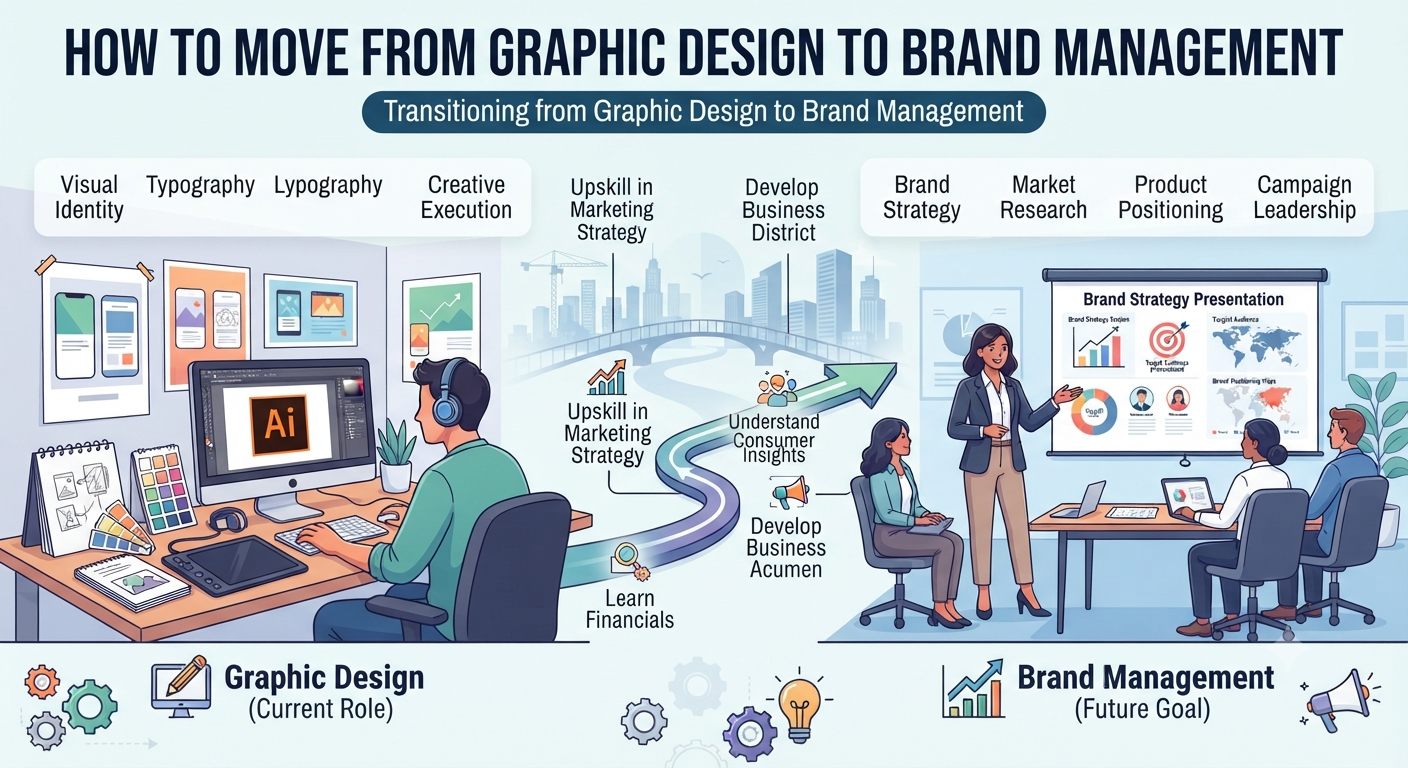
Moving from graphic design to brand management can be a natural career progression for creative professionals who want to take on greater responsibility for marketing strategy, customer communication, and business growth. Graphic designers already understand visual identity, storytelling, audience attention, and brand consistency. The next step is learning how these creative skills connect with consumer behavior, market research, positioning, campaign planning, and business objectives.
Brand management requires a broader perspective than creating visual assets. Brand managers help determine how a company should communicate with its target audience, how products should be positioned, and how marketing activities should support business goals. This makes the transition especially valuable for designers who enjoy understanding the reasoning behind creative decisions.
The transition does not require abandoning design. Instead, it involves combining design expertise with marketing and commercial knowledge. By developing the right skills, creating strategic portfolio projects, gaining cross-functional experience, and targeting suitable roles, graphic designers can build a credible path toward brand management.
Understand the Difference Between Graphic Design and Brand Management
Before changing careers, understand what a brand manager actually does. Graphic designers generally focus on visual communication, while brand managers coordinate multiple aspects of a brand’s market presence.
A brand manager may work on:
- Brand positioning and messaging
- Customer and competitor research
- Marketing campaigns
- Product launches
- Content strategy
- Customer segmentation
- Agency management
- Campaign performance
- Brand guidelines
- Market trends
- Customer experience
The role is often highly collaborative. Brand managers may work with designers, copywriters, sales teams, product managers, researchers, agencies, and senior executives.
This means that your design experience is useful, but it needs to be supported by additional business skills.
Start by reviewing current brand-management job descriptions. Identify the skills employers repeatedly mention and divide them into three groups:
- Skills you already possess
- Skills you need to develop
- Skills you need to demonstrate through practical work
This gives your career transition a measurable starting point.
Turn Your Design Experience Into Strategic Experience
One of the biggest advantages graphic designers have is existing exposure to branding. The challenge is presenting that experience in a way that demonstrates strategic thinking.
Instead of describing your responsibilities only in terms of design production, explain the purpose behind your work.
For example, replace descriptions such as:
- Created social media graphics
- Designed advertisements
- Developed marketing materials
- Created website banners
with accurate descriptions that show the broader context:
- Developed visual assets aligned with brand positioning and campaign objectives.
- Maintained consistent visual communication across multiple marketing channels.
- Adapted creative concepts for different customer audiences.
- Collaborated with marketing teams to support campaign launches.
- Used audience feedback and campaign performance to refine creative direction.
Do not claim responsibilities you did not actually perform. The objective is to highlight the strategic elements already present in your work.
If you participated in campaign planning, contributed to brand guidelines, worked with marketing teams, or helped interpret customer feedback, make those contributions visible on your resume and LinkedIn profile.
Learn the Marketing Skills Required for Brand Management
The most important step in the transition is expanding your knowledge beyond visual design.
Brand managers need to understand how businesses attract customers, differentiate products, and build long-term brand value. Start with core marketing concepts before moving into advanced strategy.
Focus on:
- Target audience identification
- Customer segmentation
- Brand positioning
- Value propositions
- Competitive analysis
- Consumer behavior
- Marketing funnels
- Customer journeys
- Product positioning
- Campaign planning
- Brand awareness
- Customer retention
Consumer psychology is particularly useful because brand decisions are ultimately connected to customer perceptions and behavior.
For example, a company may have an attractive visual identity but still struggle to attract customers because its positioning is unclear. Similarly, a campaign may receive strong engagement without generating meaningful business results.
Learning marketing helps you understand why these situations occur.
Online courses, professional certifications, industry reports, marketing books, and practical projects can all support this learning process. However, prioritize applied knowledge over collecting certificates.
Develop Market Research and Analytics Skills
Brand management increasingly depends on evidence. Creative intuition can be valuable, but decisions also need support from consumer and market data.
Start by learning the fundamentals of market research.
You should understand how to:
- Create basic surveys
- Conduct customer interviews
- Analyze competitor activity
- Identify customer needs
- Interpret survey results
- Understand customer segments
- Evaluate campaign performance
- Identify market trends
You should also become comfortable with spreadsheets and basic marketing analytics.
Important metrics include:
- Conversion rate
- Customer acquisition cost
- Customer retention
- Engagement rate
- Click-through rate
- Campaign reach
- Brand awareness
- Market share
- Return on advertising spend
You do not need to become a data scientist to enter brand management. However, you should be able to look at marketing data, identify meaningful patterns, and explain what those patterns could mean for the brand.
For example, if a campaign receives thousands of interactions but produces very few qualified leads, a brand manager should investigate whether the campaign reached the wrong audience, used unclear messaging, or directed users toward an ineffective customer journey.
That ability to connect creative work with measurable outcomes is an important career advantage.
Build a Brand Strategy Portfolio
A traditional graphic design portfolio focuses heavily on finished visuals. A brand-management portfolio should show the thinking behind those visuals.
You can transform existing projects into strategic case studies.
For each project, explain:
Business objective: What problem was the brand trying to solve?
Target audience: Who was the campaign or brand intended to reach?
Market context: What competitors or trends influenced the project?
Brand positioning: What should customers understand or remember?
Creative strategy: How did the visual direction support the positioning?
Execution: Which channels and formats were used?
Measurement: Which metrics could determine whether the campaign succeeded?
Recommendation: What could be improved in the future?
You can also create hypothetical projects if your professional portfolio does not contain enough strategic examples.
For instance, choose a consumer brand category and develop a complete brand strategy. Research competitors, define a target customer, create a positioning statement, develop messaging, establish visual direction, and propose a launch campaign.
The purpose is not to pretend that the project was commissioned. Clearly label it as a strategic concept.
This type of portfolio demonstrates that you can approach branding from both creative and commercial perspectives.
Gain Marketing Experience Through Cross-Functional Work
A direct move from graphic designer to brand manager is possible in some organizations, but a transitional role can often make the process easier.
Relevant positions may include:
- Brand Coordinator
- Marketing Coordinator
- Brand Designer
- Creative Strategist
- Marketing Specialist
- Content Strategist
- Brand Strategy Associate
- Creative Project Manager
- Marketing Analyst
If you already work within a company, look for opportunities to participate in marketing projects.
Ask to contribute to activities such as:
- Product launches
- Campaign planning
- Brand audits
- Competitor research
- Customer research
- Marketing presentations
- Content strategy
- Campaign reporting
- Agency coordination
Working with marketing professionals will expose you to the commercial decisions behind campaigns.
It will also help you develop project-management and stakeholder-management skills. These capabilities are important because brand managers rarely work independently. They coordinate multiple teams and often need to balance creative ideas with budgets, deadlines, customer expectations, and business priorities.
Strengthen Remote and Digital Brand Management Skills
Modern brand teams often collaborate across locations, making remote-work skills increasingly useful.
A single campaign may involve designers, marketers, copywriters, agencies, product teams, and regional stakeholders working from different locations.
Develop a reliable digital workflow by:
- Organizing brand assets in shared systems
- Maintaining clear campaign briefs
- Documenting creative decisions
- Recording stakeholder feedback
- Tracking deadlines
- Preparing concise presentation decks
- Maintaining consistent approval processes
- Monitoring campaign performance
Digital skills are also important because brand management increasingly involves social platforms, websites, email marketing, digital advertising, online communities, and customer analytics.
For professionals interested in international markets, digital research can provide useful exposure to different customer behaviors. Travel-related brands, for example, may need to understand how customer expectations vary between destinations.
Travel testing can be approached as structured market research. Instead of relying only on personal impressions, compare customer experiences, pricing, messaging, booking processes, and service expectations across markets. Document observations and identify what additional research would be needed before making a business recommendation.
This approach strengthens both research and strategic thinking.
Create a Targeted Job Search and Financial Plan
Once your skills and portfolio are ready, approach your job search strategically.
Search for roles where your design background provides a clear advantage rather than applying indiscriminately to every marketing position.
A global job platform such as best job tool can help you discover opportunities across different companies, locations, and work arrangements.
Create an application tracker containing:
- Company name
- Job title
- Location
- Remote, hybrid, or onsite status
- Required skills
- Your matching skills
- Skills you need to develop
- Application date
- Interview stage
- Follow-up date
Tailor your resume for each relevant position. Your professional summary should emphasize the combination of creative, branding, marketing, and strategic capabilities that accurately represents your experience.
Financial planning should also be part of the transition. Career changes can involve training expenses, temporary income changes, relocation costs, or a period of searching before securing the right role.
Consider:
- Maintaining emergency savings
- Budgeting for professional development
- Comparing relocation costs
- Evaluating potential salary changes
- Accounting for commuting or remote-work expenses
- Planning for long-term career development
A structured financial plan can give you greater flexibility while developing your new career direction.
Measure Your Progress and Plan the Next Career Step
Career transitions become easier when progress is measured rather than left to guesswork.
Set practical milestones for the next six to twelve months.
During the first three months, focus on marketing fundamentals, consumer behavior, research, and analytics.
Over the next three months, build strategic portfolio projects and look for opportunities to participate in marketing initiatives.
After that, begin applying for relevant transitional roles while continuing to develop your business knowledge.
At each stage, ask:
- Can I explain brand positioning clearly?
- Can I analyze basic marketing data?
- Can I describe consumer segments?
- Can I conduct basic market research?
- Can I connect creative decisions with business objectives?
- Can I present recommendations to non-design stakeholders?
- Can I manage a project across multiple teams?
The answers will reveal where further development is needed.
Over time, experience can lead to positions such as Brand Manager, Senior Brand Manager, Marketing Manager, Brand Strategist, Category Manager, or broader marketing leadership roles.
Conclusion
Moving from graphic design to brand management is a career expansion rather than a complete career change. Your existing design experience provides valuable knowledge of visual identity, storytelling, communication, and customer attention. The next step is to add marketing strategy, consumer research, analytics, business understanding, and stakeholder management.
Start by studying brand-management responsibilities and identifying your skill gaps. Reframe relevant design experience around strategic objectives, build a portfolio that demonstrates business thinking, and gain exposure to marketing projects whenever possible.
A best job tool can support a broader global job search, but your ability to demonstrate strategic thinking will be central to the transition. Employers need professionals who can understand both how a brand looks and why it communicates in a particular way.
With consistent skill development, practical projects, targeted applications, and careful financial planning, graphic designers can build a credible pathway into brand management and take on greater responsibility for how brands connect with their customers.



Leave a Reply